roadwise.Open study app

Iowa driving lesson · Signs, Signals & Markings

Regulatory signs

A 3-minute lesson from the Iowa course. Read the rules and examples, follow the handbook page references, and check your understanding before you move on.

Read time
3 minutes
Course unit
Signs, Signals & Markings
Checkpoint questions
6
Source pages
8

Regulatory signs tell you what the law requires: which way to go, which lane to use, how fast to drive, and where to stop or yield. A red circle with a red slash over a symbol means you cannot do that thing—for example, no left turn, no right turn, or no U-turn.

Speed limit signs

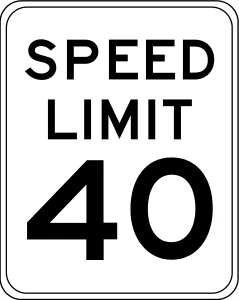
Show the maximum or minimum speed allowed. Maximum limits are for ideal conditions—slow down when roads are slippery (rain, snow) or it's hard to see ahead (fog).

Handbook p. 8 ↗

Know the rule

Some high-speed roads have minimum speed limits. If the minimum is too fast for you, use another route.

Handbook p. 8 ↗
Speed limit
Speed limit sign

Lane control signs

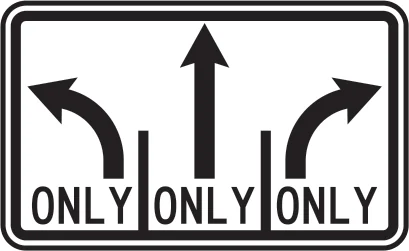
Mark where you can go and where you can turn, often with arrows. They stand along the road or hang over it; white arrows may also be painted on the road.

Handbook p. 8 ↗
Lane-use control sign (left, straight, right only)
Lane control sign: the movement allowed from each lane

Know the rule

No passing signs mark where it is not safe to pass. The no passing zone sign is at the beginning of the zone. Where passing is allowed, pass only if it is safe.

Handbook p. 8 ↗

Know the rule

Stop sign: come to a full stop and wait until crossing vehicles and the crosswalk are clear. Stop at the stop line if there is one; if necessary, then pull forward to the sign or edge of the intersection and go when safe.

Handbook p. 8 ↗

Know the rule

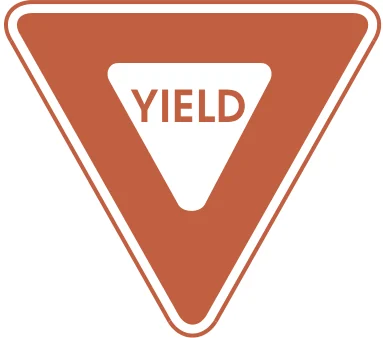
Yield sign: slow down and yield the right-of-way to traffic in the intersection you are crossing or the roadway you are entering.

Handbook p. 8 ↗
Yield
Yield sign

Divided highway sign

The road ahead is divided; the sign directs traffic around an island or barrier.

Handbook p. 8 ↗

One-way sign

Traffic moves only in the direction of the arrow.

Handbook p. 8 ↗

Know the rule

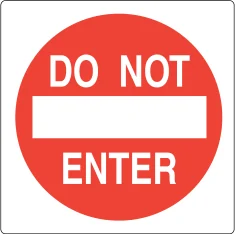
Do Not Enter signs mark roadway openings you must not enter—at exit ramps, crossovers on divided roadways, and many places on one-way roads.

Handbook p. 8 ↗
Do not enter
Do Not Enter

Know the rule

Wrong Way means you made a wrong turn into oncoming traffic. Get off the traveled part of the road, stop, and turn around as quickly and safely as possible.

Handbook p. 8 ↗

Put it into practice

You reach a stop sign with a painted stop line set well back, and parked cars block your view. Stop at the line first, then pull forward to the edge of the intersection and go only when crossing traffic and the crosswalk are clear.

Check your understanding

Read the question, decide on an answer, then open it to check the explanation. These are Roadwise study questions based on the source handbook.

At a stop sign with a stop line, where must you come to a complete stop?
  1. At the stop sign post
  2. At the stop line
  3. At the edge of the intersection
  4. Just past the crosswalk

Answer: At the stop line

Stop at the stop line if one is present; only after stopping may you pull forward to the sign or the edge of the intersection.
Handbook p. 8 ↗
A road has a posted minimum speed limit that feels too fast for you to drive safely. What should you do?
  1. Drive below the minimum in the right lane
  2. Use a different route
  3. Drive on the shoulder at a slower speed
  4. Drive at the minimum with hazards on

Answer: Use a different route

If the posted minimum speed is too fast for you, the manual advises using another route.

Handbook p. 8 ↗
What does a 'Do Not Enter' sign usually mark?
  1. A roadway you are not to enter
  2. A construction detour
  3. A speed limit reduction zone
  4. A lane reserved for buses

Answer: A roadway you are not to enter

You'll see Do Not Enter signs at roadway openings you are not to enter, such as exit ramps.

Handbook p. 8 ↗
You accidentally enter a lane of oncoming traffic and see a 'Wrong Way' sign. What should you do?
  1. Continue forward carefully until the next intersection
  2. Get off the road and turn around safely
  3. Back up in the lane to the last exit
  4. Stop in the lane and wait for traffic to pass

Answer: Get off the road and turn around safely

A Wrong Way sign means you should remove your vehicle from the traveled road and get turned around safely as soon as possible.

Handbook p. 8 ↗
According to the manual, posted maximum speed limits are set for which conditions?
  1. Nighttime driving
  2. Heavy traffic
  3. Ideal driving conditions
  4. Wet or snowy roads

Answer: Ideal driving conditions

Maximum speed limits are for ideal driving conditions; you must slow down when roads are slippery or visibility is poor.

Handbook p. 8 ↗
A yield sign means you must slow down and yield the right-of-way to traffic in the intersection or roadway you are entering.
  1. True
  2. False

Answer: True

The manual defines a yield sign this way.

Handbook p. 8 ↗
Take the lesson checkpoint in the app

More in Signs, Signals & Markings