A 3-minute lesson from the Iowa course. Read the rules and examples, follow the handbook page references, and check your understanding before you move on.
Under a 2024 update to Iowa law, vehicles must yield the right-of-way to pedestrians on foot AND to people using any human-powered device—a pedestrian conveyance. Whenever the manual says 'pedestrian,' it means both.
Pedestrian conveyance
Any human-powered device by which a pedestrian may move other than by walking, or by which a pedestrian may move another person.
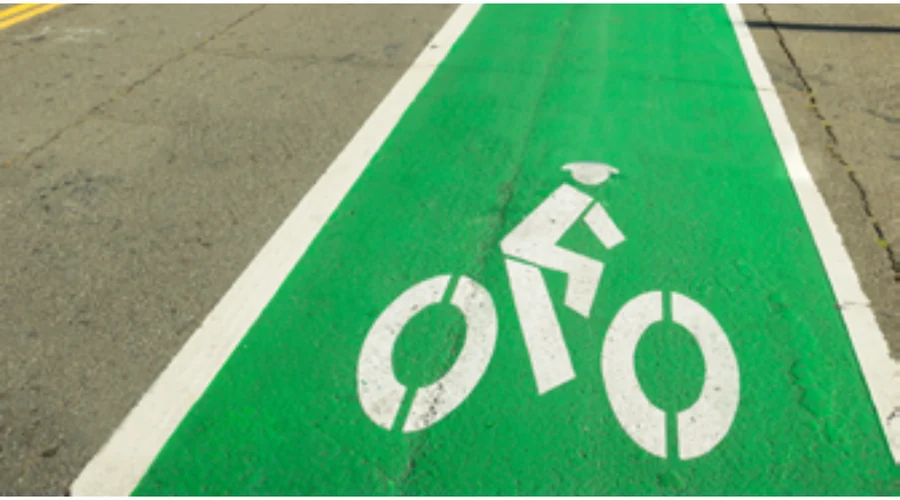
Part of the road meant for bicyclists, marked by solid white lines with bicycle markings and signs. Some are separated by double white lines, curbs, posts, or planters.
Alert drivers to bicyclists, encourage safe passing, and reduce wrong-way riding and door crashes. Unlike bike lanes, they don't reserve space for bikes only.
Solid green box with a bicyclist image, next to the crosswalk and covering the whole travel lane, giving bicyclists a safe way to turn at a signalized intersection.
Rectangular Rapid Flashing Beacons are push-button amber lights at crosswalks without signals or mid-block. When flashing, stop for anyone in the crosswalk and watch for anyone about to enter.
A pedestrian hybrid beacon is dark as you approach, then its bottom yellow starts flashing. Slow down; when it turns solid yellow, prepare to stop; stop on solid red. Once the reds flash, you may go after stopping if the crosswalk is clear.
Check your understanding
Read the question, decide on an answer, then open it to check the explanation. These are Roadwise study questions based on the source handbook.
Under Iowa's 2024 crosswalk law, which of these is a pedestrian conveyance whose user you must yield to like a pedestrian?
A moped
A stroller
A golf cart
A motorcycle
Answer: A stroller
Pedestrian conveyances are human-powered devices such as wheelchairs, strollers, bicycles, skateboards, and scooters; motorized vehicles are not.