A 3-minute lesson from the California course. Read the rules and examples, follow the handbook page references, and check your understanding before you move on.
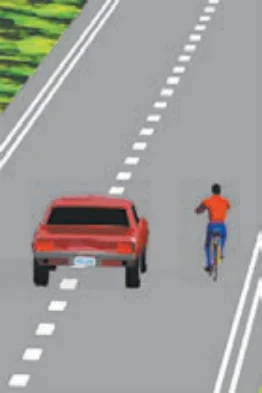
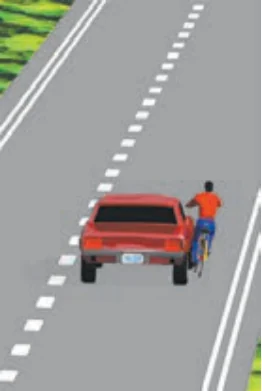
A bicyclist slower than traffic normally rides near the right edge, but there are several legal reasons to move into the lane. When you pass, you must give at least three feet.
A slower bicyclist must ride close to the right curb or edge, unless:
Passing a vehicle or another bicycle going the same direction
Preparing to make a left turn
Avoiding a hazard or road condition
The lane is too narrow for a bicycle and a vehicle to travel safely side by side
Approaching a right turn
On a one-way road with two or more lanes (may ride near the left curb or edge)
To pass a bicyclist in the travel lane, you may need to change lanes. Pass safely, then return to your original lane, leaving space between you and the bicyclist.
On a narrow two-lane road, a cyclist rides in the middle of your lane because the lane is too narrow to share. Stay behind at a safe distance. When the opposite lane is clear, change lanes to pass with plenty of room, then return.
Check your understanding
Read the question, decide on an answer, then open it to check the explanation. These are Roadwise study questions based on the source handbook.
When can a bicyclist traveling slower than traffic legally ride away from the right curb, such as near the center of a lane?
When wearing high-visibility clothing
Never; they must stay at the right curb
When the lane is too narrow to share
When traffic is moving under 25 mph
Answer: When the lane is too narrow to share
A cyclist may move away from the right edge when a lane is too narrow to share safely, among other exceptions.