Roadwise States California Driving lessons Bicyclists: rights, duties & night equipment California driving lesson · Sharing the Road
Bicyclists: rights, duties & night equipment A 3-minute lesson from the California course. Read the rules and examples, follow the handbook page references, and check your understanding before you move on.
Read time 3 minutes
Course unit Sharing the Road
Checkpoint questions 6
Source pages 52, 53 Bicyclists have the same rights and responsibilities as drivers. Knowing what they may and must do helps you predict where they'll ride.
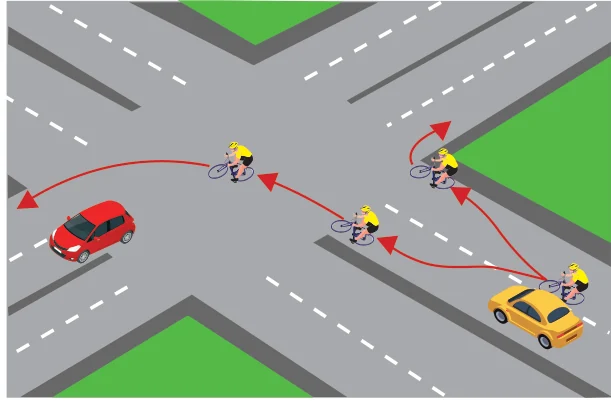
Bicyclists may: Ride on certain freeway sections where there is no alternate route and bicycling isn't forbidden Move left to avoid hazards such as parked or moving vehicles, bicycles, animals, or trash Choose to ride near the left curb or edge of a one-way street Choose to use crosswalks by stopping and crossing as a pedestrian Handbook p. 52 ↗ As a bicyclist, you must: Obey all traffic signs, signal lights, and basic right-of-way rules Ride in the same direction as traffic and yield to pedestrians Look over your shoulder before turning or changing lanes Wear a helmet if under 18 years old Stay visible (never weave between parked vehicles) Ride as near the right curb or edge as possible Not ride on the sidewalk (unless allowed by the city) Turn like drivers do, using hand signals and turn lanes Use a bike lane whenever possible, or a through traffic lane; have fully working brakes Handbook p. 53 ↗ Examples of turns for bicyclists Know the rule
At night, bicyclists should avoid wearing dark clothing.
Handbook p. 53 ↗ Put it into practice
At dusk you see a cyclist on the left side of a one-way, two-lane street. That's allowed: on a one-way street a bicyclist may ride near the left curb. Give them room and pass only when safe.
A useful reminder Night gear distances go front 300, rear 500, pedals 200.
Check your understanding Read the question, decide on an answer, then open it to check the explanation. These are Roadwise study questions based on the source handbook.
In which direction must bicyclists ride relative to traffic? Facing oncoming traffic for visibility The same direction as traffic Either direction, rider's choice Against traffic on one-way streets Answer: The same direction as traffic
Bicyclists must ride in the same direction as traffic.
Handbook p. 53 ↗ At what age must a bicyclist wear a helmet, according to the handbook? Under 12 years old Under 21 years old Under 18 years old There is no age requirement Answer: Under 18 years old
Bicyclists under 18 years old must wear a helmet.
Handbook p. 53 ↗ How far away must a bicycle's front lamp be visible at night? 100 feet 500 feet 1,000 feet 300 feet Answer: 300 feet
A bicycle's front lamp must have a white light visible from 300 feet at night.
Handbook p. 53 ↗ How far away must a bicycle's rear reflector or light be visible? 500 feet 300 feet 200 feet 1,000 feet Answer: 500 feet
A built-in rear red reflector or light must be visible from 500 feet.
Handbook p. 53 ↗ How far away must a bicyclist's pedal reflectors be visible? 300 feet 200 feet 500 feet 100 feet Answer: 200 feet
White or yellow pedal reflectors must be visible from 200 feet.
Handbook p. 53 ↗ Bicyclists must obey all traffic signs, signal lights, and basic right-of-way rules. True False Answer: True
Bicyclists have the same rights and responsibilities as drivers, including obeying signs and signals.
Handbook p. 53 ↗ Previous lesson Slow-moving vehicles, NEVs & animals Next lesson Sharing lanes with & passing bicyclists About the source Roadwise’s California course uses the driver handbook edition supplied with this study pack. This lesson cites source pages 52, 53. The linked PDF is a third-party mirror of the handbook, rather than a government-hosted page.
Open the handbook source PDF · View the source edition
For current application requirements, fees, appointments, and the format that applies to your age or license type, check California’s DMV. Roadwise provides study material and does not issue permits or licenses.