roadwise.Open study app

California driving lesson · Sharing the Road

Buses, streetcars & light rail

A 3-minute lesson from the California course. Read the rules and examples, follow the handbook page references, and check your understanding before you move on.

Read time
3 minutes
Course unit
Sharing the Road
Checkpoint questions
6
Source pages
49, 50

Transit vehicles stop often and people board from the street. Safety zones protect waiting riders, and light rail vehicles follow the same road rules as you but can't swerve.

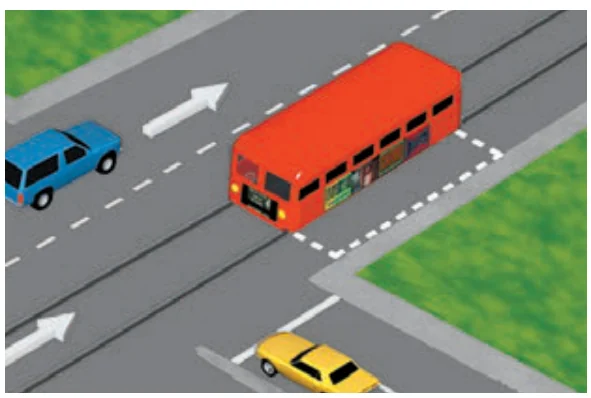
Safety zone

A space set aside for pedestrians waiting for buses, streetcars, and trolleys, marked by raised buttons or markers on the road (shown with dotted white lines).

Handbook p. 49 ↗

Know the rule

Do not drive through a safety zone under any condition.

Handbook p. 49 ↗
10 mph

Maximum speed to pass a bus, streetcar, or trolley stopped at a safety zone or traffic light

Handbook p. 49 ↗
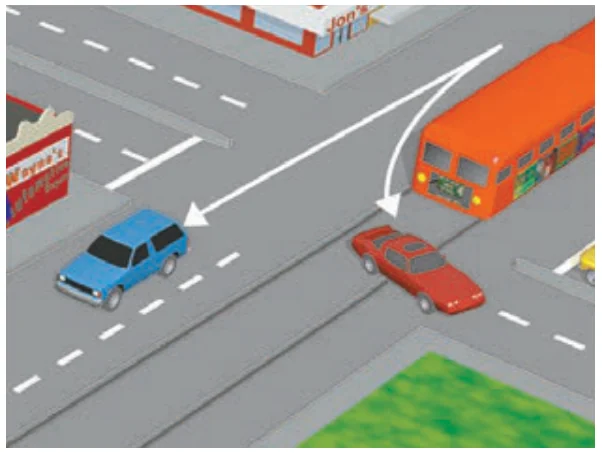
Sharing the road with a streetcar or light rail vehicle
Safety zones are marked by dotted white lines

Do not pass a light rail vehicle or streetcar on the left (moving or standing) unless:

  • The tracks are so close to the right side that you cannot pass on the right
  • You are on a one-way street
  • A traffic officer directs you to pass on the left
Handbook p. 50 ↗

Know the rule

On public roads, light rail vehicles have the same rights and responsibilities as other vehicles.

Handbook p. 50 ↗

To share the road with light rail vehicles:

  • Know where they operate; buildings and trees can create blind spots for the operator
  • Never turn in front of an approaching light rail vehicle
  • Maintain a safe distance
  • Check for them before turning across the tracks; turn only when the light says you may
Handbook p. 50 ↗

Know the rule

Light rail vehicles can interrupt traffic lights.

Handbook p. 50 ↗
Sharing the road with a streetcar or light rail vehicle
Do not turn in front of light rail vehicles

Put it into practice

A streetcar has stopped at a safety zone to load passengers and the lane beside it is open. You may pass, but no faster than 10 mph, and never drive through the safety zone itself.

Check your understanding

Read the question, decide on an answer, then open it to check the explanation. These are Roadwise study questions based on the source handbook.

What are safety zones for buses, streetcars, and trolleys marked with?
  1. Raised buttons or markers
  2. Double solid white lines
  3. Yellow crosshatched paint
  4. Red painted curbs

Answer: Raised buttons or markers

Safety zones are marked by raised buttons or markers on the road, and by dotted white lines.
Handbook p. 49 ↗
At what maximum speed may you pass a bus or streetcar stopped at a safety zone or light?
  1. 25 mph
  2. 5 mph
  3. 15 mph
  4. 10 mph

Answer: 10 mph

You may pass a stopped bus, streetcar, or trolley at a safety zone or light at no more than 10 mph.

Handbook p. 49 ↗
When may you pass a light rail vehicle or streetcar on the left?
  1. When the tracks are too close on the right to pass there
  2. When the streetcar is stopped
  3. When the streetcar is moving slowly
  4. When no passengers are boarding

Answer: When the tracks are too close on the right to pass there

You may pass on the left if the tracks are too close on the right, you're on a one-way street, or an officer directs you.

Handbook p. 50 ↗
Is it ever legal to drive through a safety zone?
  1. Yes, if no pedestrians are waiting
  2. No, not under any condition
  3. Yes, at 10 mph or less
  4. Yes, once the bus has left

Answer: No, not under any condition

Do not drive through a safety zone under any condition.

Handbook p. 49 ↗
Before turning across light rail tracks, what should you do?
  1. Proceed if your light is green
  2. Turn quickly ahead of any train
  3. Assume it is clear if no train is in sight
  4. Check for trains; turn when signal allows

Answer: Check for trains; turn when signal allows

Check for approaching light rail vehicles before crossing tracks, and only complete your turn when the signal allows.

Handbook p. 50 ↗
Light rail vehicles have the same rights and responsibilities as other vehicles on public roads.
  1. True
  2. False

Answer: True

On public roads, light rail vehicles have the same rights and responsibilities as other vehicles.

Handbook p. 50 ↗
Take the lesson checkpoint in the app

More in Sharing the Road