A 3-minute lesson from the California course. Read the rules and examples, follow the handbook page references, and check your understanding before you move on.
Big trucks see farther ahead but have huge blind spots, take longer to stop and swing wide to turn. Most truck-car crashes happen when drivers forget these limits.
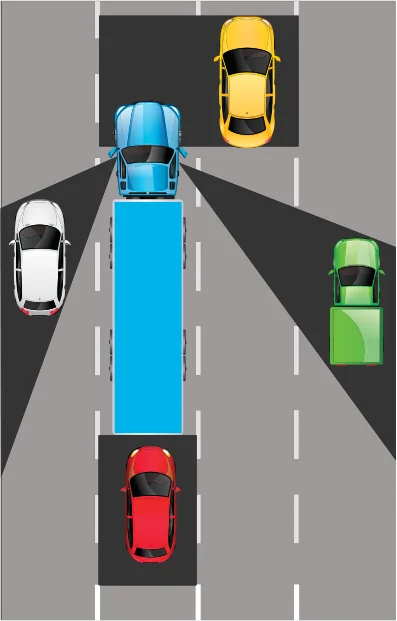
No Zones
A large vehicle's large blind spots, where your vehicle can disappear from the driver's view.
The heavier and faster the vehicle, the longer it takes to stop; a loaded truck takes longer than an empty one. Do not move in front of a large vehicle and suddenly slow or stop.
When turning, a vehicle's rear wheels follow a shorter path than the front wheels, so large vehicles often swing wide. Look at its turn signals before you start to pass.
You must drive in the far-right lane or a lane marked for slower vehicles when towing a vehicle or trailer, or driving a truck with three or more axles.
If no lanes are marked and there are four or more lanes in your direction, towing vehicles and trucks with three or more axles may only use the two lanes closest to the right edge.
A semi ahead signals right but drifts left at an intersection. It's swinging wide to make its right turn. Don't pass it on the right; stay back until it completes the turn.
Check your understanding
Read the question, decide on an answer, then open it to check the explanation. These are Roadwise study questions based on the source handbook.
Why are large vehicle blind spots called No Zones?
Trucks may not legally drive there
No passing is allowed near trucks
Your car can vanish from the driver's view
No parking is allowed beside trucks
Answer: Your car can vanish from the driver's view
No Zones are the large blind spots around trucks where your vehicle can become invisible to the driver.