Roadwise States California Driving lessons Motorcycles & emergency vehicles California driving lesson · Sharing the Road
Motorcycles & emergency vehicles A 3-minute lesson from the California course. Read the rules and examples, follow the handbook page references, and check your understanding before you move on.
Read time 3 minutes
Course unit Sharing the Road
Checkpoint questions 6
Source pages 50, 51 Motorcycles are small and easy to miss. Emergency vehicles need a clear path. Both call for specific actions from you.
Know the rule
Motorcyclists have the same rights and responsibilities as other vehicle drivers.
Handbook p. 50 ↗ To share the road with motorcyclists: Check for motorcycles and use mirrors when changing lanes or entering a road Allow a three-second following distance Whenever possible, give a motorcycle the full lane Never try to pass a motorcycle in the same lane as you Check for motorcyclists before you open your door next to traffic When possible, move to one side of your lane to give motorcyclists room to pass Handbook p. 50 ↗ Lane splitting Sharing lanes with motorcycles. It is legal in California.
Handbook p. 50 ↗ Know the rule
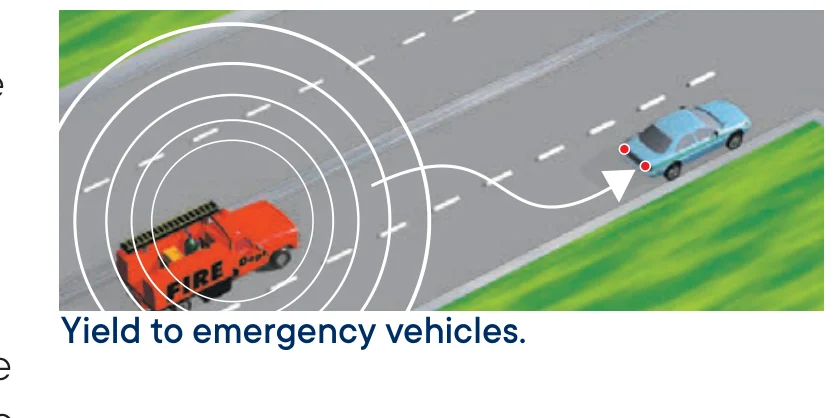
Give the right-of-way to any law enforcement vehicle, fire engine, ambulance, or other emergency vehicle using a siren and red lights. Drive to the right edge of the road and stop until they have passed.
Handbook p. 51 ↗ Know the rule
Failure to pull over for an emergency vehicle may result in a ticket.
Handbook p. 51 ↗ Know the rule
If you are in an intersection when you see an emergency vehicle, continue through the intersection, then drive to the right as soon as it is safe and stop.
Handbook p. 51 ↗ Know the rule
When approaching a stationary emergency vehicle with flashing emergency signal lights, move over and slow down.
Handbook p. 51 ↗ 300 ft Illegal to follow within this distance of an emergency vehicle with siren or lights on
Handbook p. 51 ↗ Know the rule
Obey any direction, order, or signal from a law enforcement officer or firefighter, even if it conflicts with existing signs, signals, or laws.
Handbook p. 51 ↗ Know the rule
You can be arrested if you drive to the scene of a fire, collision, or other disaster; you get in the way of rescue and emergency personnel.
Handbook p. 51 ↗ Yield to emergency vehicles: pull to the right edge and stop Put it into practice
You're halfway through an intersection on green when you hear a siren behind you. Don't stop in the intersection. Continue through, then pull to the right as soon as it's safe and stop until the emergency vehicle passes.
A useful reminder Road conditions can make motorcyclists suddenly change speed or direction, which is why you keep three seconds behind them.
Check your understanding Read the question, decide on an answer, then open it to check the explanation. These are Roadwise study questions based on the source handbook.
How many seconds of following distance should you give a motorcycle? Three seconds One second Five seconds Ten seconds Answer: Three seconds
Allow a safe three-second following distance behind a motorcycle.
Handbook p. 50 ↗ What is it called when motorcycles share lanes by riding between other vehicles? Lane hopping Lane splitting Shoulder riding Tandem riding Answer: Lane splitting
Sharing lanes with motorcycles, known as lane splitting, is legal in California.
Handbook p. 50 ↗ What must you do when a law enforcement vehicle, fire engine, or ambulance approaches with siren and lights on? Speed up to clear the intersection Continue at your current speed Pull to the left shoulder Pull to the right edge and stop Answer: Pull to the right edge and stop
Give the right-of-way to emergency vehicles by driving to the right edge of the road and stopping.
Handbook p. 51 ↗ Within how many feet is it illegal to follow a fire engine or other emergency vehicle with lights/siren on? 300 feet 100 feet 500 feet 1,000 feet Answer: 300 feet
It is against the law to follow within 300 feet of an emergency vehicle using its siren or flashing lights.
Handbook p. 51 ↗ If you are already in an intersection when you see an approaching emergency vehicle, what should you do? Stop immediately in the intersection Continue through the intersection, then move right and stop Turn right at the intersection Turn left to get out of the way Answer: Continue through the intersection, then move right and stop
If already in an intersection, continue through it, then move to the right as soon as safe and stop.
Handbook p. 51 ↗ What must you do when approaching a stationary emergency vehicle with flashing hazard lights? Maintain your current lane and speed Stop until it drives away Move over and slow down Speed up to pass it quickly Answer: Move over and slow down
When approaching a stationary emergency vehicle with flashing lights, move over and slow down.
Handbook p. 51 ↗ Previous lesson Buses, streetcars & light rail Next lesson Slow-moving vehicles, NEVs & animals About the source Roadwise’s California course uses the driver handbook edition supplied with this study pack. This lesson cites source pages 50, 51. The linked PDF is a third-party mirror of the handbook, rather than a government-hosted page.
Open the handbook source PDF · View the source edition
For current application requirements, fees, appointments, and the format that applies to your age or license type, check California’s DMV. Roadwise provides study material and does not issue permits or licenses.