roadwise.Open study app

Virginia driving lesson · Signals, Signs & Pavement Markings

Railroad Crossings & Work Zones

A 4-minute lesson from the Virginia course. Read the rules and examples, follow the handbook page references, and check your understanding before you move on.

Read time
4 minutes
Course unit
Signals, Signs & Pavement Markings
Checkpoint questions
6
Source pages
11, 12, 13

Trains can't stop quickly or swerve, and highway workers stand just feet from your car. Both demand full attention. At rail crossings, trains may come from either direction on any track; in work zones, the color orange means slow down and be alert.

Railroad crossing warnings

Railroad crossing warnings
DeviceWhat to do
Advance warning sign (round)Look, listen, slow down, be ready to stop
CrossbuckLook, listen, slow; trains may come either way
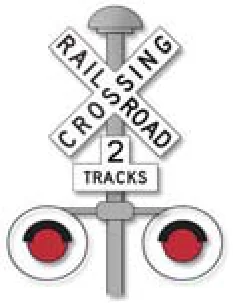
Crossbuck + flashing lightsStop when lights flash; wait until clear and dark
Crossbuck, lights + gateStop before gate lowers; stay until gate rises
Handbook p. 11 ↗
Railroad crossbuck with flashing lights
Crossbuck with flashing lights

Railroad crossing rules:

  • Never drive around a lowered gate
  • At multitrack crossings, a second train could come from the opposite direction
  • An X and RR may be painted on the pavement before some crossings
  • Never start across unless you can clear the tracks completely, with room on the other side
  • School buses must always stop at railroad crossings, even when lights aren't flashing
Handbook p. 12 ↗

Know the rule

If a dangerous condition exists at a crossing, call the number on the emergency sign and give the posted crossing number so the railroad can stop or reroute trains.

Handbook p. 12 ↗

Put it into practice

Your car stalls on the tracks and a train is coming. Don't hesitate: get out right away and run diagonally away from the tracks in the direction of the oncoming train.

Up to $500

Fine for exceeding the speed limit in a highway work zone

Handbook p. 12 ↗
$250

Fine for using a handheld communications device in a highway work zone

Handbook p. 12 ↗

Work zone signs and devices:

  • Rough Road, Bump, Uneven Lanes: poor surface, especially risky for motorcyclists
  • Road Construction Ahead / Detour: traffic pattern or route changes; slow down
  • Flashing arrow boards: move into other lanes; part of the road ahead is closed
  • Photo Speed Enforcement: automated cameras enforce the work zone speed limit
  • Rumble Strips Ahead: drive slowly over the strips; don't swerve around them
  • Message boards: obey any directions; info at 511virginia.org or call 511
Handbook p. 12 ↗

Flaggers

Highway workers, usually in orange or yellow vests or yellow-green shirts or jackets, who use STOP/SLOW paddles or red flags to stop or direct traffic through a work zone.

Handbook p. 12 ↗

Know the rule

Near barricades, drums, cones and barriers, keep to the middle of your lane and obey the posted speed. Leaving the work zone, stay in your lane and don't change lanes until you're completely clear.

Handbook p. 12 ↗

Know the rule

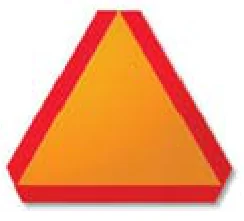
Vehicles going 25 MPH or less (farm equipment, horse-drawn vehicles, highway work vehicles) must display the slow-moving vehicle emblem on public highways. Be ready to adjust speed or position.
Handbook p. 13 ↗
Triangle shape (slow-moving vehicle)
Slow-moving vehicle emblem

Check your understanding

Read the question, decide on an answer, then open it to check the explanation. These are Roadwise study questions based on the source handbook.

At a crossing with flashing lights and a gate, when must you stop?
  1. Only after the gate is fully lowered
  2. When the lights begin to flash and before the gate lowers
  3. Only if you see the train approaching
  4. When the gate is halfway down

Answer: When the lights begin to flash and before the gate lowers

You must stop when the lights begin to flash and before the gate lowers, remaining stopped until they stop flashing.

Handbook p. 11 ↗
What must you make sure of before starting across railroad tracks?
  1. You are traveling under 15 MPH
  2. You have shifted into a lower gear
  3. Your hazard lights are on
  4. There is room for your vehicle on the other side

Answer: There is room for your vehicle on the other side

Unless you can clear the tracks completely, never start across; make sure there's room on the other side first.

Handbook p. 12 ↗
Which vehicles must always stop at railroad crossings, even when lights are not flashing?
  1. School buses
  2. Motorcycles
  3. Emergency vehicles with sirens off
  4. Vehicles towing trailers

Answer: School buses

School buses must always stop at railroad crossings, even when the warning lights are not flashing.

Handbook p. 12 ↗
If your car stalls on the tracks with a train approaching, what should you do?
  1. Stay in the car and try to restart it
  2. Get out and run diagonally away, toward the oncoming train
  3. Get out and run straight away from the oncoming train
  4. Push the car off the tracks yourself

Answer: Get out and run diagonally away, toward the oncoming train

If your car stalls on the tracks, get out right away and run diagonally away from the tracks in the direction of the oncoming train.

Handbook p. 12 ↗
What fine may you face for exceeding the speed limit in a highway work zone in Virginia?
  1. Up to $100
  2. Up to $1,000
  3. Up to $500
  4. Up to $50

Answer: Up to $500

If convicted of exceeding the speed limit in a highway work zone, you may be fined up to $500.

Handbook p. 12 ↗
What is the fine for using a handheld communications device while driving in a highway work zone?
  1. $500
  2. $100
  3. $1,000
  4. $250

Answer: $250

Using a handheld communications device in a highway work zone carries a $250 fine.

Handbook p. 12 ↗
Take the lesson checkpoint in the app

More in Signals, Signs & Pavement Markings