Roadwise States Virginia Driving lessons Sign Colors & Shapes Virginia driving lesson · Signals, Signs & Pavement Markings
Sign Colors & Shapes A 3-minute lesson from the Virginia course. Read the rules and examples, follow the handbook page references, and check your understanding before you move on.
Read time 3 minutes
Course unit Signals, Signs & Pavement Markings
Checkpoint questions 6
Source pages 8, 9 You can read a sign's meaning before you can read its words. In fog you may see only its shape; from far away you'll see its color long before the message or symbol. Learn the color and shape codes and you'll get advance warning every time.
Know the rule
Red is also used for the circle and slash in a no-turn sign and the restrictions on a parking sign. Orange and pink signs are paired with black-and-white signs showing regulations that exist only because of the construction or incident.
Handbook p. 8 ↗ Know the rule
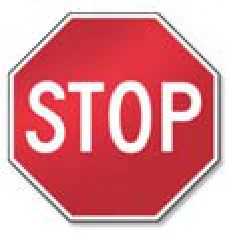
Octagon (8 sides) always means stop. Stop completely at the sign, stop line, crosswalk or curb, and wait for vehicles and pedestrians to clear.
Handbook p. 8 ↗ Stop sign (octagon) Know the rule
An 'All Way' or '4 Way' sign under a stop sign means every road into the intersection must stop. If you arrive at the same time as another vehicle, the driver on the left yields to the driver on the right.
Handbook p. 8 ↗ Know the rule
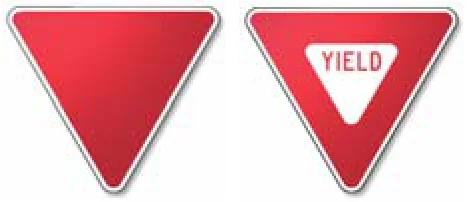
Triangle (yield): slow down as you reach the intersection, be prepared to stop, and let vehicles, pedestrians or bicyclists pass safely first.
Handbook p. 8 ↗ Yield sign (triangle) Know the rule
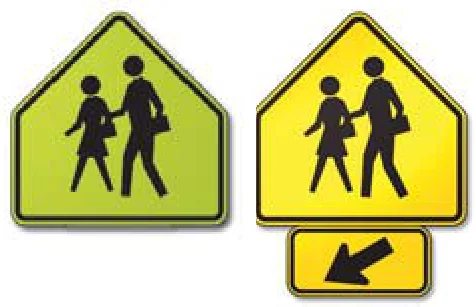
Diamond warning signs mean slow down, drive with caution and be ready to stop. Two pentagon signs may be used together to show the actual location of the school crosswalk.
Handbook p. 9 ↗ School zone/school crossing signs (pentagon) Put it into practice
In thick fog you make out an eight-sided sign but can't read it. Only a stop sign uses an octagon, so prepare to come to a complete stop.
A useful reminder Yellow-green (fluorescent) is the special warning color for schools, pedestrians and bicyclists; pink is for incident areas.
Check your understanding Read the question, decide on an answer, then open it to check the explanation. These are Roadwise study questions based on the source handbook.
Red and white signs generally convey which message? Stop, yield, do not, or no A warning of a hazard ahead Helpful destination information Motorist services nearby Answer: Stop, yield, do not, or no
Red used with white conveys stop, yield, do not, and no, as on stop and yield signs.
Handbook p. 8 ↗ What does a black and white sign generally convey? A warning of a curve ahead Regulatory information Historical or cultural interest nearby Construction zone regulations Answer: Regulatory information
Black used with white conveys regulatory information such as speed limits and passing restrictions.
Handbook p. 8 ↗ A strong yellow-green color combined with black on a sign specifically advises of what? Construction ahead A historical landmark School zones, pedestrian, or bicyclist activity A toll plaza ahead Answer: School zones, pedestrian, or bicyclist activity
A specialized yellow-green and black sign class warns of school zone, pedestrian, and bicyclist activity.
Handbook p. 8 ↗ Brown and white signs are used to indicate what? Motorist services like gas or food Destination distances Incident areas Historical or cultural sites Answer: Historical or cultural sites
Brown and white signs advise of historical or cultural interest sites that might exist in the area.
Handbook p. 8 ↗ Pink and black signs are used to advise and warn drivers in what type of area? Incident areas Construction zones School zones Toll zones Answer: Incident areas
Orange and black signs mark construction areas, while pink and black signs mark incident areas.
Handbook p. 8 ↗ What shape marks school zones and school crossings? Triangle Octagon Pentagon Rectangle Answer: Pentagon
The five-sided pentagon shape marks school zones and warns of school crossings.
Handbook p. 9 ↗ Previous lesson Yellow & Green Signals, Dark Signals, Lane Use Signals & PHBs Next lesson Regulatory Signs More in Signals, Signs & Pavement Markings About the source Roadwise’s Virginia course uses the driver handbook edition supplied with this study pack. This lesson cites source pages 8, 9. The linked PDF is a third-party mirror of the handbook, rather than a government-hosted page.
Open the handbook source PDF · View the source edition
For current application requirements, fees, appointments, and the format that applies to your age or license type, check Virginia’s DMV. Roadwise provides study material and does not issue permits or licenses.