roadwise.Open study app

Vermont driving lesson · Signs, Signals & Road Markings

Police stops & the Move Over law

A 3-minute lesson from the Vermont course. Read the rules and examples, follow the handbook page references, and check your understanding before you move on.

Read time
3 minutes
Course unit
Signs, Signals & Road Markings
Checkpoint questions
6
Source pages
31, 32, 52

Flashing lights mean someone needs space: an officer stopping you, an ambulance rushing by, or a crew working at the roadside. Vermont law spells out what to do in each case, and the steps protect both you and them.

Know the rule

Police signal a driver to stop by turning on flashing lights, or flashing lights and a siren.

Handbook p. 31 ↗

When police stop you:

  • Pull as far right as you safely can; don't stop in an intersection or a divided highway's median
  • Keep your safety belt fastened until the officer has seen you wearing it
  • In a dimly lit area, turn on interior lights after stopping, before the officer approaches
  • Limit your movements and your passengers'; stay calm
  • Show your license, registration and proof of insurance when asked
  • Stay in the vehicle unless asked to get out
  • Don't argue at the roadside; there will be time in court
Handbook p. 31 ↗

Know the rule

If a vehicle with flashing blue or red lights and/or a siren approaches from any direction, pull over to the right side of the road and stop. Stay stopped until it has gone by.

Handbook p. 32 ↗

Know the rule

If a police vehicle (flashing blue) or emergency vehicle (flashing red) is stopped, proceed with caution and slow down. On a four-lane highway such as an Interstate, you must also change lanes if you can do so safely.

Handbook p. 32 ↗

Know the rule

You must yield the right-of-way to any state, city or town maintenance vehicle working on a highway. For example, approaching a snowplow with lights flashing, proceed with caution and yield.

Handbook p. 32 ↗

Know the rule

Towing and repair vehicles usually have amber flashing lights. Approach them with the same caution and procedures.

Handbook p. 32 ↗
20 mph below

On the Interstate, if you can't change lanes away from a stopped emergency, police or repair vehicle, slow to 20 mph below the speed limit

Handbook p. 52 ↗
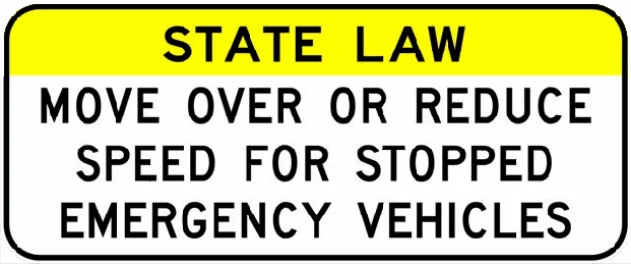
Move over law
State law sign: Move over or reduce speed for stopped emergency vehicles

Put it into practice

On I-89 at 65 mph, you see a trooper stopped on the right shoulder with blue lights flashing. Move to the left lane if it's safe. If traffic blocks you, slow to 45 mph (20 below the limit) as you pass.

Check your understanding

Read the question, decide on an answer, then open it to check the explanation. These are Roadwise study questions based on the source handbook.

A police vehicle signals you to stop with flashing lights. Where should you pull over?
  1. Into the center median of a divided highway
  2. Into the left lane and stop
  3. As close to the right side of the road as you can safely get
  4. Onto the opposite road shoulder

Answer: As close to the right side of the road as you can safely get

Drive as close as you safely can to the right side; never stop in an intersection or a median.
Handbook p. 31 ↗
Vermont's Move Over law requires you to do what when you see flashing blue or red lights approaching?
  1. Pull to the left and stop
  2. Keep your speed and stay in your lane
  3. Stay in your lane and slow slightly
  4. Pull to the right and stop

Answer: Pull to the right and stop

The Move Over law requires pulling to the right and stopping for an approaching emergency vehicle.

Handbook p. 32 ↗
You're on a 4-lane highway and see a stopped police vehicle with flashing lights ahead. What must you do if it's safe?
  1. Change lanes away from the vehicle
  2. Stay in your lane but slow down only
  3. Stop completely in your lane
  4. Speed up to pass it quickly

Answer: Change lanes away from the vehicle

On a four-lane highway, the law requires a lane change away from a stopped emergency vehicle if it's safe.

Handbook p. 32 ↗
You approach a snowplow with its lights flashing, working on the highway. What does the law require?
  1. Pass immediately on the right side
  2. Proceed with caution and yield
  3. Pass on the left at the first gap
  4. Come to a complete stop behind it

Answer: Proceed with caution and yield

Drivers must yield the right-of-way to maintenance vehicles like snowplows, proceeding with caution.

Handbook p. 32 ↗
You should never stop in an intersection or a median when a police officer signals you to pull over.
  1. True
  2. False

Answer: True

The handbook specifically warns not to stop in an intersection or the center median.

Handbook p. 31 ↗
You're unable to change lanes away from a stopped emergency vehicle on the Interstate. What must you do instead?
  1. Maintain the posted speed limit exactly
  2. Slow to 10 mph below the speed limit
  3. Stop completely in your lane
  4. Slow to 20 mph below the speed limit

Answer: Slow to 20 mph below the speed limit

If you can't change lanes, you must slow to 20 mph below the speed limit to pass the stopped vehicles.

Handbook p. 52 ↗
Take the lesson checkpoint in the app

More in Signs, Signals & Road Markings