roadwise.Open study app

Vermont driving lesson · Sharing the Road

Pedestrians & school zones

A 4-minute lesson from the Vermont course. Read the rules and examples, follow the handbook page references, and check your understanding before you move on.

Read time
4 minutes
Course unit
Sharing the Road
Checkpoint questions
6
Source pages
38, 39, 40

Drivers must watch carefully for pedestrians. Crashes happen both when pedestrians enter traffic carelessly and when drivers fail to yield or don't use caution. Either way, the law expects you to yield, even to someone crossing carelessly.

Know the rule

Be especially alert for young, elderly, disabled or intoxicated pedestrians. They are the most frequent victims in vehicle-pedestrian collisions.

Handbook p. 38 ↗

Driver responsibilities around pedestrians:

  • Drive slowly and stay alert where pedestrians are present
  • Don't pass a vehicle stopped for a pedestrian, even with two lanes; it's a frequent cause of pedestrian deaths
  • Watch for people crossing against a red light, stepping out between parked cars or crossing mid-block
  • Don't block a crosswalk, even partly, when stopped or waiting to turn
  • Watch for pedestrians when crossing a sidewalk or shoulder at an alley, driveway or private road
  • Use caution near children, who move quickly, and elderly people, who may not be alert to traffic
  • Don't stop to pick up hitchhikers on the Interstate or its ramps
  • When turning, look for and yield to pedestrians crossing side streets
Handbook p. 39 ↗

Know the rule

Even when pedestrians cross the street carelessly, the driver must yield.

Handbook p. 39 ↗

Know the rule

When a pedestrian with a white cane or a guide dog is crossing or waiting to cross ahead, you must stop and yield the right-of-way.

Handbook p. 39 ↗

Know the rule

Many signals have "No Turn On Red" signs that light up during pedestrian crossing times. Don't turn right on red while they're lit, and never turn right on a red arrow.

Handbook p. 39 ↗
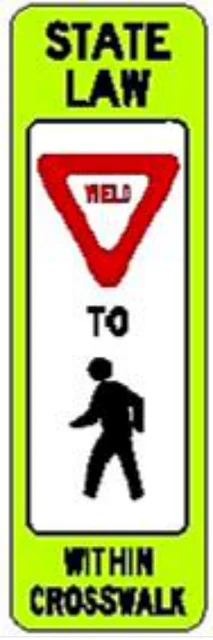
State law yield to pedestrians in crosswalk
State law sign: Yield to pedestrians within crosswalk

Know the rule

School zones often have lower speed limits marked "when flashing" or "when children are present." Watch for school buses arriving and leaving, and remember children are at schools after hours and on weekends too.

Handbook p. 39 ↗

Know the rule

Be extra careful in residential areas, and extra watchful when backing in or out of a driveway. Children may be behind your vehicle.

Handbook p. 40 ↗

Pedestrian responsibilities:

  • Don't step off the curb into the path of a vehicle so close it's an immediate hazard
  • Look both ways before crossing, and obey "Walk" and "Don't Walk" signs
  • Don't start across on a flashing "Don't Walk"; if you already started on "Walk," you have time to finish
  • Facing a yellow or red light, cross only if a "Walk" sign shows; with no pedestrian signal, cross on green
  • Where there are no sidewalks, walk on the left side, facing traffic
  • At dusk or night, wear light or reflective clothing and carry a light; skip the headphones
Handbook p. 40 ↗

Put it into practice

You're in the right lane of a four-lane street. The car in the left lane stops at a crosswalk. You can't see why, but you must not pass it, because a pedestrian may be stepping out in front of it. Stop too.

Check your understanding

Read the question, decide on an answer, then open it to check the explanation. These are Roadwise study questions based on the source handbook.

A vehicle ahead of you has stopped for a pedestrian in a crosswalk on a two-lane road. What should you do?
  1. Pass carefully in the open lane
  2. Wave the pedestrian across first, then pass
  3. Pass only if the pedestrian has cleared halfway
  4. Not pass the stopped vehicle

Answer: Not pass the stopped vehicle

Never pass a vehicle stopped for a pedestrian, even with two lanes available; it's a frequent cause of pedestrian deaths.
Handbook p. 39 ↗
A pedestrian using a white cane is waiting to cross ahead of you. What must you do?
  1. Stop and yield the right-of-way
  2. Proceed cautiously without stopping
  3. Honk to alert them of your approach
  4. Only yield if they are already in the crosswalk

Answer: Stop and yield the right-of-way

You must stop and yield to a pedestrian using a white cane or led by a guide dog.

Handbook p. 39 ↗
You're stopped at a red light and want to turn right, but a crosswalk is in front of you. What should you avoid?
  1. Stopping before the crosswalk
  2. Blocking the crosswalk
  3. Yielding to people crossing
  4. Signaling your turn early

Answer: Blocking the crosswalk

Blocking a crosswalk forces pedestrians to go around your vehicle, putting them in danger.

Handbook p. 39 ↗
A pedestrian jaywalks carelessly into your path from between parked cars. What is your legal responsibility?
  1. You have no duty to yield
  2. You must only yield if they are a child
  3. You must still yield to them
  4. You may proceed if you have the green light

Answer: You must still yield to them

Even when pedestrians cross carelessly, the driver must yield to avoid a collision.

Handbook p. 39 ↗
A school zone sign reads "25 mph when children are present." When does this reduced limit apply?
  1. At all times, 24/7
  2. Only during posted school hours
  3. Only when flashing lights are also present
  4. Only when children are actually present

Answer: Only when children are actually present

These lower limits apply only "when flashing" or "when children are present," not at all times.

Handbook p. 39 ↗
A "No Turn On Red" sign is lit during pedestrian crossing times at a signal. What should you do?
  1. Turn right cautiously since the light is red anyway
  2. Turn right only if no pedestrians are visible
  3. Not turn right on red while it's lit
  4. Ignore the sign if traffic is light

Answer: Not turn right on red while it's lit

Do not turn right on red when a "No Turn On Red" sign is lit during pedestrian crossing times.

Handbook p. 39 ↗
Take the lesson checkpoint in the app

More in Sharing the Road