Roadwise States Vermont Driving lessons Sharing the road with bicyclists Vermont driving lesson · Sharing the Road
Sharing the road with bicyclists A 4-minute lesson from the Vermont course. Read the rules and examples, follow the handbook page references, and check your understanding before you move on.
Read time 4 minutes
Course unit Sharing the Road
Checkpoint questions 6
Source pages 41, 42, 43 Bicyclists have the same rights and duties as drivers. They're quieter and harder to see, especially at night, and the slightest mistake by a driver can seriously injure or kill a rider. Slow down, give them room, and expect them in the lane.
Know the rule
Bicyclists may ride on all roads unless specially prohibited, such as limited-access highways like the Interstate. The same traffic rules apply to them.
Handbook p. 41 ↗ Know the rule
Don't honk at a bicyclist unless you have good cause to warn them. The loud noise could startle the rider and cause a loss of control.
Handbook p. 41 ↗ Driver responsibilities: Bicyclists may ride as far left as needed to be safe, and may "take the lane" by riding toward its center Watch for hazards to cyclists: potholes, drain grates, railroad tracks, narrow bridges or roads A cyclist turning left signals and moves left; let them finish before you overtake Two bicyclists may legally ride side by side; slow down until it's safe to pass Turning left, yield to oncoming bicyclists as you would to motorists; they may be faster than you think Handbook p. 41 ↗ 4 feet Minimum passing space between the right side of your vehicle and a bicyclist
Handbook p. 41 ↗ Know the rule
If the road is too narrow for a car and a bicycle side by side, wait until you can pass without forcing the bicyclist off the road.
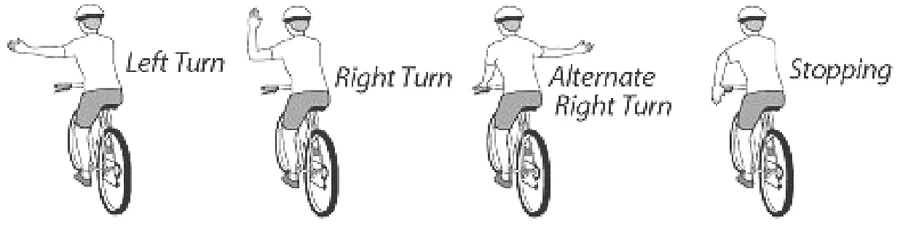
Handbook p. 41 ↗ Four common driver errors that hit bicyclists: Turning left without noticing or yielding to an oncoming bicyclist Turning right without checking for a bicyclist on the right going straight or coming off a sidewalk Entering or crossing a street without checking for a bicyclist in the street or on the sidewalk Opening a vehicle door into a bicyclist's path Handbook p. 42 ↗ Bicycle hand signals: left turn, right turn, alternate right turn, stopping Bicyclists must: Obey all traffic signals and signs (they can be ticketed and fined) Ride with traffic on the right; not enter a right-turn lane when going straight Ride in a straight line and not weave between parked cars Occupy the lane if it's too narrow to share, then move back right when safe Signal turns with proper hand signals; ride two abreast only if not impeding traffic Handbook p. 42 ↗ Know the rule
Watch for skateboarders, roller-bladers, non-motorized scooters and electric wheelchairs. They can travel fast and change direction suddenly into your path.
Handbook p. 43 ↗ Put it into practice
You parallel park on a busy street and want to get out. Check your mirror and look over your shoulder before opening the door. Opening a door into a bicyclist's path is one of the four common crash errors.
A useful reminder Pass a bike with at least 4 feet of space. If the road is too narrow for that, wait.
Check your understanding Read the question, decide on an answer, then open it to check the explanation. These are Roadwise study questions based on the source handbook.
How much passing space must you leave between your vehicle and a bicyclist? At least 1 foot At least 10 feet At least 4 feet There's no specific minimum Answer: At least 4 feet
Drivers must leave at least four feet of passing space between their vehicle and a bicyclist.
Handbook p. 41 ↗ Are two bicyclists allowed to legally ride side by side (two abreast) in Vermont? No, single file is always required Only on roads with a marked bike lane Only on roads with speed limits under 25 mph Yes, as long as they don't impede the normal flow of traffic Answer: Yes, as long as they don't impede the normal flow of traffic
Bicyclists are allowed to ride two abreast as long as they don't impede the normal, reasonable flow of traffic.
Handbook p. 42 ↗ Why might a bicyclist legally "take the lane" by riding near the center of it? To avoid hazards not visible to motorists, or to position for a turn To intentionally slow down traffic Only when riding two abreast with another cyclist Because bicycles may not use the right edge Answer: To avoid hazards not visible to motorists, or to position for a turn
A bicyclist may take the lane for safety reasons, such as avoiding hazards or positioning to turn.
Handbook p. 41 ↗ What is a common cause of vehicle-bicycle collisions, according to the handbook? Passing a cyclist on a wide, straight road Turning right without checking for a cyclist going straight A cyclist riding two abreast with another A cyclist signaling a left turn Answer: Turning right without checking for a cyclist going straight
A frequent error is turning right at an intersection or driveway without checking for a cyclist continuing straight.
Handbook p. 42 ↗ Where should bicyclists ride relative to traffic, according to Vermont rules? Against traffic, facing oncoming vehicles Only on sidewalks, never the road With traffic, on the right side On the left shoulder Answer: With traffic, on the right side
Bicyclists must ride with traffic, on the right side of the road, just like other vehicles.
Handbook p. 42 ↗ What should a driver do when a bicyclist ahead signals and moves left to prepare for a left turn? Pass quickly on the left before they turn Honk to warn them to move back right Follow closely so you can pass as they turn Let the cyclist finish turning first Answer: Let the cyclist finish turning first
The cyclist should be allowed to safely complete the left turn before being overtaken by traffic.
Handbook p. 41 ↗ Previous lesson School bus stops Next lesson Sharing the road with motorcycles About the source Roadwise’s Vermont course uses the driver handbook edition supplied with this study pack. This lesson cites source pages 41, 42, 43. The linked PDF is a third-party mirror of the handbook, rather than a government-hosted page.
Open the handbook source PDF · View the source edition
For current application requirements, fees, appointments, and the format that applies to your age or license type, check Vermont’s DMV. Roadwise provides study material and does not issue permits or licenses.