Roadwise States Vermont Driving lessons Sharing the road with large trucks Vermont driving lesson · Sharing the Road
Sharing the road with large trucks A 3-minute lesson from the Vermont course. Read the rules and examples, follow the handbook page references, and check your understanding before you move on.
Read time 3 minutes
Course unit Sharing the Road
Checkpoint questions 6
Source pages 44, 45 Trucks don't drive like cars. They're bigger and heavier, they need more room and time, and their drivers can't see large areas around them. Many car-truck crashes could be avoided if drivers knew these limits.
250,000+ Crashes each year involving passenger vehicles and large trucks
Handbook p. 44 ↗ More than 70% Share of fatal car-truck crashes caused by the driver of the other vehicle, not the truck driver
Handbook p. 44 ↗ 4 out of 5 In fatal crashes involving trucks, the driver of the other vehicle was killed
Handbook p. 44 ↗ Know the rule
Most car-truck crashes happen in daylight, on straight, dry pavement in good weather.
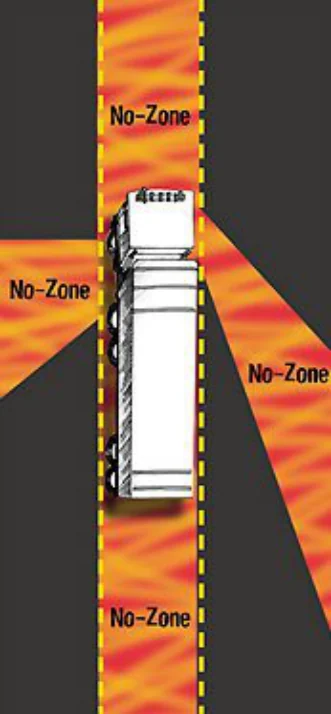
Handbook p. 44 ↗ The bigger the truck: The bigger the driver's blind spots The more room the truck needs to maneuver The longer it takes the truck to stop The longer it takes you to pass it Handbook p. 44 ↗ No-Zones A truck's blind spots, around its front, back and sides. If you can't see the truck's side mirrors, the driver can't see you.
Handbook p. 44 ↗ Truck No-Zones: front, rear and both sides Know the rule
Passing a truck takes longer. Keep a consistent speed, and don't return to the lane until you can see the truck's cab in your inside rearview mirror.
Handbook p. 44 ↗ Know the rule
Never go around a truck that is backing up or getting ready to. Its trailer can hide you completely.
Handbook p. 44 ↗ Know the rule
Trucks have long blind spots directly behind them. Following too closely greatly raises your risk of a rear-end crash and cuts your view of traffic.
Handbook p. 45 ↗ Know the rule
Trucks have much larger side blind spots than cars. Don't linger there. If the driver must change lanes quickly, you could be hit.
Handbook p. 45 ↗ Know the rule
Truck drivers often swing wide to the left to make a right turn. Don't cut in between the truck and the curb or shoulder.
Handbook p. 45 ↗ Put it into practice
A tractor-trailer ahead signals right but drifts left first. Don't take the gap on its right. It's swinging wide for the turn and could close on you. Stay back until it completes the turn.
Check your understanding Read the question, decide on an answer, then open it to check the explanation. These are Roadwise study questions based on the source handbook.
If you can't see a truck's side mirrors, what does that mean? The truck driver can't see you The truck's mirrors are broken You are following too closely, but visible Nothing significant Answer: The truck driver can't see you
If you can't see the truck's side rearview mirrors, then the truck driver can't see you either.
Handbook p. 44 ↗ What should you never do when a truck is backing up or preparing to back up? Wait for it to finish Go around the truck Stop your vehicle Watch for its backup lights Answer: Go around the truck
Never go around a truck that is preparing to back up or is in the process of backing up.
Handbook p. 44 ↗ Why do trucks often swing wide to the left before making a right turn? To get a better view of traffic It's a habit, not a necessity They need more room to maneuver To give cyclists room to pass Answer: They need more room to maneuver
The bigger the truck, the more room it needs to maneuver, so drivers often swing wide left to make a right turn.
Handbook p. 45 ↗ About what percentage of fatal crashes between cars and large trucks were caused by the other vehicle's driver, not the trucker? About 25% About 50% Less than 10% More than 70% Answer: More than 70%
In more than 70% of fatal crashes involving cars and trucks, the other driver, not the trucker, caused the crash.
Handbook p. 44 ↗ In four out of five fatal crashes involving trucks, who is most likely to be killed? The driver of the other vehicle The truck driver A pedestrian nearby A passenger in the truck Answer: The driver of the other vehicle
In four out of five fatal truck crashes, it's the other vehicle's driver who is killed.
Handbook p. 44 ↗ It's safe to cut between a truck and the curb right after it signals a right turn. True False Answer: False
Never cut between a turning truck and the curb or shoulder; it increases crash risk.
Handbook p. 45 ↗ Previous lesson Sharing the road with motorcycles Next lesson Slow-moving vehicles & horses About the source Roadwise’s Vermont course uses the driver handbook edition supplied with this study pack. This lesson cites source pages 44, 45. The linked PDF is a third-party mirror of the handbook, rather than a government-hosted page.
Open the handbook source PDF · View the source edition
For current application requirements, fees, appointments, and the format that applies to your age or license type, check Vermont’s DMV. Roadwise provides study material and does not issue permits or licenses.