roadwise.Open study app

Vermont driving lesson · Sharing the Road

Slow-moving vehicles & horses

A 3-minute lesson from the Vermont course. Read the rules and examples, follow the handbook page references, and check your understanding before you move on.

Read time
3 minutes
Course unit
Sharing the Road
Checkpoint questions
5
Source pages
45, 46

Tractors, farm machinery, horseback riders and animal-drawn vehicles all have a legal right to the road. They travel slowly and can be unpredictable, so spot them early, slow down, and pass only when it's safe.

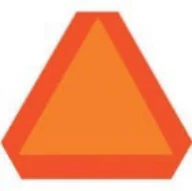
Slow-moving vehicle emblem

An orange and red triangular sign on the rear of a vehicle, such as a tractor or farm machine, that can't travel at highway speed.

Handbook p. 45 ↗
Slow-moving vehicle emblem

Watch out: slow-moving vehicles may

  • Make wide turns at unmarked entrances to the right or left
  • Be wider than the road itself
  • Sway on the roadway, and you may not be able to see the driver
Handbook p. 45 ↗

Know the rule

A slow-moving vehicle delaying traffic may pull over, when possible and safe, to let others by. Agricultural operators have a right to drive on the road.

Handbook p. 45 ↗

Know the rule

Keep a following distance at which the operator can see you, possibly more than four seconds. Yield to wide equipment on narrow roads, and pass only when it's safe and no traffic is coming.

Handbook p. 45 ↗

Know the rule

A person riding an animal or driving an animal-drawn vehicle has all the rights of a motor vehicle driver.

Handbook p. 46 ↗

Know the rule

When you come upon animals, reduce speed, and stop if needed, to avoid frightening them and to protect the rider or driver.

Handbook p. 46 ↗

Know the rule

Never blow your horn or rev your engine when meeting, following or passing animals, especially on a motorcycle.

Handbook p. 46 ↗

Know the rule

Use the full traffic lane to pass an animal completely, and never cut quickly back into your lane.

Handbook p. 46 ↗
4 seconds

Minimum following distance behind a horse and rider, a horse and wagon, or herded animals

Handbook p. 46 ↗

Know the rule

You may be fined or imprisoned for negligent operation of a motor vehicle around animals.

Handbook p. 46 ↗
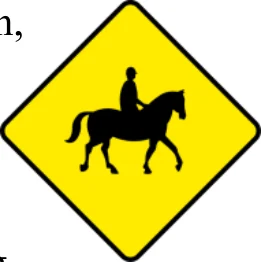
Equestrian crossing
Horse and rider warning sign

Put it into practice

You come around a bend behind a horse and buggy. Ease off the gas quietly, with no horn and no revving. Stay at least 4 seconds back. When the oncoming lane is clear, pass using the full lane and don't cut back in quickly.

Check your understanding

Read the question, decide on an answer, then open it to check the explanation. These are Roadwise study questions based on the source handbook.

What sign identifies a slow-moving vehicle, such as farm machinery, on the road?
  1. A flashing amber light on the roof
  2. An orange and red triangular sign on the rear
  3. A yellow diamond sign on the front
  4. A red flag on the roof

Answer: An orange and red triangular sign on the rear

A slow-moving vehicle is identified by an orange and red triangular sign mounted on the rear.
Handbook p. 45 ↗
What should you never do when approaching an animal, like a horse, being ridden on the road?
  1. Reduce your speed
  2. Give it a full lane of space when passing
  3. Blow your horn or rev your engine
  4. Slow to a stop if necessary

Answer: Blow your horn or rev your engine

Never blow your horn or rev your engine near an animal; it could startle it into a dangerous reaction.

Handbook p. 46 ↗
What following distance should you leave behind a horse and rider, or herded animals, on the road?
  1. At least 1 second
  2. No specific distance is required
  3. At least 30 feet, regardless of speed
  4. At least 4 seconds

Answer: At least 4 seconds

Leave at least a 4-second following distance when following a horse with a rider or herded animals.

Handbook p. 46 ↗
A slow-moving vehicle is marked with an orange and red triangular sign on the rear.
  1. True
  2. False

Answer: True

This triangular emblem helps other drivers recognize slow vehicles ahead.

Handbook p. 45 ↗
You should always blow your horn to warn animals on the road that you're approaching.
  1. True
  2. False

Answer: False

Never blow your horn near animals; it can startle them into a dangerous reaction.

Handbook p. 46 ↗
Take the lesson checkpoint in the app

More in Sharing the Road