roadwise.Open study app

Vermont driving lesson · Sharing the Road

Moose, deer & aggressive drivers

A 3-minute lesson from the Vermont course. Read the rules and examples, follow the handbook page references, and check your understanding before you move on.

Read time
3 minutes
Course unit
Sharing the Road
Checkpoint questions
6
Source pages
46

Hitting a moose or deer can kill you as well as the animal. Knowing when they move and how they behave in your headlights helps you avoid one. The same page covers another hazard: aggressive drivers, and why you should never try to get even.

Know the rule

Drive cautiously where deer and moose crossing signs are posted. Moose and deer are most likely on highways in the late evening, at night and in the early morning.

Handbook p. 46 ↗

Know the rule

Headlights may make a deer freeze in place, or bound toward its habitat. A deer on the side of the road away from its habitat may bolt in front of you.

Handbook p. 46 ↗
40 mph

Speed a deer can bound toward its habitat

Handbook p. 46 ↗

Know the rule

Animals travel in pairs. Once you see one, be ready for a second.

Handbook p. 46 ↗
1,000+ lbs

A moose weighs much more than a deer, more than a thousand pounds

Handbook p. 46 ↗

Why moose are deadlier and harder to see:

  • They're much taller and can land on top of the vehicle with crushing force
  • Their eyes may not reflect your headlights the way deer eyes do
  • They're darker colored than deer, so they're especially hard to see in the evening
Handbook p. 46 ↗
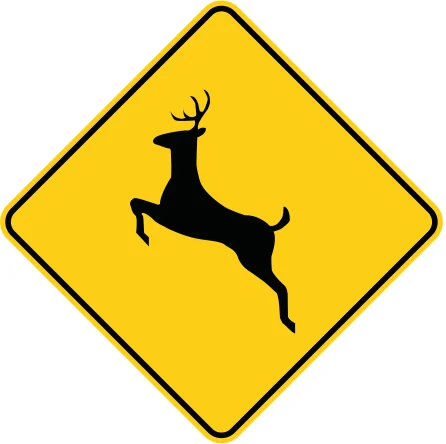
Deer crossing
Deer crossing warning sign

Aggressive drivers may:

  • Drive too fast and pass when it's unsafe
  • Skip signals for lane changes and weave in and out of traffic
  • Follow too closely and cut off other cars
  • Yell, honk their horns and flash their lights
Handbook p. 46 ↗

Know the rule

These aggressive actions are unlawful and can bring traffic tickets or worse.

Handbook p. 46 ↗

Know the rule

If an aggressive driver cuts you off, don't try to get even. Stay calm, get out of their way and don't challenge them.

Handbook p. 46 ↗

Put it into practice

At dusk a deer darts across the road ahead and disappears into the woods. Slow down and watch the same side, because a second deer is likely to follow.

Check your understanding

Read the question, decide on an answer, then open it to check the explanation. These are Roadwise study questions based on the source handbook.

Why are collisions with moose generally more deadly than collisions with deer?
  1. Moose weigh over 1,000 pounds and can land on top of the vehicle
  2. Moose are more likely to freeze in headlights
  3. Moose travel in larger herds than deer
  4. Moose are more common on Vermont roads

Answer: Moose weigh over 1,000 pounds and can land on top of the vehicle

Moose weigh over a thousand pounds and, being taller, can land on the vehicle with crushing force.
Handbook p. 46 ↗
Why are moose especially difficult to see at night compared to deer?
  1. Moose stay farther from the road
  2. Their eyes may not reflect headlights as well, and they're darker
  3. Moose are lighter in color than deer
  4. Moose travel mostly on back roads

Answer: Their eyes may not reflect headlights as well, and they're darker

Because moose are taller, their eyes may not reflect in headlights, and they're more darkly colored than deer.

Handbook p. 46 ↗
About how fast can a startled deer bound toward its habitat, potentially crossing the road?
  1. Up to 10 mph
  2. Up to 70 mph
  3. Up to 40 mph
  4. Up to 25 mph

Answer: Up to 40 mph

Headlights may cause a deer to freeze, then bound at speeds up to 40 mph toward its habitat.

Handbook p. 46 ↗
You see one deer cross the road ahead and continue driving normally. What should you expect?
  1. A second deer may follow, since they often travel in pairs
  2. The road is now clear of any deer risk
  3. Deer almost never travel with others
  4. Only moose travel in groups

Answer: A second deer may follow, since they often travel in pairs

Animals often travel in pairs, so after seeing one deer, be prepared to see a second.

Handbook p. 46 ↗
Moose are generally more dangerous to collide with than deer.
  1. True
  2. False

Answer: True

Moose are much heavier and taller, making collisions with them more severe.

Handbook p. 46 ↗
An aggressive driver cuts you off. What does the handbook tell you to do?
  1. Follow closely so they know they erred
  2. Flash your high beams to warn them
  3. Pass them and slow down in front of them
  4. Stay calm and get out of their way

Answer: Stay calm and get out of their way

Don't try to get even or challenge an aggressive driver; stay calm and get out of their way.

Handbook p. 46 ↗
Take the lesson checkpoint in the app

More in Sharing the Road