roadwise.Open study app

Vermont driving lesson · Signs, Signals & Road Markings

Pavement markings & lane use

A 3-minute lesson from the Vermont course. Read the rules and examples, follow the handbook page references, and check your understanding before you move on.

Read time
3 minutes
Course unit
Signs, Signals & Road Markings
Checkpoint questions
6
Source pages
35, 36

Lines on the road help you position your car, show when passing is allowed and warn of conditions ahead. Yellow lines separate traffic moving in opposite directions, and white lines separate lanes going the same way.

Know the rule

Major highways have yellow center lines that divide the road into travel lanes. Multi-lane highways without a median use double solid lines to separate the two directions.

Handbook p. 35 ↗

Know the rule

When two or more lanes go the same direction, a broken white line separates them.

Handbook p. 35 ↗

Can you pass?

Can you pass?
Center linePassing
Solid line or two solid linesRecommended that you don't pass
Broken line on your side, solid on the otherYou may pass if it's clear ahead
Solid line on your side, broken on the otherYou shouldn't pass; the other lane may
Handbook p. 35 ↗

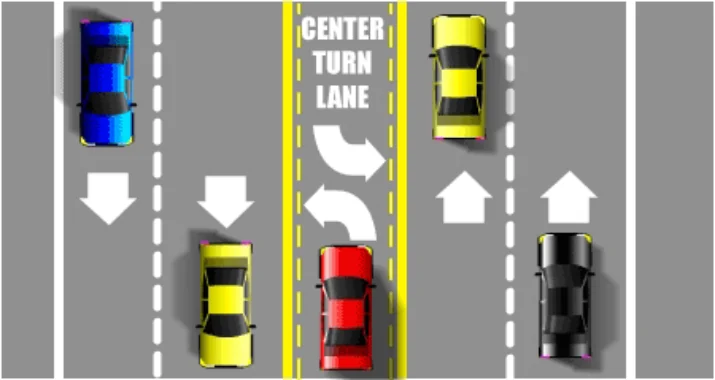
Two-way left turn lane

A center lane shared by traffic from both directions for left turns. It isn't a travel lane. Signal, move in shortly before your turn with your whole vehicle, then turn when clear.

Handbook p. 35 ↗
Center turn lane and multi-lane road
Center two-way left turn lane

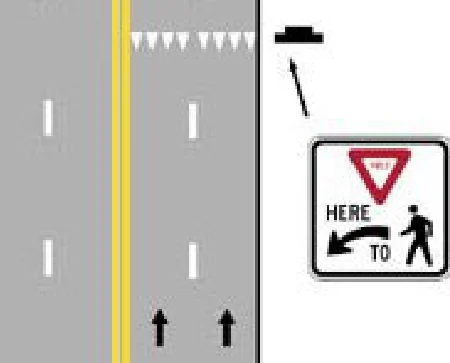
Yield line

A row of white triangles painted across the lane, pointing toward approaching cars. It shows where to stop if you must yield to pedestrians or other vehicles.

Handbook p. 35 ↗
Yield here to pedestrians (crosswalk approach)
Yield line and a "Yield Here to Pedestrians" sign

Know the rule

Turning from one road onto a multiple-lane road, right-turning drivers must turn into the right lane and left-turning drivers into the left lane.

Handbook p. 35 ↗

Know the rule

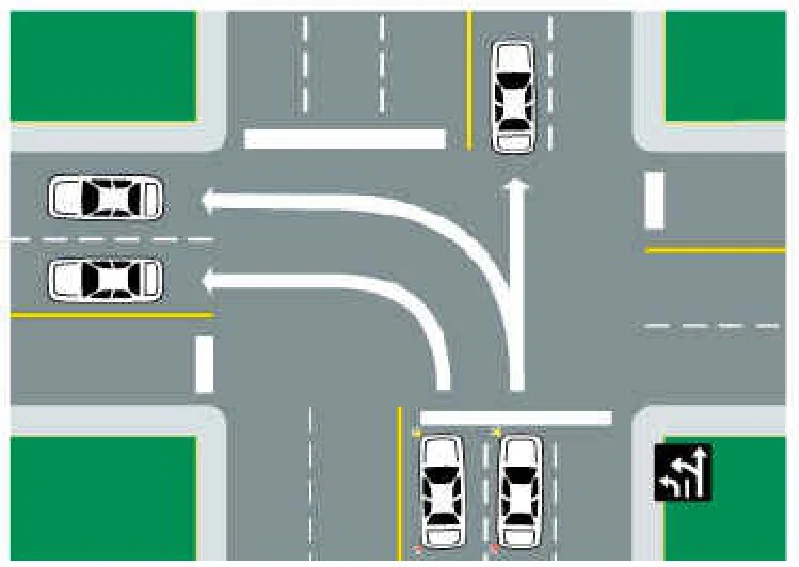
When two lanes turn the same direction, each stays in its own turning path. Multiple lanes may turn at once when lane-use signs or markings permit it. Stay in your lane until the turn is complete.

Handbook p. 35 ↗
Making a turn without crossing into oncoming lane
Two lanes turning left at once, each staying in its own path

Know the rule

Changing lanes while turning is illegal and leads to crashes. Change lanes only after the turn is complete.

Handbook p. 36 ↗

Know the rule

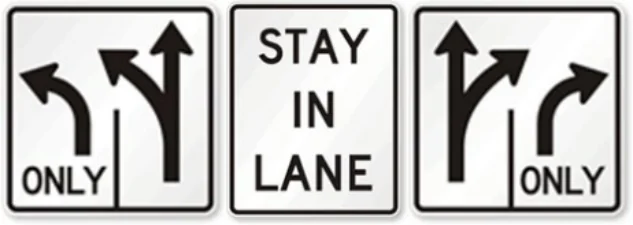
Follow the direction marked for your lane. From a straight-arrow lane, it's illegal to turn right or left at the intersection. Drive around the block instead.

Handbook p. 36 ↗
Lane-use arrow signs (stay in lane)
Lane-use control signs

Put it into practice

You're in a lane marked with a straight arrow and realize your street is on the right. Don't cut over at the intersection. Go straight, then find another route or go around the block.

Check your understanding

Read the question, decide on an answer, then open it to check the explanation. These are Roadwise study questions based on the source handbook.

What does a solid line, or two solid lines, in the road generally mean?
  1. Pass only if it is clear ahead
  2. Pass only during daylight
  3. Both lanes travel the same direction
  4. Do not pass

Answer: Do not pass

If there's a solid line, or two solid lines, it's recommended that you do not pass.
Handbook p. 35 ↗
There's a broken line in your lane but a solid line in the oncoming lane. What does this mean?
  1. You may pass if it's clear; the oncoming driver may not
  2. Neither driver may pass at all
  3. Both drivers may pass freely
  4. Only the oncoming driver may pass

Answer: You may pass if it's clear; the oncoming driver may not

A broken line in your lane with a solid line in the other lane means you may pass if clear, but they may not.

Handbook p. 35 ↗
What is a continuous two-way left-turn lane meant to be used for?
  1. A travel lane for passing slower traffic
  2. A shared lane for vehicles from both directions preparing to turn left
  3. An emergency breakdown lane
  4. A dedicated bicycle lane only

Answer: A shared lane for vehicles from both directions preparing to turn left

Continuous two-way left-turn lanes are not travel lanes; they're for left turns from both directions.

Handbook p. 35 ↗
What do white triangles painted across a lane, pointing toward approaching traffic, indicate?
  1. A pedestrian-only crossing
  2. A permanent no-passing zone
  3. A yield line, showing where to stop if yielding is required
  4. A speed bump ahead

Answer: A yield line, showing where to stop if yielding is required

This series of white triangles is a yield line, showing drivers where to stop if they must yield.

Handbook p. 35 ↗
A continuous two-way left-turn lane is meant to be used as a normal driving lane for through traffic.
  1. True
  2. False

Answer: False

This lane is only for left turns from both directions, not for through travel.

Handbook p. 35 ↗
There's a solid line in your lane, but a broken line in the oncoming lane. Can you legally pass?
  1. Yes, since the other lane is broken
  2. Yes, but only at night
  3. No, but the oncoming driver may pass
  4. No one may pass in this configuration

Answer: No, but the oncoming driver may pass

A solid line in your lane means you may not pass, even though the other lane's broken line permits them to.

Handbook p. 35 ↗
Take the lesson checkpoint in the app

More in Signs, Signals & Road Markings