A 3-minute lesson from the Vermont course. Read the rules and examples, follow the handbook page references, and check your understanding before you move on.
A roundabout replaces stop signs or signals at an intersection. In most situations it moves cars, pedestrians and bicyclists more safely than stop signs or signals. The rules are simple: go slowly, yield on entry, pick your lane early, and signal your exit.
Roundabout
An intersection where traffic enters and exits only by right turns and circulates counterclockwise.
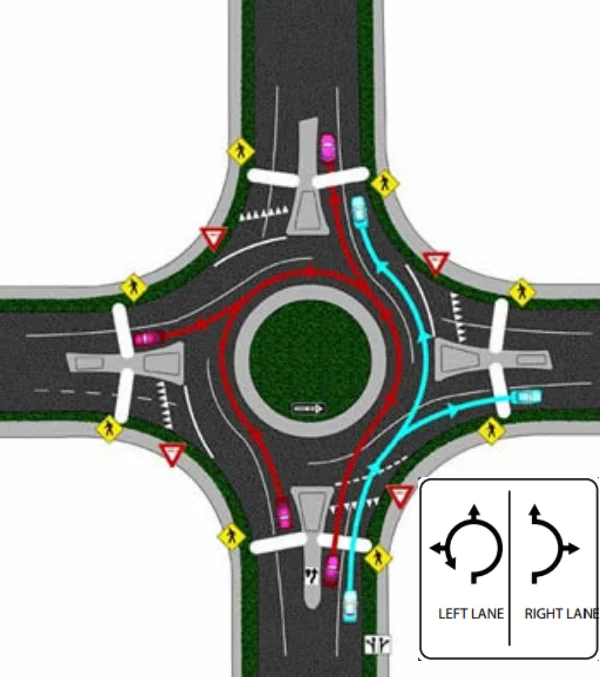
At multi-lane roundabouts, read the lane assignment signs and pavement markings before entering to choose the proper lane. You may not change lanes once inside.
Multi-lane roundabout: left-lane and right-lane paths
Know the rule
Always yield to emergency vehicles. If you're not in the roundabout yet, pull over and let them pass. If you're already in it, pull over after you have safely exited.
You want to turn left at a two-lane roundabout with no lane signs. Use the left lane, yield to circulating traffic, enter at a safe gap, stay in your lane, and signal right before your exit. Check your mirrors and blind spot as you leave.
Check your understanding
Read the question, decide on an answer, then open it to check the explanation. These are Roadwise study questions based on the source handbook.
Which direction does traffic move in a Vermont roundabout?
Counter-clockwise
Clockwise
It varies by roundabout
Clockwise on multi-lane roundabouts
Answer: Counter-clockwise
A roundabout is designed so traffic enters and exits through right turns, proceeding counter-clockwise.