A 3-minute lesson from the Vermont course. Read the rules and examples, follow the handbook page references, and check your understanding before you move on.
You can tell what a sign means from its shape and color as well as its words. If snow or dirt covers a sign, the shape alone tells you whether it's regulatory, a warning or information. That's why the test asks about shapes.
Know the rule
If a sign is covered by dirt, snow or anything else, you should still know its general meaning (regulatory, warning or information) from its shape.
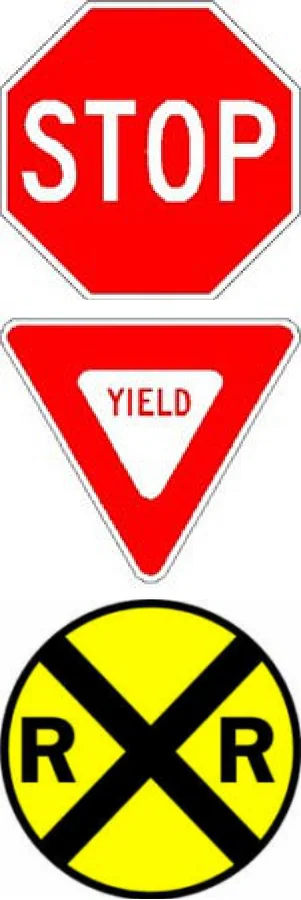
Stop sign, yield sign and railroad advance warning sign
Know the rule
A stop sign has 8 sides. Stop before the stop line, the crosswalk (marked or unmarked) or the intersecting road, whichever comes first. Scan, honor the right-of-way, then proceed.
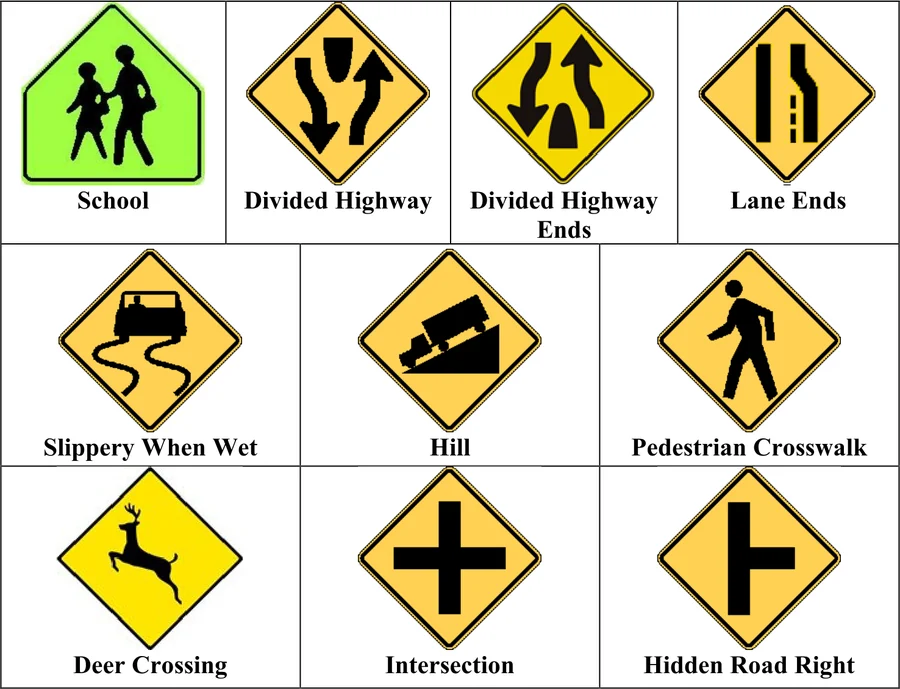
Signs placed where danger always exists and you need to slow down, such as sharp curves, unsafe intersections or dips. Usually diamond-shaped and yellow or green.
Some warning signs add a safe speed or a distance, such as "Deer Crossing, next 3 miles." A downward arrow under a school or pedestrian sign marks the crosswalk or crossing area.
A snow-crusted, eight-sided sign stands at a corner. You can't read it, but the shape tells you it's a stop sign. Stop at the line, or before the crosswalk or cross street if there's no line.
Check your understanding
Read the question, decide on an answer, then open it to check the explanation. These are Roadwise study questions based on the source handbook.
How many sides does a stop sign have?
4
6
8
3
Answer: 8
A stop sign has 8 sides, making it recognizable by shape alone even if covered in snow or dirt.