roadwise.Open study app

Vermont driving lesson · Signs, Signals & Road Markings

Railroad crossings

A 3-minute lesson from the Vermont course. Read the rules and examples, follow the handbook page references, and check your understanding before you move on.

Read time
3 minutes
Course unit
Signs, Signals & Road Markings
Checkpoint questions
6
Source pages
30, 33, 34, 38

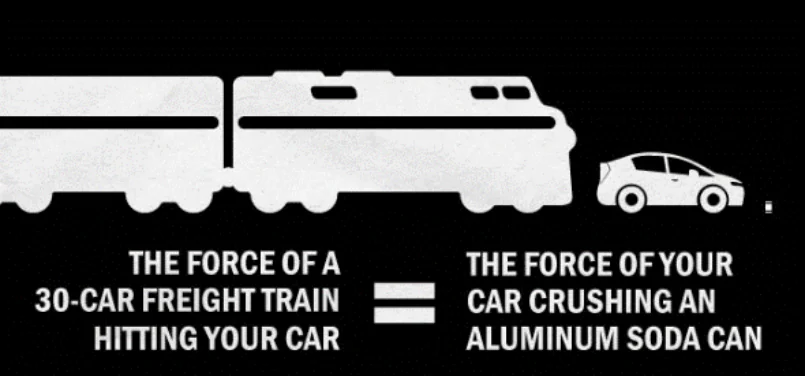
A handbook graphic puts it plainly: a 30-car freight train hitting your car is like your car crushing an aluminum soda can. That's why crossings have strict rules. The test focuses on the signs, the 15-foot stopping rule and when you must stop.

Train vs. car force comparison
The force of a 30-car freight train hitting your car equals your car crushing a soda can
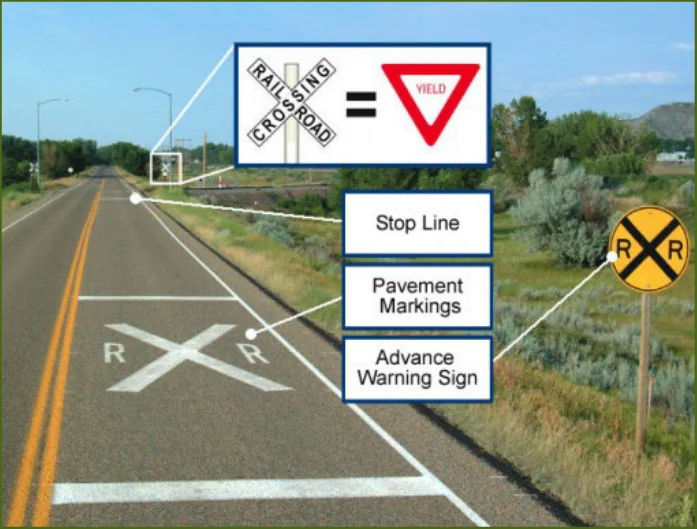
Railroad crossing approach (stop line, markings, advance sign)
A railroad crossing: advance warning sign, pavement markings, stop line and crossbuck

Know the rule

A round sign with a large X and RR warns that a railroad crossing is ahead.

Handbook p. 33 ↗

Know the rule

Crossbuck signs are at all railroad crossings and show where the tracks are. Slow down, look both ways and listen for trains before crossing.

Handbook p. 34 ↗

Know the rule

Smaller signs below the crossbuck show how many tracks there are. With 2 or more tracks, one passing train may hide a train coming the other way. There may also be gates and/or flashing lights.

Handbook p. 34 ↗

Know the rule

It is illegal to drive through, around or under a closed railroad gate, and illegal to pass another vehicle at a railroad crossing.

Handbook p. 38 ↗

Know the rule

Drive at a safe, reduced speed when approaching and crossing any public or private railroad crossing.

Handbook p. 38 ↗
15 feet

When a stop is required, stop not less than 15 feet from the nearest rail

Handbook p. 38 ↗

You must stop at a crossing when:

  • Flashing lights, lowered gates or a flagman signal that a train is approaching or passing
  • You see a train or hear its whistle
  • There is a STOP sign at the crossing
Handbook p. 38 ↗

Know the rule

After a required full stop, you may cross when it is safe.

Handbook p. 38 ↗

Know the rule

Pedestrians, bicyclists and moped riders must also obey railroad warning signals and not cross until it's safe.

Handbook p. 38 ↗

Know the rule

If a dangerous condition exists at a crossing, call the number on the emergency sign and give the posted crossing number, so the railroad can stop or reroute trains.

Handbook p. 38 ↗

Know the rule

Never park on railroad tracks or within 50 feet of the nearest rail of a crossing.

Handbook p. 30 ↗

Put it into practice

At a two-track crossing, the lights are flashing as a freight train clears. Stay stopped at least 15 feet from the nearest rail until the lights stop. A second train could be hidden behind the first.

Check your understanding

Read the question, decide on an answer, then open it to check the explanation. These are Roadwise study questions based on the source handbook.

What sign marks every railroad crossing, showing exactly where the tracks are?
  1. A circular RR sign
  2. A crossbuck sign
  3. A yellow diamond sign
  4. A blue directional sign

Answer: A crossbuck sign

Crossbuck signs are posted at all railroad crossings and indicate exactly where the tracks are.
Handbook p. 34 ↗
How close to the nearest rail must you stop when required to stop at a railroad crossing?
  1. Not less than 50 feet
  2. Not less than 5 feet
  3. Not less than 15 feet
  4. Not less than 30 feet

Answer: Not less than 15 feet

By law, drivers must stop not less than 15 feet from the nearest rail when required to stop.

Handbook p. 38 ↗
Which of these requires you to stop at a railroad crossing?
  1. The crossing has only a crossbuck sign
  2. It's nighttime
  3. The tracks look old or unused
  4. You see a train or hear its whistle

Answer: You see a train or hear its whistle

You must stop if flashing lights or gates activate, you see/hear a train, or there's a stop sign at the crossing.

Handbook p. 38 ↗
Is it legal to pass another vehicle while at a railroad crossing?
  1. No, it is against the law
  2. Yes, if visibility is good
  3. Yes, only on multilane roads
  4. Yes, if the other vehicle is stopped

Answer: No, it is against the law

It is against the law to pass another vehicle at a railroad crossing.

Handbook p. 38 ↗
What do the smaller signs mounted below a crossbuck indicate?
  1. The train's scheduled arrival time
  2. How many tracks are at the crossing
  3. The speed limit through the crossing
  4. Which direction trains normally travel

Answer: How many tracks are at the crossing

The smaller signs below the crossbuck show how many tracks there are at that crossing.

Handbook p. 34 ↗
A crossing has flashing lights active, but you don't see a train yet. Must you stop?
  1. Yes, flashing lights alone require a stop
  2. No, only an actual visible train requires stopping
  3. No, only a lowered gate requires stopping
  4. Only if a flagman is also present

Answer: Yes, flashing lights alone require a stop

Flashing lights alone are enough to require a stop, even without a visible train yet.

Handbook p. 38 ↗
Take the lesson checkpoint in the app

More in Signs, Signals & Road Markings