roadwise.Open study app

Utah driving lesson · Basic Driving Skills

Stopping and school buses

A 3-minute lesson from the Utah course. Read the rules and examples, follow the handbook page references, and check your understanding before you move on.

Read time
3 minutes
Course unit
Basic Driving Skills
Checkpoint questions
5
Source pages
45, 46

A rolling stop is not a stop. Utah lists situations where you must come to a complete stop, and school buses have their own rules that depend on the type of road you're on.

Know the rule

Apply the brake smoothly with steady pressure. Check mirrors for traffic behind you and press steadily until the vehicle stops.

Handbook p. 45 ↗

You must make a complete stop:

  • At a steady red light or a flashing red light
  • At all stop signs
  • At railroad crossings controlled by flashing signals, gates, a watchman, or stop signs
  • At the scene of any crash you're involved in, until you meet all legal requirements
  • When a police or other officer tells you to stop
  • Before the sidewalk or street when coming out of an alley, driveway, private road, or building
Handbook p. 45 ↗
15–50 feet

At a railroad crossing, stop more than 15 feet but not more than 50 feet from the nearest rail; if there's a gate, wait for it to rise

Handbook p. 45 ↗

Know the rule

When a school bus shows alternating flashing red lights (front or rear), stop before reaching the bus and don't move until the lights stop flashing.

Handbook p. 46 ↗

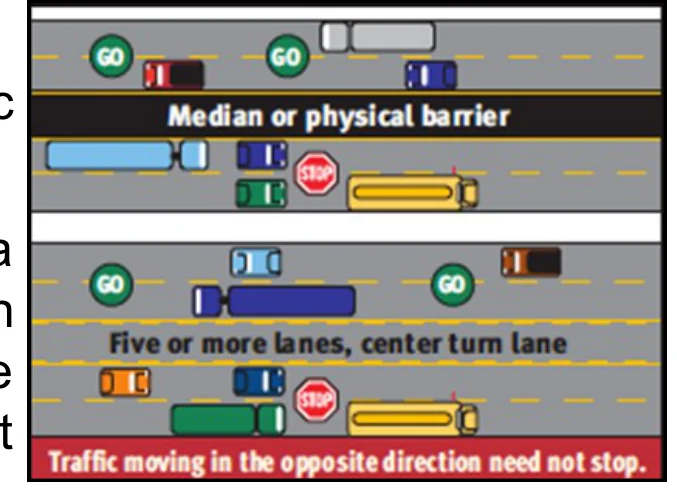
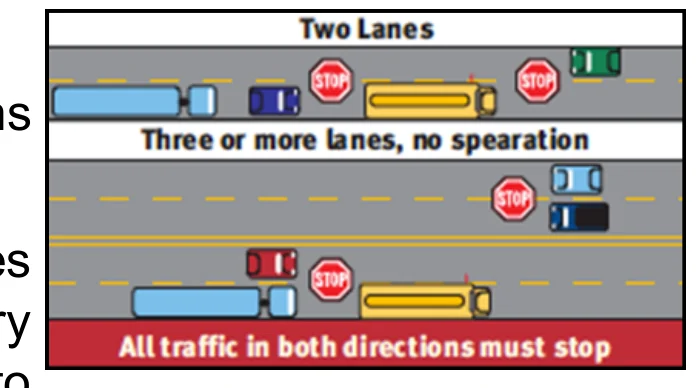
Who must stop for a school bus with flashing red lights

Who must stop for a school bus with flashing red lights
RoadWho stops
Two-lane roadTraffic in both directions
Four lanes, no medianTraffic in both directions
Divided highway, 4+ lanes with a medianOnly traffic in both lanes behind the bus
Five+ lanes with a shared center turn laneOnly traffic in both lanes behind the bus
Handbook p. 46 ↗
School bus stopping law
Two lanes, or four lanes with no separation: all traffic stops
School bus stopping law
Median, or five lanes with a center turn lane: opposite traffic need not stop

Know the rule

Even when the law doesn't require you to stop, students may be getting on and off. Children are unpredictable, so slow down and use caution near school buses.

Handbook p. 46 ↗

Know the rule

School bus drivers may report vehicles that pass illegally, and the report may go to local law enforcement.

Handbook p. 46 ↗
$3,000

Fines for illegally passing a school bus can run this high; a conviction usually raises insurance rates

Handbook p. 46 ↗

Put it into practice

You're on a four-lane street with no median when an oncoming school bus stops and flashes red. You must stop too, even though the bus is on the other side, because there is no median.

Check your understanding

Read the question, decide on an answer, then open it to check the explanation. These are Roadwise study questions based on the source handbook.

When stopping behind another vehicle, what should you be able to see?
  1. The full trunk of the vehicle ahead
  2. The rear tires of the vehicle ahead
  3. The vehicle's license plate only
  4. Only the vehicle's roofline

Answer: The rear tires of the vehicle ahead

A safe gap when stopping behind another vehicle lets you see the vehicle's rear tires.
Handbook p. 41 ↗
Fines for illegally passing a stopped school bus can run up to:
  1. $500
  2. $1,000
  3. $3,000
  4. $2,500

Answer: $3,000

Fines for passing a stopped school bus illegally can run up to $3,000.

Handbook p. 46 ↗
You must come to a complete stop at a steady red light and at a flashing red light.
  1. True
  2. False

Answer: True

Both a steady red light and a flashing red light require a complete stop.

Handbook p. 45 ↗
On a divided highway with four or more lanes and a median, opposing traffic must also stop for a school bus.
  1. True
  2. False

Answer: False

On a divided highway with a median, only vehicles behind the bus must stop; opposing traffic does not.

Handbook p. 46 ↗
On a highway with five or more lanes and a shared center turn lane, who must stop for a school bus with flashing red lights?
  1. All traffic in both directions
  2. No one is required to stop
  3. Only oncoming traffic
  4. Only vehicles in both lanes behind the bus

Answer: Only vehicles in both lanes behind the bus

On a highway with five or more lanes and a shared center turn lane, only vehicles behind the bus must stop.

Handbook p. 46 ↗
Take the lesson checkpoint in the app

More in Basic Driving Skills