A 3-minute lesson from the Utah course. Read the rules and examples, follow the handbook page references, and check your understanding before you move on.
Lane changes and merges cause many crashes because drivers skip a step. Follow the same routine every time (mirror, signal, head check, then move), stay out of the gore area, and use the zipper method when lanes squeeze together.
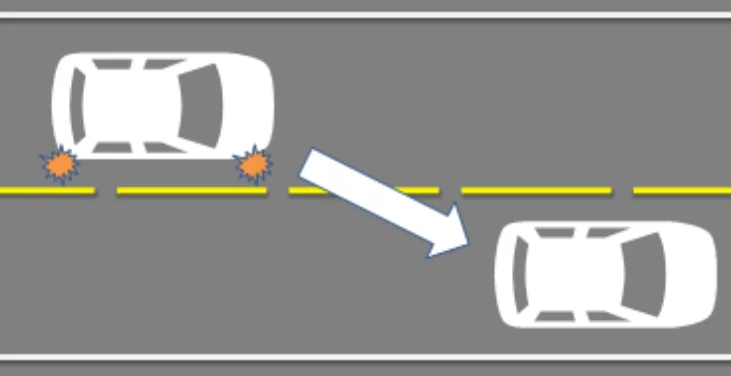
Changing lanes:
Check your mirrors
Signal for at least two seconds in the direction you'll move
Head check: look over your shoulder toward your blind spot
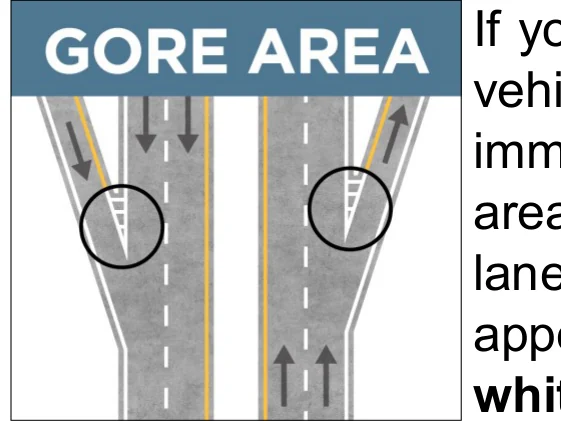
The area between the solid white lines separating a traffic lane from a lane used to enter or exit it. It also appears where two highways merge or split.
The gore area between a through lane and an exit or entrance lane
Zipper method
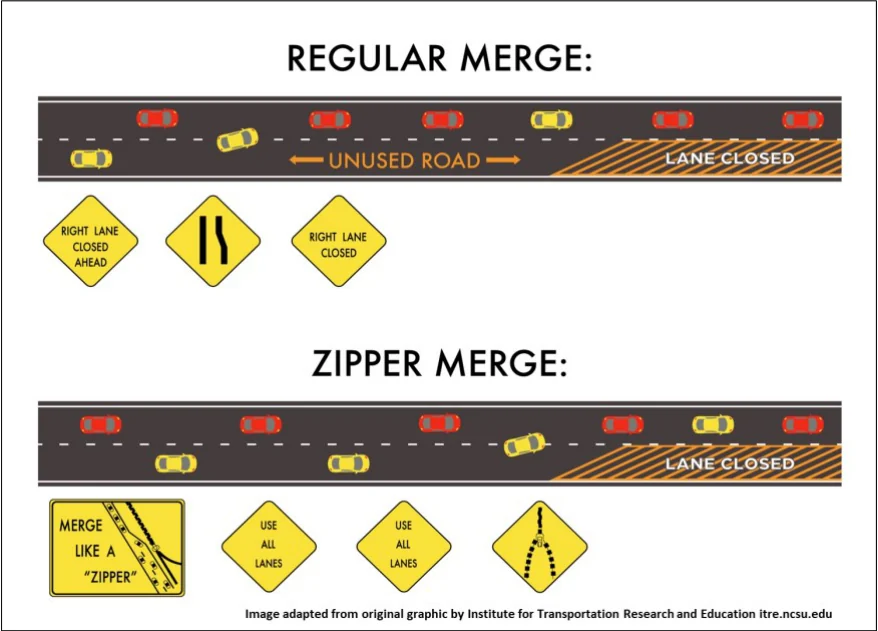
At a congested merge point (such as a construction zone), use both lanes up to the merge point, then take turns entering the single lane. Violating this is an infraction.
Check traffic and mirrors before, during, and after every intersection, turn, and lane change. Search left and right at intersections, driveways, store entrances, and railroad tracks.
Traffic slows where two lanes become one in a work zone. Instead of merging early and leaving the right lane empty, both lanes fill to the merge point, and drivers take turns, one from each lane, like a zipper.
Check your understanding
Read the question, decide on an answer, then open it to check the explanation. These are Roadwise study questions based on the source handbook.
What is the 'gore area'?
The paved shoulder outside the white edge line
The shared center left-turn lane
The area between solid white lines at an entry or exit lane
The striped area beside a crosswalk
Answer: The area between solid white lines at an entry or exit lane
The gore area is between the solid white lines of a lane of traffic and a lane used to enter or exit that lane.