roadwise.Open study app

Utah driving lesson · Basic Driving Skills

Passing safely

A 3-minute lesson from the Utah course. Read the rules and examples, follow the handbook page references, and check your understanding before you move on.

Read time
3 minutes
Course unit
Basic Driving Skills
Checkpoint questions
4
Source pages
43, 44

Passing puts you in the path of oncoming traffic, so do it only when you can see it is safe and finish it quickly. Know the places where passing is never allowed and the special rules for bicyclists and snowplows.

Know the rule

On multi-lane roads, the left lane is for passing slower vehicles. Never pass on the shoulder. Pass as quickly and safely as possible and don't stay alongside the other vehicle longer than you must.

Handbook p. 43 ↗

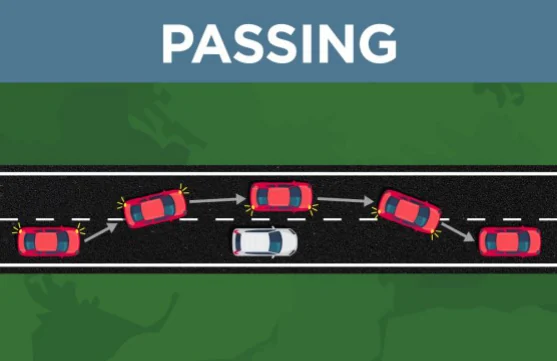
How to pass:

  • Check for oncoming traffic
  • Check mirrors and head check for vehicles following or passing you
  • Signal and steer into the passing lane
  • Adjust speed and move entirely into the left lane
  • Return no less than 200 feet ahead of oncoming vehicles
  • Wait until you can see the passed vehicle in your rearview mirror
  • Signal, steer back into the lane, and adjust your speed
Handbook p. 43 ↗
200 feet

Minimum distance from oncoming vehicles when you return to the right lane

Handbook p. 44 ↗
Passing on a two-lane road
Passing: move fully into the left lane, then return once the car shows in your mirror

Know the rule

When passing on the right, it is illegal to leave the roadway. When you are being passed, stay in your lane and keep a steady speed.

Handbook p. 44 ↗

Never pass:

  • When there is an oncoming vehicle
  • When a curve or hill blocks your view
  • At intersections, or a car stopped at a crosswalk
  • Before a railroad crossing or bridge
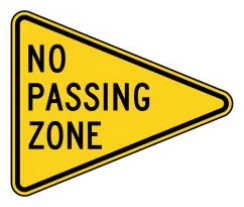
  • In a no-passing zone
Handbook p. 44 ↗
No passing zone
No Passing Zone sign

Know the rule

Slow down when passing bicyclists and give them as much space as possible.

Handbook p. 44 ↗

Know the rule

If a snowplow shows flashing yellow lights, you may not pass it on the side where its plow blade is deployed. If three or more snowplows work in echelon formation, you may not pass them on either side.

Handbook p. 44 ↗

Put it into practice

You're behind a slow truck on a two-lane road and a hill is ahead. Even with no cars in sight, you wait: the hill blocks your view. You pass after the crest, when you can see enough road to finish at least 200 feet before any oncoming car.

Check your understanding

Read the question, decide on an answer, then open it to check the explanation. These are Roadwise study questions based on the source handbook.

How far from an oncoming vehicle must you return to your lane after passing?
  1. Not less than 100 feet
  2. Not less than 500 feet
  3. Not less than 200 feet
  4. Not less than 50 feet

Answer: Not less than 200 feet

Return to the right-hand lane no less than 200 feet from oncoming vehicles.
Handbook p. 44 ↗
A single snowplow with flashing yellow lights has its blade out on its right side. Where may you NOT pass it?
  1. On the side away from the blade
  2. On its right side, where the blade is
  3. On either side of the plow
  4. Behind it within 200 feet

Answer: On its right side, where the blade is

You may not pass or overtake a snowplow displaying flashing yellow lights on the side where its plow blade is deployed.

Handbook p. 44 ↗
Three snowplows are working together in echelon formation. You may:
  1. Pass on the side without blades
  2. Pass on the left side only
  3. Not pass them on either side
  4. Pass on the right shoulder

Answer: Not pass them on either side

If three or more snowplows operate in echelon formation, you may not pass or overtake them on either side.

Handbook p. 44 ↗
You may pass a slow vehicle on the shoulder if the shoulder is wide and paved.
  1. True
  2. False

Answer: False

The handbook says never pass on the shoulder. On multi-lane roads, use the left lane to pass.

Handbook p. 43 ↗
Take the lesson checkpoint in the app

More in Basic Driving Skills