Every turn follows the same pattern: check, signal, slow, turn into the correct lane, then cancel the signal. When you need to reverse direction, going around the block is best, then a two-point turn, then a three-point turn.
Making any turn:
- Check traffic in all directions; use the correct signal; brake smoothly
- Get into the correct lane for the turn
- If you must stop, stop behind the stop line, crosswalk, or stop sign, whichever comes first
- Waiting behind a car, see its rear tires; keep your front wheels pointed straight
- Finish in the correct lane, cancel the signal, and move right when safe
Right and left turns
| Step | Right turn | Left turn |
|---|---|---|
| Signal | Right, for two seconds | Left, for two seconds |
| Head check | Over your right shoulder | Over your left shoulder |
| While turning | Look for pedestrians and objects | Look for pedestrians and objects |
| Path | Don't cut the corner or swing wide | Don't cut the corner or swing wide |
Know the rule
On multiple lanes, enter the lane you'll turn from and stay in it until the turn is done. You may not drive over, across, or within any part of an island.
Handbook p. 47 ↗Know the rule
A street, alley, or driveway can be used for a two-point turn when you can't drive around the block.
Handbook p. 47 ↗Forward two-point turn (into a driveway on the left):
- Check for oncoming traffic and signal left
- Move near the center of the road and turn in, keeping to the right side of the drive
- Stop when your rear clears the curb or driveway edge
- Check traffic, signal right, shift to reverse
- Back out turning the wheel quickly right; straighten and stop centered in the lane
- Shift to drive, cancel the signal, and drive away
Reverse two-point turn (backing into a driveway on the right):
- Check that no vehicles are behind you and signal right
- Drive one car length past the driveway or alley
- Put your right arm on the seat, look over your right shoulder, and back in
- Shift to drive and check traffic
- When clear, signal left and turn left into the proper lane
Know the rule
Use a three-point turn only on a two-lane road that is too narrow for a U-turn. It's best to go around the block if you can.
Handbook p. 48 ↗Three-point turn:
- Mirrors, head check, signal right, and stop on the right side
- Signal left, check traffic, head check over your left shoulder
- When clear, turn hard left, drive to the other side, and stop
- Shift to reverse, check traffic and head check over both shoulders
- When clear, turn hard right and back up
- Brake, shift to drive, check traffic and head check, then merge and accelerate smoothly
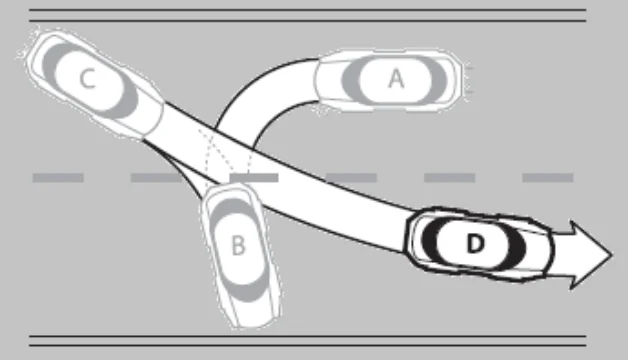
Never make a U-turn:
- On a curve or near a hilltop where you can't see or be seen from both directions for 500 feet
- Where an official traffic control device prohibits it
- On a railroad track or grade crossing
- On a freeway
Know the rule
Each city has its own U-turn laws. Make a U-turn only on a street wide enough to turn from the left-hand lane (or just right of the center line): signal, head check, turn with a traffic check, and cancel the signal.
Handbook p. 48 ↗Put it into practice
You're on a narrow two-lane road and missed your turn. A driveway is just ahead on the right with no one behind you. You signal right, drive one car length past it, back in while looking over your right shoulder, then signal left and pull out.