A train can't swerve and needs more than a mile to stop, so every crossing is on you. Learn the warning devices, where to stop, and what to do if you stall on the tracks. TRAX light rail crossings follow the same rules.
At every crossing:
- Use extreme caution and always slow down
- Never pass a car going your direction at a railroad crossing
- Turn down the radio so you can hear the train's horn
- Don't assume no train is coming at night just because you see no lights
- Slow down or stop and look before crossing the tracks
When stopped at a crossing, you must be between 15 and 50 feet from the nearest rail
Handbook p. 97 ↗Know the rule
When the lights flash, come to a complete stop and don't go while they flash. If after stopping you suspect they're malfunctioning, you may cross only with a clear view of at least one mile both ways, no sign of a train, and a safe crossing.
Handbook p. 97 ↗Know the rule
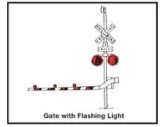
You may not drive through, around, or under a crossing gate while it is down or being lowered or raised.
Handbook p. 97 ↗Railroad warning devices
| Device | What it tells you |
|---|---|
| Round yellow sign with X and RR | Crossing ahead: slow, look, listen, be ready to stop |
| Stop line, X, and RR on the pavement | Crossing ahead; watch for an approaching train |
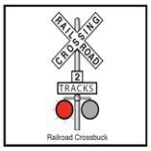
| Crossbuck | At all public crossings; yield to trains |
| Number sign below the crossbuck | How many tracks cross here |
| Flashing lights and bells | Stop: a train is coming; make sure all tracks clear |
| Gates | Stop before they lower; wait until up and lights stop |
Know the rule
Look both ways and cross quickly; never stop on the tracks. If a train is crossing, wait until it is well down the track. If you must stop for traffic or a signal, wait at the stop line before the tracks.
Handbook p. 56 ↗Train facts:
- Trains have the right-of-way 100% of the time, even over ambulances, fire engines, and police
- A 100-car freight train at 55 mph needs more than a mile (about 18 football fields) to stop
- A train may extend three feet or more beyond the rails
- Trains can move either direction at any time, and may be pushed instead of pulled
- Expect a train on any track at any time; rusty or weedy rails may still be in use
Know the rule
If your vehicle stalls on a crossing, get everyone out and off the tracks immediately and notify authorities. If a train is coming, run toward it at an angle away from the tracks to avoid flying debris.
Handbook p. 99 ↗Know the rule
School buses and trucks carrying hazardous materials must stop at all crossings and not shift gears on the tracks. Motorcyclists and bicyclists shouldn't swerve to get a better crossing angle.
Handbook p. 98 ↗Know the rule
TRAX light rail cars are 88 feet long, weigh about 88,000 pounds, and reach 65 mph within 21 seconds. Wait until gates are fully raised and red lights stop, and be sure you can clear the tracks before entering.
Handbook p. 99 ↗Know the rule
A flashing train logo on an overhead sign means a light rail train is approaching. It is an extra warning, not a signal to stop.
Handbook p. 99 ↗Put it into practice
Crossing lights are flashing but you see no train after a full stop, and you suspect the signal is broken. You may cross only if you can see at least one mile down the tracks both ways with no train coming. If you can't, keep waiting.