Utah sets exact distances your lights, horn, and reflectors must reach so other people can see and hear you. Test questions love these numbers, so learn them as pairs: the equipment and how far it must work.
Front lights, horn, and plate light
| Equipment | Requirement |
|---|---|
| Headlights (all but motorcycles) | At least 2 white, one on each side |
| High beams | Shine 350 feet |
| Low beams | Shine 100 feet |
| Horn (one, working) | Heard from at least 200 feet |
| License plate light | White; plate readable from 50 feet |
| Parking lights | One or more white or amber, on the front |
Rear lights, signals, and reflectors
| Equipment | Requirement |
|---|---|
| Tail/stop lights | 2 red on the rear; seen 500 ft in sunlight |
| Turn signals | Seen from 100 feet in normal sunlight |
| Reflectors | Seen 500 ft at night; 15–60 inches high |
Know the rule
One tail/stop light is allowed on motorcycles and certain vehicles made before 1956.
Handbook p. 102 ↗Know the rule
Turn signals: two red, yellow, or amber lights on the rear and two white, yellow, or amber lights on the front. They aren't required on vehicles made before 1953 that are less than 80 inches wide.
Handbook p. 102 ↗Know the rule
Reflectors: one amber on each side at or near the front and one red on each side at or near the rear. If the structure is lower than 15 inches, mount them as high as possible. Vehicles 30 feet or longer also need an amber reflector near the center of each side.
Handbook p. 102 ↗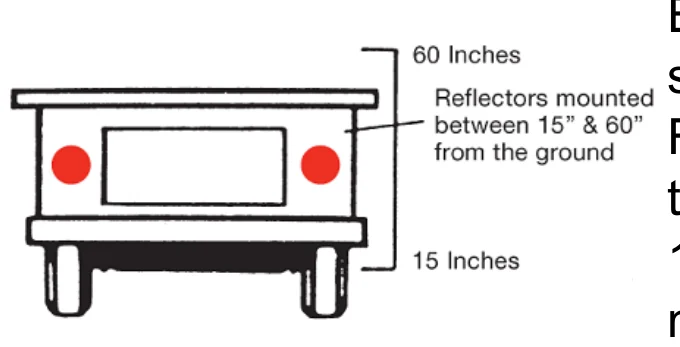
Know the rule
Buses, RVs, and trailers 80 inches or wider need clearance lights: two amber on the front and one on each side; two red on the rear and one on each side at the rear, visible 500 feet at night.
Handbook p. 101 ↗Know the rule
Those same wide vehicles need two side marker lights on each side (amber in front, red at the rear), visible at night from 500 feet to the side.
Handbook p. 102 ↗Know the rule
Red or blue lights visible from the front are only for emergency, school, snow removal, or other authorized vehicles. Only authorized emergency vehicles may have sirens, whistles, or bells.
Handbook p. 102 ↗Put it into practice
Your car's horn stops working. It must be fixed: every motor vehicle needs one functioning horn that can be heard from at least 200 feet under normal conditions.