Towing another vehicle has three simple rules. Large vehicles that break down must also be marked with flares, lights, or reflectors placed in a set pattern, and tire and brake heat can start fires you need to prevent and handle.
The three towing rules:
- The drawbar or other connection may not be longer than 15 feet from one vehicle to the other
- A chain, rope, or cable connection needs a red flag or signal at least 12 inches square
- Don't tow if the towed vehicle whips or swerves dangerously from side to side
Know the rule
Every towed vehicle and regular hitch or coupling must have a chain or cable strong enough to keep the vehicles from separating.
Handbook p. 102 ↗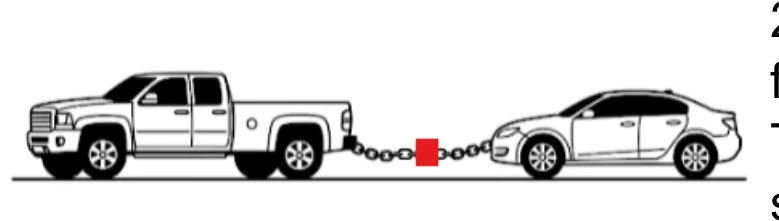
Know the rule
Warning devices must be displayed whenever a vehicle at least 80 inches wide or 30 feet long is disabled or stopped along the road for more than 10 minutes.
Handbook p. 103 ↗Warning devices aren't required when you are:
- Legally parked in an urban district
- Lawfully picking up or letting off passengers
- Stopped to avoid conflict with other traffic
- Following directions from a police officer or a traffic control device
- In light good enough to reveal people and vehicles 1,000 feet away
Placing warning devices:
- First: a flare, lighted fuse, lantern, or reflector beside the vehicle, toward oncoming traffic
- Next: devices 100 feet to the front and 100 feet to the rear
- Also one on the traffic side, at least 10 feet behind the vehicle
- On a one-way street: the rear device goes 200 feet behind
- Within 500 feet of a curve or hilltop: place it far enough to warn, 100 to 500 feet away
Know the rule
Put warning devices in the center of the lane where you're stopped. If your vehicle is completely off the road, put them on the shoulder as close to the road as possible.
Handbook p. 104 ↗Know the rule
Trucks, truck tractors, and buses must carry three flares, red reflectors, or red electric lights (visible at least 600 feet) and two red flags with standards. Flares burn 12 hours; fuses at least 15 minutes. Vehicles carrying explosives or flammables may not use flares or fuses.
Handbook p. 101 ↗Know the rule
Keep a lit flare or fuse away from your face and eyes and away from fuel leaks. Never attach one to your vehicle; that is dangerous and illegal.
Handbook p. 104 ↗Preventing tire fires:
- Check tires and brakes often for unusual heat; change soft or flat tires
- Don't drive long on a soft or flat tire or with a dragging brake
- Never ignore a hot tire: stay with the vehicle until it cools, or change it
- Always release the parking brake before moving
- Watch for leaking oil seals and partly deflated dual tires
Know the rule
If a tire catches fire, water is best; get to a fire station if possible. Extinguishers aren't very practical, but dirt may slow it. If you can't remove the tire, drive until it burns off or you reach water; as a last resort, drop the trailer.
Handbook p. 104 ↗Know the rule
With a fire extinguisher, make every burst count and keep the wind at your back. Never fight a gasoline or oil fire with water; it only spreads the fire.
Handbook p. 105 ↗Put it into practice
Your 32-foot motor home breaks down on a two-way highway and will sit more than 10 minutes. You set a reflector beside it toward oncoming traffic, then devices 100 feet ahead and 100 feet behind, plus one at least 10 feet behind on the traffic side.