roadwise.Open study app

Utah driving lesson · Sharing the Road

Pedestrians and vulnerable road users

A 4-minute lesson from the Utah course. Read the rules and examples, follow the handbook page references, and check your understanding before you move on.

Read time
4 minutes
Course unit
Sharing the Road
Checkpoint questions
6
Source pages
84, 93, 94

People on foot, on bikes, or in wheelchairs have no protection in a crash, and higher speeds mean worse injuries. Utah law gives these 'vulnerable users' special protection, and you must yield to pedestrians even where no crosswalk is marked.

Vulnerable user of the highway

A pedestrian (including road workers and emergency responders), an animal rider, or anyone on a bike, e-bike, skateboard, skates, moped, scooter, motorcycle, wheelchair, or open farm tractor.

Handbook p. 84 ↗

Know the rule

Distracting a vulnerable user with intent to cause violence or injury, or forcing one off the road, can bring a citation. A conviction goes on your driving record with points.

Handbook p. 84 ↗

Know the rule

You must yield to all pedestrians, even if they are not in a marked or unmarked crosswalk. Watch for mid-block crosswalks that may have no signs or markings.

Handbook p. 93 ↗

Know the rule

Always yield to the visually impaired. When a pedestrian with a guide dog or a white cane is crossing, you must come to a complete stop.

Handbook p. 93 ↗

Know the rule

Even when your light is green, you must yield to pedestrians.

Handbook p. 93 ↗
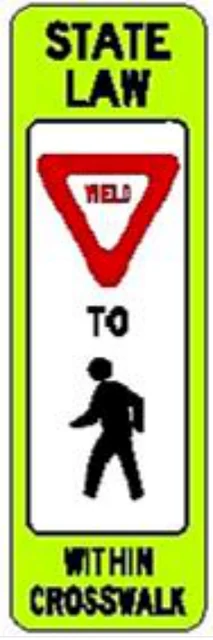
State law yield to pedestrians in crosswalk
State law: yield to pedestrians within the crosswalk

When you are driving:

  • Look twice for pedestrians when turning; many pedestrian crashes happen during turns
  • Stop before the crosswalk so other drivers can see the people crossing
  • Never pass a vehicle stopped at a crosswalk; someone may be crossing out of view
  • Be extra cautious when backing up; pedestrians can move into your path
  • Slow near playgrounds and in neighborhoods; children can run out between parked cars
  • Use extra care at night, early morning, and in bad weather
  • Never assume you have the right of way
Handbook p. 93 ↗

Know the rule

Where a traffic patrol works a school crossing, stop and yield as signaled. Flashing school-zone lights mean children are present and a slower limit applies.

Handbook p. 93 ↗

Pedestrians must:

  • Use sidewalks where they exist
  • With no sidewalk, walk or jog on the left shoulder, as far from the roadway as possible
  • With no sidewalk or shoulder, walk as near as possible to the outside edge of the road
  • Always walk facing traffic, on the left side
Handbook p. 93 ↗

Utah pedestrian deaths

Utah pedestrian deaths
FactFigure
Pedestrian deaths in 202445
Deadliest months, 2014–2024October (61), December (58)
Deadliest hour, 2014–20249 p.m. (52)
Next deadliest hours10 p.m. (41); 6 and 7 p.m. (40 each)
Handbook p. 94 ↗

Know the rule

Leading driver factors in 2024 pedestrian deaths were failing to yield right-of-way and improper turning. Leading pedestrian factors were entering or crossing the road and walking or cycling on the roadway or sidewalk.

Handbook p. 94 ↗

Put it into practice

Your light turns green and you start a right turn just as a man with a white cane steps into the crosswalk. You come to a complete stop and wait until he has fully crossed, even though your signal is green.

Check your understanding

Read the question, decide on an answer, then open it to check the explanation. These are Roadwise study questions based on the source handbook.

Must a driver yield to a pedestrian who is not in a marked or unmarked crosswalk?
  1. Yes, a driver must yield to all pedestrians
  2. No, only in marked crosswalks
  3. No, only if the pedestrian has a green light
  4. Only during school hours

Answer: Yes, a driver must yield to all pedestrians

A driver must yield to all pedestrians, even if they are not in a marked or unmarked crosswalk.
Handbook p. 93 ↗
What must you do when a pedestrian is crossing with a guide dog or white cane?
  1. Slow down but you need not stop
  2. Come to a complete stop
  3. Sound your horn to alert them
  4. Proceed with caution only if convenient

Answer: Come to a complete stop

When a visually impaired pedestrian crosses with a guide dog or white cane, you must come to a complete stop.

Handbook p. 93 ↗
How many pedestrian fatalities did Utah report in 2024, according to the handbook?
  1. 25
  2. 60
  3. 45
  4. 15

Answer: 45

The Highway Safety Office reported 45 pedestrian fatalities in Utah in 2024.

Handbook p. 93 ↗
You must never pass a vehicle stopped at a crosswalk, since a pedestrian may be crossing that you can't see.
  1. True
  2. False

Answer: True

Never pass vehicles stopped at a crosswalk, because a pedestrian you can't see may be crossing.

Handbook p. 93 ↗
Where should pedestrians walk if there is no sidewalk or shoulder available?
  1. In the center of the road
  2. As near as possible to the outside edge of the roadway
  3. On the right side, with traffic
  4. Only on marked bike lanes

Answer: As near as possible to the outside edge of the roadway

Where neither sidewalk nor shoulder is available, pedestrians should walk as near as possible to the outside edge of the roadway.

Handbook p. 93 ↗
Utah law defines a 'vulnerable user of the highway' as including:
  1. Only pedestrians
  2. Only bicyclists
  3. Pedestrians, bicyclists, and people riding animals or operating mopeds and scooters
  4. Only wheelchair users

Answer: Pedestrians, bicyclists, and people riding animals or operating mopeds and scooters

A vulnerable user includes pedestrians, a person riding an animal, and operators of bicycles, mopeds, scooters, and similar devices.

Handbook p. 84 ↗
Take the lesson checkpoint in the app

More in Sharing the Road