roadwise.Open study app

Tennessee driving lesson · Turning, Passing & Lane Use

Making left & right turns

A 4-minute lesson from the Tennessee course. Read the rules and examples, follow the handbook page references, and check your understanding before you move on.

Read time
4 minutes
Course unit
Turning, Passing & Lane Use
Checkpoint questions
6
Source pages
70, 71, 72

A good turn starts well before the corner: pick the right lane early, signal, check all around, and finish in the correct lane. Most bad turns come from rushing, swinging wide or cutting the corner.

DO:

  • Signal at least 50 feet before the turn
  • Check traffic behind and on both sides
  • Move into the turn lane early — sooner when traffic is faster
  • Pick your gear before the intersection; accelerate slightly through the turn
  • Watch for pedestrians and cyclists as you turn
  • Finish in the proper lane, then change lanes if needed
Handbook p. 70 ↗

DON'T:

  • Turn from the wrong lane — go to the next intersection and circle back
  • Swing wide or cut the corner
  • Turn your wheels while waiting — a rear hit could push you into traffic
  • Enter if traffic may keep you from finishing before the light changes
  • Brake or push the clutch while actually turning
  • Shift gears in the intersection
Handbook p. 70 ↗

Left turns: where to start and finish

Left turns: where to start and finish
From → ontoStart inTurn into
Two-way → two-wayLane just right of center lineFirst lane right of center line
Two-way → one-wayLane next to center lineFirst lane, nearest left curb
One-way → one-wayLane farthest leftFirst lane on the left side
One-way → two-wayLane farthest leftFirst lane right of yellow line
Handbook p. 71 ↗
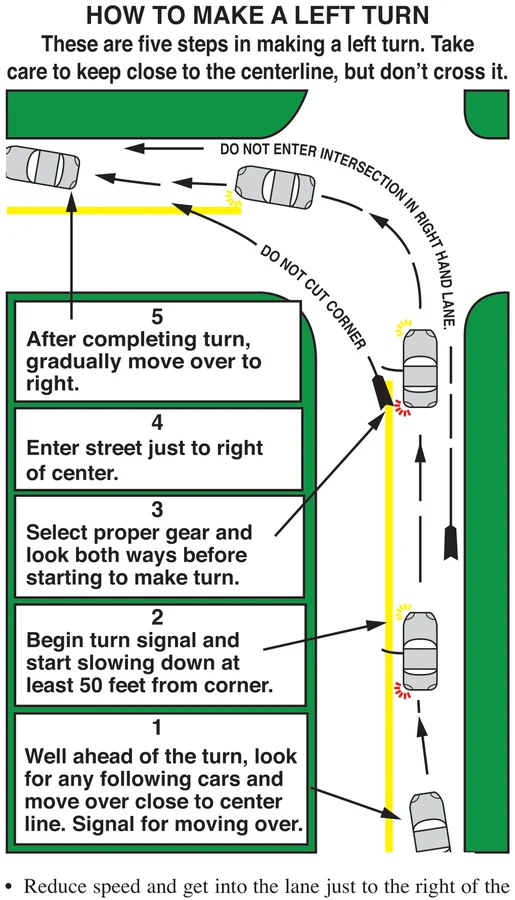
How to make a left turn

Know the rule

When two drivers meet at an intersection and both turn left, each turns to the left of the other. Never turn wide into the right lane — oncoming right-turners use it.

Handbook p. 70 ↗

Know the rule

If the light turns yellow while you wait for oncoming traffic, don't pull into the intersection.

Handbook p. 71 ↗

Know the rule

Center lines on two-way streets are yellow; on one-way streets they're white. Watch for 'one-way' signs before turning.

Handbook p. 71 ↗

Know the rule

Left on red is allowed only from a one-way street onto a one-way street moving the way you're turning, after a full stop, unless 'No Turn on Red' is posted. You may NOT turn left on red from a one-way onto a two-way street.

Handbook p. 71 ↗

Know the rule

With multiple turn lanes, stay in your lane through the turn. A second lane may make the same turn only if signs or markings allow it.

Handbook p. 72 ↗

Right turns

  • Well ahead, check behind and beside you
  • Get close to the right curb without crowding walkers, cyclists or parked cars
  • Signal for at least 50 feet
  • Look left and right and check for pedestrians and bicyclists
  • Turn into the lane closest to the right curb — don't swing wide
Handbook p. 72 ↗

Know the rule

Turning right on red: stop completely before the marked or unmarked crosswalk or stop line, then yield to oncoming traffic, pedestrians and bicyclists.

Handbook p. 72 ↗

Know the rule

Large trucks and buses must make wide right turns and may leave space on their right. Don't pass a truck on the right if it might turn right.

Handbook p. 72 ↗

Put it into practice

You're heading west on a one-way street and want to turn left onto a two-way street. Start from the far-left lane, drive into the intersection before turning, and turn sharply into the first lane right of the yellow line. If your light is red, you must wait — no left on red here.

Check your understanding

Read the question, decide on an answer, then open it to check the explanation. These are Roadwise study questions based on the source handbook.

When making a left turn from a two-way street onto another two-way street, you should turn into:
  1. The second lane past the center line
  2. The far right lane of the new street
  3. Whichever lane has less traffic
  4. The first lane past the center line

Answer: The first lane past the center line

You should turn into the first lane just to the right of the center line of the street you're entering.
Handbook p. 71 ↗
When turning left from a one-way street onto a two-way street, you should:
  1. Turn sharply into the first lane right of the yellow line
  2. Turn wide into the far right lane
  3. Start turning at the crosswalk
  4. Turn into the lane nearest the left curb

Answer: Turn sharply into the first lane right of the yellow line

From a one-way street onto a two-way street, turn into the intersection first, then sharply into the first lane right of the yellow line.

Handbook p. 71 ↗
A left turn on red is permitted only when:
  1. Turning from any street onto any other street
  2. Turning from a one-way street onto another one-way street
  3. The intersection has no traffic at all
  4. You are turning from a two-way street onto a one-way street

Answer: Turning from a one-way street onto another one-way street

A left turn on red is allowed only when going from a one-way street onto another one-way street, after a complete stop.

Handbook p. 71 ↗
Before making a right turn on red, you must:
  1. Slow to a rolling stop only
  2. Signal but you do not need to stop
  3. Come to a complete stop before the crosswalk or stop line
  4. Wait for a green arrow only

Answer: Come to a complete stop before the crosswalk or stop line

Before turning right on red, you must first come to a complete stop before the marked or unmarked crosswalk or stop line.

Handbook p. 72 ↗
Large trucks and buses making right turns often need to first:
  1. Hug the right curb tightly
  2. Move onto the right shoulder
  3. Slow to a full stop at the corner
  4. Swing wide to the left before turning right

Answer: Swing wide to the left before turning right

Large trucks and buses must make wide turns, sometimes swinging left first to safely complete a right turn.

Handbook p. 72 ↗
You should turn your wheels toward your turn direction while waiting for oncoming traffic to clear, so you are ready to go.
  1. True
  2. False

Answer: False

You should keep your wheels straight while waiting; if hit from behind, turned wheels could push you into oncoming traffic.

Handbook p. 70 ↗
Take the lesson checkpoint in the app

More in Turning, Passing & Lane Use