roadwise.Open study app

Tennessee driving lesson · Turning, Passing & Lane Use

Lane use & special lanes

A 4-minute lesson from the Tennessee course. Read the rules and examples, follow the handbook page references, and check your understanding before you move on.

Read time
4 minutes
Course unit
Turning, Passing & Lane Use
Checkpoint questions
6
Source pages
73, 74, 75

'White on your right, yellow on your left' sums up how American roads work: keep right except to pass or turn left. Special lanes — center turn lanes, reversible lanes and reserved lanes — each have their own rules.

Know the rule

On a road with no center line and traffic both ways, give oncoming drivers at least half the road.

Handbook p. 73 ↗

Know the rule

Drive on the right except when passing, going around an obstruction (go around it on the right when possible), on a one-way road, or turning left.

Handbook p. 73 ↗

Know the rule

Two-lane highways have a broken yellow center line. Four-lane highways have two solid yellow center lines with dashed white lines between same-direction lanes — use the right lane except to pass or turn left.

Handbook p. 73 ↗

Know the rule

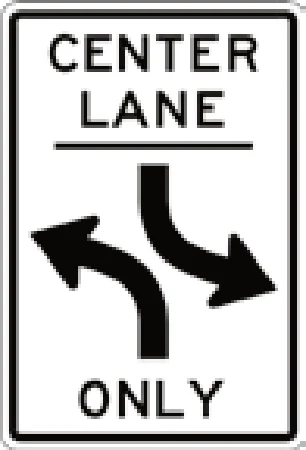
The center lane of a two-way, three-lane or five-lane highway is used only for turning left.

Handbook p. 73 ↗

Know the rule

On a divided highway use the roadway on your right and never cross the median except at an authorized crossover or intersection. In a crossover, keep to its right side; if a car is already waiting there, wait in the left lane with your signal on. Interstates have no crossovers.

Handbook p. 74 ↗

Know the rule

Red reflectors facing you on lane lines, or WRONG WAY / DO NOT ENTER signs, mean you're going the wrong way. Red reflectors on edge lines mean you're on the wrong ramp — pull over immediately.

Handbook p. 74 ↗

Two-way left-turn lane

A center lane, marked with solid and broken yellow lines, for left turns from either direction. Never use it for passing.

Handbook p. 74 ↗
300 feet

Maximum distance you may travel in a shared center turn lane

Handbook p. 74 ↗

Know the rule

Enter the center turn lane just before your turn. You may turn into it from a side street and wait to merge right. If cars enter from opposite ends, the first one in has the right-of-way.

Handbook p. 74 ↗
Center lane left turn only (two-way left turn)
Center lane left turns only

Know the rule

Dual-use lanes show a turn arrow and a straight arrow — you may turn or go straight, following normal right-of-way rules unless there's a protected arrow.

Handbook p. 74 ↗

Know the rule

Reversible lanes, usually marked with double broken yellow lines, change direction at different times. Check the overhead signals: a steady yellow X means the lane is changing — get out when safe.

Handbook p. 75 ↗

Know the rule

Reserved lanes (often marked with a white diamond) are only for the vehicles shown — buses, bikes or HOVs — unless you're turning across them within the next half block. 'HOV 2' means at least two people in the car.

Handbook p. 75 ↗

Safe lane change

  • Check space ahead and behind
  • Check your rearview mirrors
  • Signal
  • Look over your shoulder in the direction you're moving
  • Check your blind spots
  • Change lanes gradually
Handbook p. 75 ↗

Put it into practice

You want to turn left into a store on a five-lane road. Signal, move into the center turn lane just before the store, and wait there for a gap. Don't drive a block in it to reach the next traffic light.

Check your understanding

Read the question, decide on an answer, then open it to check the explanation. These are Roadwise study questions based on the source handbook.

On a four-lane highway with two-way traffic, in which lane should you normally drive?
  1. The far left lane at all times
  2. Any lane, since all lanes are equal
  3. The left lane, away from merging traffic
  4. The right lanes, except when passing or turning left

Answer: The right lanes, except when passing or turning left

On a four-or-more lane roadway, drive in the right lanes except when passing another vehicle or turning left.
Handbook p. 73 ↗
The center lane of a two-way, three-lane highway is reserved for:
  1. Left turns only
  2. Passing slower traffic
  3. High-speed through travel
  4. Emergency vehicles only

Answer: Left turns only

The center lane of a three-lane (or five-lane) two-way highway is used only for turning left.

Handbook p. 73 ↗
A shared center left-turn lane cannot be used for travel farther than:
  1. 50 feet
  2. 300 feet
  3. 1 mile
  4. There is no distance limit

Answer: 300 feet

Shared center turn lanes cannot be used for passing and cannot be used for travel farther than 300 feet.

Handbook p. 74 ↗
In a shared center turn lane, if two vehicles enter from opposite directions at the same time, who has the right-of-way?
  1. The first vehicle to enter the lane
  2. The vehicle turning onto the busier road
  3. The larger of the two vehicles
  4. The vehicle on the right

Answer: The first vehicle to enter the lane

When vehicles enter a shared center turn lane from opposite directions, the first vehicle to enter has the right-of-way.

Handbook p. 74 ↗
On a reversible lane system, what does a steady yellow 'X' displayed above a lane mean?
  1. You may drive in that lane freely
  2. The lane is for turning only
  3. The lane is permanently closed
  4. The lane's direction is changing; move out of it when safe

Answer: The lane's direction is changing; move out of it when safe

A steady yellow X means the lane's use or direction is changing, and you should move out of it as soon as it's safe.

Handbook p. 75 ↗
Before changing lanes on a multi-lane highway, you should always:
  1. Simply check your mirrors, nothing else is needed
  2. Only signal after you begin moving into the new lane
  3. Mirrors, signal, and a shoulder check
  4. Speed up first, then signal

Answer: Mirrors, signal, and a shoulder check

Safe lane changes require checking mirrors, signaling, and looking over your shoulder to check blind spots before moving.

Handbook p. 75 ↗
Take the lesson checkpoint in the app

More in Turning, Passing & Lane Use