Freeways have no crossroads, lights or pedestrians, but higher speeds mean you must think, anticipate and act sooner. Use the right lanes, signal every lane change, and never treat the speed limit as a target in bad conditions.
Limited access highway
A road such as an interstate or freeway built so traffic flows freely. 'Limited access' means there are no intersections.
Handbook p. 35 ↗Freeway lanes
| Lane | Use |
|---|---|
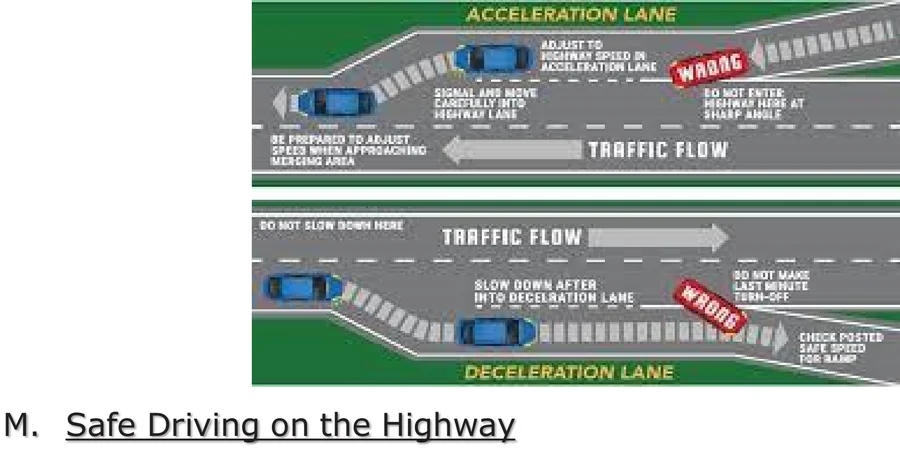
| Acceleration lane | Speed up to match traffic before merging |
| Merging area | Beyond the acceleration lane, where you merge into traffic |
| Far-left lane | Passing (trucks, buses banned where posted) |
| Middle lane(s) | Through traffic |
| Right lane | Slower traffic; entering and exiting |
| Deceleration lane | Slow to the exit-ramp speed |
Rhode Island speed limits
| Where | Limit |
|---|---|
| Residential areas | 25 mph |
| Most highways | 50–65 mph |
Basic Speed Law
Drive only as fast as conditions allow. The posted limit is the maximum for ideal conditions; slow down for snow, rain, sleet, ice or construction.
Handbook p. 36 ↗Know the rule
If you must stop for a mechanical or other emergency, signal and move into the breakdown lane; watch for vehicles wrongly using it. For repairs, get all four wheels off the pavement and turn on hazard lights; use flares, reflectors or triangles if available.
Handbook p. 35 ↗Highway hypnosis
A condition caused by long periods of driving. Pull off to a designated safe area (not the breakdown lane), get out, relax and take refreshments.
Handbook p. 35 ↗Recommended rest stop interval on long trips
Handbook p. 35 ↗Know the rule
If you're tailgated, change lanes or let the driver pass. Never speed up and never slam on your brakes.
Handbook p. 35 ↗Highway safety rules:
- Change your speed occasionally on long trips
- Check mirrors; never pass until sure no one is coming in the passing lane
- Signal lane changes early—within 100 feet
- Drive in the right lane unless passing or posted; slow traffic keeps right
- Missed your exit? Go to the next one—never stop and back up
- Take extra care when buses stop to load passengers
Know the rule
Never stop in a traffic lane. If you need help, raise your hood, tie a white cloth to the door handle and stay in your locked vehicle.
Handbook p. 36 ↗Know the rule
Give emergency vehicles the right-of-way: pull right, stop and let them pass; before re-entering, signal and look over your shoulder for another one. Always stay 500 feet behind emergency vehicles.
Handbook p. 36 ↗Know the rule
Move Over Law: on a road with multiple lanes in your direction, change lanes away from the designated vehicle as soon as it is safe; if you can't safely move over, slow down.
Handbook p. 36 ↗Put it into practice
On I-95 you see a police car stopped on the right shoulder with lights flashing. Signal and move one lane left as soon as it's safe. If traffic beside you blocks the move, slow down as you pass.