roadwise.Open study app

Rhode Island driving lesson · Basic Driving Skills & Safety Rules

Turnabouts

A 3-minute lesson from the Rhode Island course. Read the rules and examples, follow the handbook page references, and check your understanding before you move on.

Read time
3 minutes
Course unit
Basic Driving Skills & Safety Rules
Checkpoint questions
5
Source pages
30, 31

A turnabout turns your car around to go the opposite way. You may be asked to do one on your road test. There are four types; choose the one that is safest for the traffic and the street you're on.

Before any turnabout, make sure:

  • No sign prohibits it (such as No U Turn), and local rules allow it
  • You won't cross a solid yellow line—you can't at any time
  • You can see 500 feet in each direction
  • No hills or curves nearby block your view
  • You're at least 200 feet from an intersection
  • There's room to finish, traffic is light, and no pedestrians are in your path
Handbook p. 30 ↗
500 ft

Clear visibility needed in each direction for a turnabout

Handbook p. 30 ↗
200 ft

Minimum distance from an intersection for a turnabout

Handbook p. 30 ↗

Know the rule

In Rhode Island you may make a U-turn only when it is allowed and does not interfere with the free flow of traffic in either direction.

Handbook p. 30 ↗

U-turn steps:

  • Signal and pull to the right curb and stop
  • Signal with your left turn signal or four-way hazards
  • Check traffic both ways
  • When clear, turn the wheel fully left and drive slowly around
  • Cancel the signal or hazards
Handbook p. 30 ↗

Backing into a driveway or side street on the right:

  • Signal and pull to the right, past the driveway
  • Check for pedestrians and traffic both ways
  • Back up slowly, turning the wheel right
  • Straighten and stop once past the curb line
  • Check traffic, signal and drive forward into the street
Handbook p. 30 ↗

Know the rule

Pulling into a street or driveway on the left and backing out is more hazardous, because you back into the travel lane. Choose one with clear visibility both ways.

Handbook p. 30 ↗

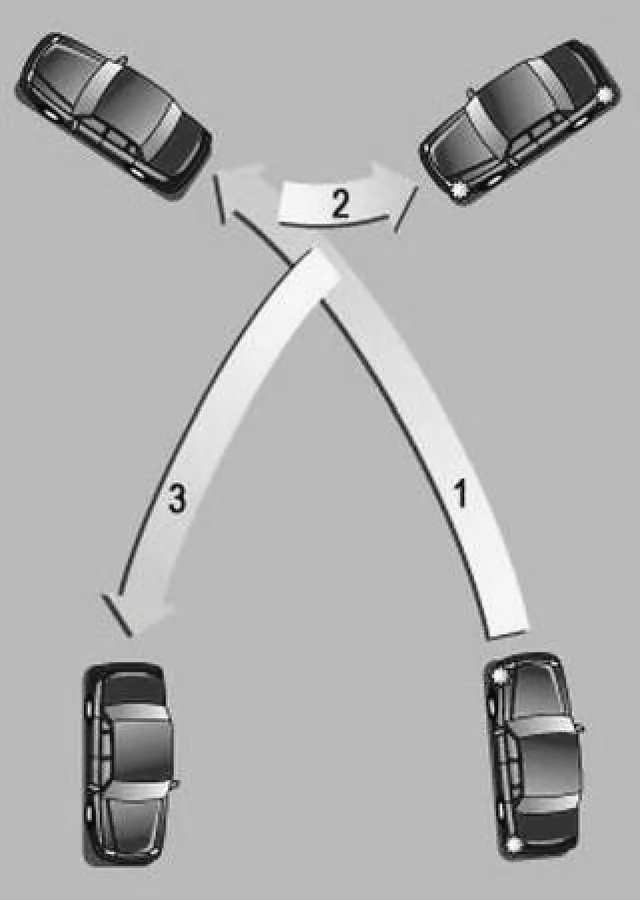
Three-point turn (for narrow streets):

  • Pull to the right, stop, signal left or use hazards
  • Turn fully left and creep forward across the street; stop before the curb
  • Check traffic, turn fully right and back up until the car's front is mid-street; stop
  • Check traffic, turn left and drive off; cancel the signal
Handbook p. 31 ↗
Three-point turn (turnabout)
Three-point turn

Put it into practice

On a narrow residential street with good visibility 500 feet each way and the nearest intersection 300 feet back, you can use a three-point turn. If the street had a hill blocking your view, pick another spot.

Check your understanding

Read the question, decide on an answer, then open it to check the explanation. These are Roadwise study questions based on the source handbook.

How much clear visibility in each direction do you need before attempting a turnabout?
  1. 200 feet
  2. 100 feet
  3. 500 feet
  4. 1,000 feet

Answer: 500 feet

Before a turnabout, you need clear visibility in each direction for a distance of 500 feet.
Handbook p. 30 ↗
How far from an intersection must you be to safely perform a turnabout?
  1. At least 500 feet
  2. At least 100 feet
  3. At least 50 feet
  4. At least 200 feet

Answer: At least 200 feet

You must be at least 200 feet from an intersection to safely perform a turnabout.

Handbook p. 30 ↗
Which of these is a valid reason NOT to attempt a turnabout at a chosen spot?
  1. The street has a speed limit under 40 mph
  2. There is a stop sign 400 feet away
  3. A hill or curve nearby obstructs your view
  4. It is a two-lane road with light local traffic

Answer: A hill or curve nearby obstructs your view

You should not attempt a turnabout where hills or curves could obstruct your view of oncoming traffic.

Handbook p. 30 ↗
Which turnabout maneuver is described as more hazardous because you back into the travel lane?
  1. The three-point turn
  2. Pulling into a street or driveway on the left
  3. The U-turn
  4. Backing into a driveway on the right

Answer: Pulling into a street or driveway on the left

Pulling into a street or driveway on the left is more hazardous because you back into the travel lane.

Handbook p. 30 ↗
True or False: You may cross a solid yellow line to complete a legal U-turn.
  1. True
  2. False

Answer: False

You cannot cross a solid yellow line at any time, including to make a turnabout.

Handbook p. 30 ↗
Take the lesson checkpoint in the app

More in Basic Driving Skills & Safety Rules