A 3-minute lesson from the Rhode Island course. Read the rules and examples, follow the handbook page references, and check your understanding before you move on.
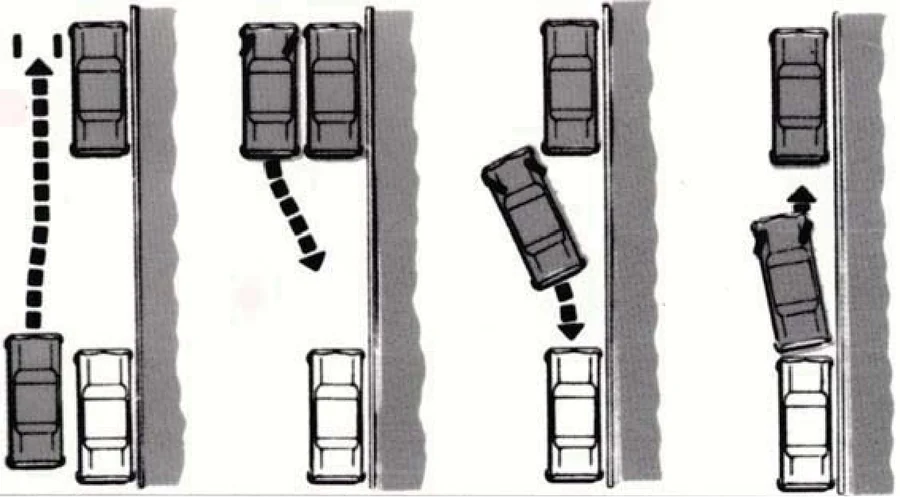
A real stop is a full stop—long enough to look properly. This lesson covers where to stop, who goes first at a four-way stop, how to parallel park and pull out, start on a hill, and leave a driveway.
3 seconds
Minimum time to completely stop all forward motion: look left, right, center, left again, then go
Hill start on the road test: the examiner has you pull right, stop, set the parking brake and shift to neutral—the parking brake must hold the car. To start, look over your left shoulder, shift into gear, signal, release the brake and drive out.
You and another car reach a four-way stop at the same moment; it is on your right. Yield and let it go first. A third car that pulls up after you must wait for you.
Check your understanding
Read the question, decide on an answer, then open it to check the explanation. These are Roadwise study questions based on the source handbook.
For how long should drivers completely cease forward motion when stopping, per the handbook?
A minimum of one second
A minimum of ten full seconds
There is no minimum time
A minimum of three seconds
Answer: A minimum of three seconds
When stopping, drivers should completely cease all forward motion for a minimum of three seconds.
You approach a stop sign where there is no crosswalk but there is a clearly marked stop line. Where must you stop?
Beside the stop sign post
At the stop line
At the point nearest the cross street
Past the line, where you can see traffic
Answer: At the stop line
Under RIGL 31-20-9, stop before the crosswalk; with no crosswalk, stop at a clearly marked stop line; only if there's no line, stop nearest the cross street.