roadwise.Open study app

Rhode Island driving lesson · Signals & Roadway Markings

Hand Signals & Roadway Lines

A 3-minute lesson from the Rhode Island course. Read the rules and examples, follow the handbook page references, and check your understanding before you move on.

Read time
3 minutes
Course unit
Signals & Roadway Markings
Checkpoint questions
6
Source pages
38

Signals tell other drivers what you're about to do; pavement lines tell you what you're allowed to do. Line color says which way traffic flows, and whether the line is solid or broken says whether you may cross it.

Know the rule

Rhode Island law requires a signal—by hand or with directional lights—when driving out of a parking space and at least 100 feet before making a turn. Give every signal in time for drivers behind you.

Handbook p. 38 ↗

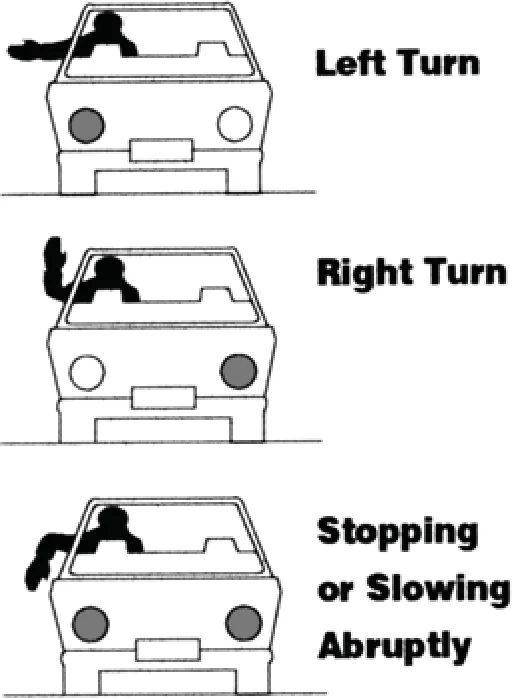
Hand signals (left arm, held still)

Hand signals (left arm, held still)
SignalArm position
Left turnStraight out
Right turnUp
Stop or slow downDown
Handbook p. 38 ↗
Hand signals (left turn / right turn / stop)
Hand signals: left turn, right turn, stop or slow

What the lines mean

What the lines mean
LineMeaning
YellowSeparates traffic moving in opposite directions
WhiteSeparates traffic moving in the same direction
SolidNo passing or lane changes; cross only for exceptions
BrokenPassing allowed (yellow or white); lane changes (white)
Single or double solid yellowNo passing; don't cross except legal turns etc.
Broken yellowOpposite directions; passing permitted with care
Solid white at edgePassing and lane changes restricted
Broken whiteYou may pass and change lanes
Handbook p. 38 ↗

You may cross a solid line for:

  • A legal left or right turn
  • A breakdown
  • An object or vehicle in the roadway
  • Parking
Handbook p. 38 ↗

Know the rule

A solid line beside a broken line: if the solid line is on your side, don't pass or cross it (except for emergencies and legal turns). If the broken line is on your side, you may pass with care.

Handbook p. 38 ↗

Know the rule

Solid white lines usually mark the far right or left of the road—carpool, restricted, breakdown or parking lanes.

Handbook p. 38 ↗

Other roadway markings include:

  • Crosswalks and 'Xing'
  • RR (railroad) markings and stop lines
  • Parking lanes
  • Reversible lanes, restricted lanes and shared turn lanes
Handbook p. 38 ↗

Put it into practice

On a two-lane road you're behind a slow truck. Your side of the center has a solid yellow line; the other side has a broken line. You may not pass—even though oncoming drivers are allowed to.

Check your understanding

Read the question, decide on an answer, then open it to check the explanation. These are Roadwise study questions based on the source handbook.

How far before a turn must you begin signaling, at minimum?
  1. At least 50 feet
  2. At least 20 feet
  3. At least 100 feet
  4. At least 200 feet

Answer: At least 100 feet

RI law requires a signal, by hand or directional lights, at least 100 feet before making a turn.
Handbook p. 38 ↗
What does it mean to hold your left hand and arm straight out from the vehicle?
  1. A hand signal for a right turn
  2. A hand signal for stopping
  3. A hand signal for backing up
  4. A hand signal for a left turn

Answer: A hand signal for a left turn

To signal a left turn by hand, put your left hand and arm straight out, keeping them still.

Handbook p. 38 ↗
What do solid roadway lines indicate to drivers?
  1. Passing and lane changes are not permitted
  2. Passing is allowed with care
  3. Lane changes are allowed, but not passing
  4. The lane is reserved for turning

Answer: Passing and lane changes are not permitted

Solid lines separate lanes of traffic, and motorists are not permitted to pass or change lanes across them.

Handbook p. 38 ↗
On a two-lane road, the solid line is on your side and the broken line is on the other driver's side. Which is true?
  1. You may pass with care; the other driver may not
  2. Neither driver may pass
  3. You may not pass; the other driver may pass with care
  4. Both drivers may pass with care

Answer: You may not pass; the other driver may pass with care

Motorists with the solid line on their side should not pass; motorists with the broken line on their side may pass with care.

Handbook p. 38 ↗
What do yellow lines on a roadway separate?
  1. Traffic traveling in the same direction
  2. Parking spaces from travel lanes
  3. Traffic traveling in opposite directions
  4. Bicycle lanes from adjacent vehicle travel lanes

Answer: Traffic traveling in opposite directions

Yellow lines separate traffic traveling in opposite directions, while white lines separate traffic in the same direction.

Handbook p. 38 ↗
What hand position signals a stop or slowdown?
  1. Left hand and arm up
  2. Left hand and arm down
  3. Left hand and arm straight out
  4. Right arm straight out the passenger window

Answer: Left hand and arm down

To signal a stop or slowdown by hand, put your left hand and arm down, keeping them still.

Handbook p. 38 ↗
Take the lesson checkpoint in the app

More in Signals & Roadway Markings