roadwise.Open study app

Rhode Island driving lesson · Signals & Roadway Markings

Roundabouts & Rotaries

A 3-minute lesson from the Rhode Island course. Read the rules and examples, follow the handbook page references, and check your understanding before you move on.

Read time
3 minutes
Course unit
Signals & Roadway Markings
Checkpoint questions
6
Source pages
40, 41

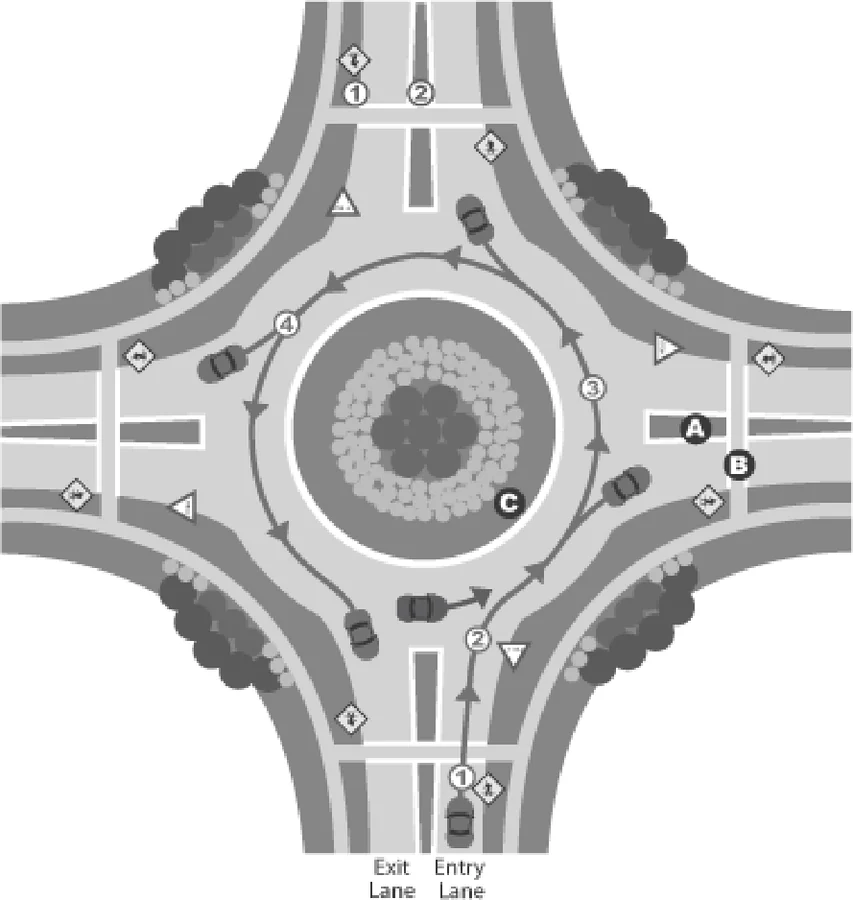
A roundabout is a circular intersection that moves traffic counterclockwise around a center island. It slows traffic while reducing delays, and it uses yield signs, directional signs and pavement markings instead of stop signs or signals.

Know the rule

Before a roundabout you'll see a yellow diamond warning sign showing a circle with two or more arrows pointing away—the exits.

Handbook p. 40 ↗
Roundabout diagram
Single-lane roundabout: A = splitter island, B = crosswalk, C = center island

Motorist duties in a roundabout:

  • Slow to the posted speed; yield to pedestrians and other motorists
  • Wait for an adequate safe gap; use the proper lane position
  • ENTER: yield to vehicles already in the roundabout, then merge counterclockwise
  • PROCEED: keep going until your street; never stop unless it's an emergency
  • EXIT: signal, exit to the right, and yield to pedestrians
Handbook p. 40 ↗

Know the rule

The handbook describes single-lane roundabouts; many states use multi-lane roundabouts, so plan ahead.

Handbook p. 40 ↗

Cyclists in a roundabout:

  • Generally walk the bicycle across the pedestrian crosswalk
  • Experienced cyclists may ride it like a motorist
  • Ride in the middle of the lane, not near the curb, so vehicles don't pass them
  • Yield to pedestrians in crosswalks
Handbook p. 41 ↗

Pedestrians at a roundabout:

  • Look left for oncoming vehicles and bicycles
  • Cross to the raised or painted splitter island (refuge)
  • Look right, then finish crossing
  • Never walk through the roundabout or across the center island
Handbook p. 41 ↗

Know the rule

R.I.G.L. 31-17-8: with no sign or signal, a driver entering a rotary—from any direction—must yield the right-of-way to all vehicles already in the rotary.

Handbook p. 41 ↗

Put it into practice

You reach a roundabout and a car is already circling toward you from the left. Yield, wait for a safe gap, then merge counterclockwise. At your street, signal right, exit and yield to anyone in the crosswalk.

Check your understanding

Read the question, decide on an answer, then open it to check the explanation. These are Roadwise study questions based on the source handbook.

In which direction does traffic move through a Rhode Island roundabout?
  1. Counterclockwise
  2. Clockwise
  3. Either direction, driver's choice
  4. Straight through only

Answer: Counterclockwise

Roundabouts direct traffic in a counterclockwise direction around a center island.
Handbook p. 40 ↗
What traffic control does a roundabout use to control vehicles entering it?
  1. Stop signs
  2. Traffic signals
  3. Yield signs
  4. Flashing red lights

Answer: Yield signs

Roundabouts use yield signs, directional signs, and pavement markings instead of stop signs or traffic signals.

Handbook p. 40 ↗
Who has the right-of-way when entering a roundabout?
  1. The entering vehicle, always
  2. Vehicles approaching from the right
  3. Vehicles and pedestrians already in the roundabout
  4. Whoever arrives first, regardless of their position

Answer: Vehicles and pedestrians already in the roundabout

You must yield to pedestrians and to vehicles already in the roundabout before entering.

Handbook p. 40 ↗
What should pedestrians do while crossing at a roundabout, according to the handbook?
  1. Cross directly through the center island for the shortest path
  2. Cross without stopping at the splitter island
  3. Wait for a police officer to direct them
  4. Cross to the splitter island, then look right and finish

Answer: Cross to the splitter island, then look right and finish

Pedestrians should cross to the splitter or refuge, then look right before finishing the crossing on the far side.

Handbook p. 41 ↗
Under RIGL 31-17-8, who must yield when entering a rotary with no traffic control device present?
  1. Vehicles already in the rotary, to entering traffic
  2. The driver approaching from the right
  3. Whichever driver reaches the rotary first
  4. The driver entering the rotary, to vehicles already in it

Answer: The driver entering the rotary, to vehicles already in it

RIGL 31-17-8 requires a driver about to enter a rotary to yield to all vehicles already in the rotary.

Handbook p. 41 ↗
True or False: If traffic in a roundabout is heavy, you may stop inside it to wait for a gap at your exit.
  1. True
  2. False

Answer: False

Continue through the roundabout until you reach your street; never stop in a roundabout unless it is an emergency.

Handbook p. 40 ↗
Take the lesson checkpoint in the app

More in Signals & Roadway Markings