roadwise.Open study app

Rhode Island driving lesson · Signals & Roadway Markings

Arrows, Flashing Signals & Pedestrian Signals

A 3-minute lesson from the Rhode Island course. Read the rules and examples, follow the handbook page references, and check your understanding before you move on.

Read time
3 minutes
Course unit
Signals & Roadway Markings
Checkpoint questions
6
Source pages
41, 42, 53

Arrows control a single direction of travel. Flashing lights change a signal's meaning entirely. And special signals—like the HAWK beacon—exist just for pedestrians.

Arrows and flashing signals

Arrows and flashing signals
SignalMeaning
Flashing redFull stop; yield to vehicles on right and left—a stop sign
Flashing yellowSlow down, cover the brake, proceed with caution
Green arrowYou may go in the arrow's direction (protected turn)
Red arrowStop; you may not go in the arrow's direction
Flashing yellow arrowTurn only after yielding to oncoming traffic and pedestrians
Handbook p. 41 ↗

Protected turn lane

A marked turn lane with an arrow signal. When the green arrow shows, turning traffic is protected from oncoming traffic.

Handbook p. 41 ↗

Know the rule

When a red arrow goes out, it is followed by a green arrow, a steady green light or a flashing yellow arrow.

Handbook p. 41 ↗

Know the rule

With a flashing yellow arrow, oncoming traffic has a steady green light—so you must yield before turning.

Handbook p. 41 ↗

Know the rule

If there is a turn lane, get into it well before the intersection, signal, and turn without interfering with other traffic.

Handbook p. 41 ↗

Stale green light

A light that has been green for a while.

Handbook p. 42 ↗

Fresh green light

A light that has just turned green.

Handbook p. 42 ↗

HAWK

High-Intensity Activated Crosswalk beacon, used to let pedestrians cross a street safely.

Handbook p. 42 ↗
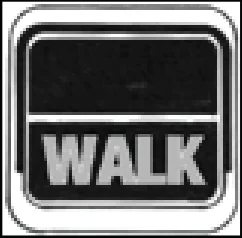
Pedestrian walk signal
Pedestrian WALK signal

Know the rule

Pedestrians must follow Walk and Don't Walk signals; if facing a yellow or red light, they may cross only when a Walk signal is showing.

Handbook p. 53 ↗

Put it into practice

You're waiting to turn left and the signal shows a flashing yellow arrow. Oncoming traffic has a green light, so wait for a gap and for pedestrians to clear before turning.

Check your understanding

Read the question, decide on an answer, then open it to check the explanation. These are Roadwise study questions based on the source handbook.

What does a flashing red traffic light require you to do?
  1. Slow down and proceed without stopping
  2. Treat it as a yield sign only
  3. Stop only if other vehicles are present
  4. Make a full stop and yield, as with a stop sign

Answer: Make a full stop and yield, as with a stop sign

A flashing red signal should be treated exactly like a stop sign: make a full stop and yield the right-of-way.
Handbook p. 41 ↗
What does a flashing yellow light instruct a driver to do?
  1. Slow down, cover the brake, and proceed with caution
  2. Stop completely as with a red light
  3. Speed up to clear the intersection
  4. Treat it exactly like a green light with no caution needed

Answer: Slow down, cover the brake, and proceed with caution

A flashing yellow light tells drivers to slow down, cover the brake, and proceed with caution.

Handbook p. 41 ↗
What does a flashing yellow arrow mean for a left turn?
  1. You have the exclusive right-of-way to turn
  2. You may turn after yielding to oncoming traffic
  3. You must stop and wait for a steady green arrow
  4. Oncoming traffic also has a red light

Answer: You may turn after yielding to oncoming traffic

A flashing yellow arrow allows a turn only after yielding, since oncoming traffic has a steady green light at the same time.

Handbook p. 41 ↗
What is a 'protected turn lane', as described in the handbook?
  1. Any lane marked with a solid white line
  2. A turn lane where a green arrow protects you
  3. A lane reserved exclusively for buses
  4. A lane used only during rush hour

Answer: A turn lane where a green arrow protects you

A protected turn lane has a green arrow signal that protects motorists turning from oncoming traffic.

Handbook p. 41 ↗
What is the difference between a 'stale' and a 'fresh' green light?
  1. A stale light has been green for a while; a fresh light just turned green
  2. A stale light just turned green; a fresh light has been green a while
  3. A stale green light is flashing; a fresh green light is steady
  4. A stale green light is an arrow; a fresh green light is a full circle

Answer: A stale light has been green for a while; a fresh light just turned green

A stale green light has been green for a while, while a fresh green light has just turned green.

Handbook p. 42 ↗
What does a HAWK signal do?
  1. Warns of an approaching train
  2. Lets pedestrians safely cross a street
  3. Signals that a school bus is about to stop ahead
  4. Indicates a reversible lane change

Answer: Lets pedestrians safely cross a street

HAWK (High-Intensity Activated Crosswalk) is used to let pedestrians safely cross a street.

Handbook p. 42 ↗
Take the lesson checkpoint in the app

More in Signals & Roadway Markings