roadwise.Open study app

Pennsylvania driving lesson · Space, Speed and Conditions

Signals, brake lights and your horn

A 3-minute lesson from the Pennsylvania course. Read the rules and examples, follow the handbook page references, and check your understanding before you move on.

Read time
3 minutes
Course unit
Space, Speed and Conditions
Checkpoint questions
6
Source pages
48, 49

Crashes often happen because one driver does something another doesn't expect. Tell other drivers where you are and what you plan to do, early and clearly. Pennsylvania sets exact distances for turn signals.

Know the rule

Your brake lights tell others you're slowing or stopping. If you'll brake where others may not expect it, quickly tap the brake pedal three or four times.

Handbook p. 48 ↗
Below 40 mph

On a limited access highway, use your hazard (four-way) flashers to warn drivers behind you

Handbook p. 48 ↗

Know the rule

Signaling tells others you want to turn, but it does not give you the right to turn.

Handbook p. 48 ↗

Turn signal distance (PA law)

Turn signal distance (PA law)
Your speedSignal at least
Less than 35 mph100 feet before turning
35 mph or more300 feet before turning
Handbook p. 48 ↗

Know the rule

As a timing guide, signal three to four seconds before your turn.

Handbook p. 49 ↗
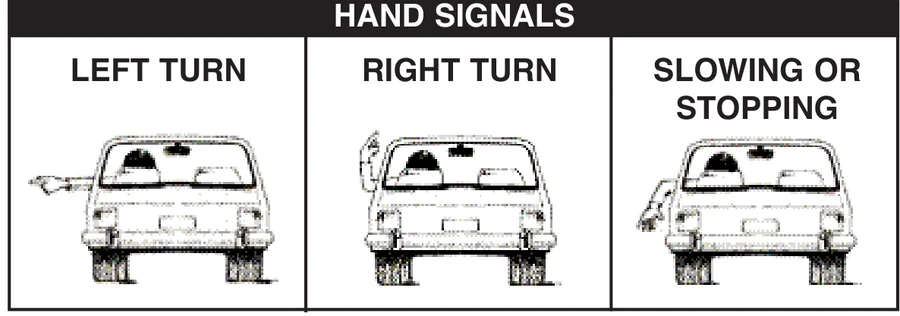
Hand signals (left turn / right turn / slow-stop)
Hand signals: left turn, right turn, slowing or stopping

Know the rule

If your turn signals don't work, use hand signals.

Handbook p. 48 ↗

Know the rule

If you break down, signal, carefully leave the roadway and turn on your hazard flashers. Get as far off the road as possible where others can easily see you, and lift your hood to show you're disabled.

Handbook p. 48 ↗

Know the rule

Use your horn when a driver or pedestrian doesn't see you, such as a child starting to run into the street or a vehicle about to hit you. Also sound it if you lose control of your vehicle.

Handbook p. 48 ↗

Put it into practice

You're driving 40 mph and plan to turn right into a shopping center. Turn on your signal at least 300 feet before the driveway; at 30 mph, 100 feet would be the minimum.

Check your understanding

Read the question, decide on an answer, then open it to check the explanation. These are Roadwise study questions based on the source handbook.

How far before a turn must you signal if you are driving less than 35 mph?
  1. At least 100 feet before turning
  2. At least 300 feet before turning
  3. At least 50 feet before turning
  4. Signaling isn't required under 35 mph

Answer: At least 100 feet before turning

PA law requires signaling at least 100 feet before turning when driving under 35 mph.

Handbook p. 48 ↗
How far before a turn must you signal if driving 35 mph or more?
  1. At least 100 feet before turning
  2. At least 300 feet before turning
  3. At least 500 feet before turning
  4. At least 50 feet before turning

Answer: At least 300 feet before turning

At 35 mph or more, you must signal at least 300 feet before turning.

Handbook p. 48 ↗
You must signal at least 300 feet before turning if driving 35 mph or faster.
  1. True
  2. False

Answer: True

PA law requires an earlier signal, 300 feet, at higher speeds.

Handbook p. 48 ↗
You need to brake where drivers behind you may not expect it. What should you do?
  1. Turn on your four-way flashers
  2. Quickly tap the brake pedal three or four times
  3. Sound your horn twice
  4. Signal a right turn

Answer: Quickly tap the brake pedal three or four times

Tapping the brake pedal three or four times flashes your brake lights to warn drivers behind you.

Handbook p. 48 ↗
If you must drive below what speed on a limited access highway, you should use your hazard (four-way) flashers?
  1. 25 mph
  2. 35 mph
  3. 40 mph
  4. 45 mph

Answer: 40 mph

Below 40 mph on a limited access highway, use your four-way flashers to warn the drivers behind you.

Handbook p. 48 ↗
Your car breaks down on the highway. After pulling as far off the road as possible and turning on your flashers, what else does the handbook say to do?
  1. Lift your hood
  2. Stand behind the car and wave traffic by
  3. Leave your turn signal on
  4. Turn on your high beams

Answer: Lift your hood

Park where others can see you easily and lift the hood to let drivers know your vehicle is disabled.
Handbook p. 48 ↗
Take the lesson checkpoint in the app

More in Space, Speed and Conditions