A 4-minute lesson from the Pennsylvania course. Read the rules and examples, follow the handbook page references, and check your understanding before you move on.
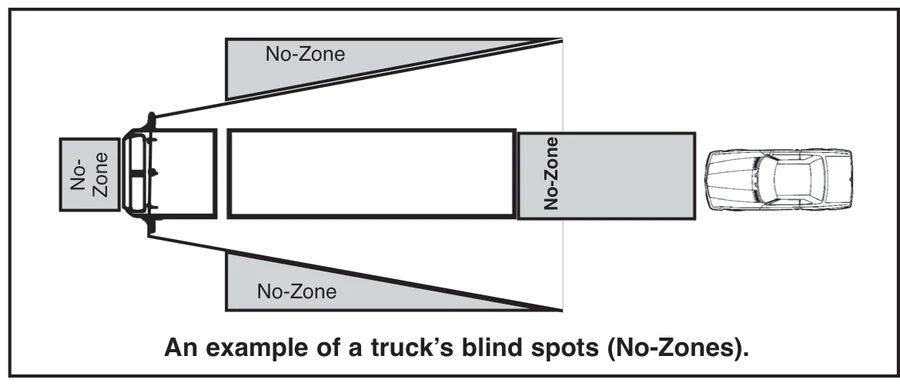
Trucks and buses are big, slow to stop and blind in large areas around them. The key to sharing the road safely is knowing their No-Zones and staying out of them, whether you're passing, following or being passed.
No-Zone
The blind spots around a truck or bus where crashes are more likely. Trucks have much larger No-Zones on both sides than cars; in them, the truck driver cannot see you.
On a level highway it takes only 3 to 5 seconds longer to pass a truck than a car. On an upgrade a truck often loses speed, so it's easier to pass; on a downgrade its momentum speeds it up, so you may need to go faster.
Pass quickly without lingering in the blind spot, keep both hands on the wheel for turbulence, and move back only when you see the truck's headlights or front grille in your rearview mirror. Keep your speed after passing; don't cut in and slow down.
When meeting a truck from the opposite direction, keep as far to the side as possible. Wind turbulence pushes vehicles apart; it doesn't pull them together.
If you're in a truck's blind spot and it starts moving into your lane, stay calm, note your position relative to its front, and decide whether to speed up or slow down. The shoulder can be an escape route.
When following, stay where the driver can see you in the side mirrors; if you can't see the mirrors, the driver can't see you. Leave room when stopping on a hill, since trucks may roll back.
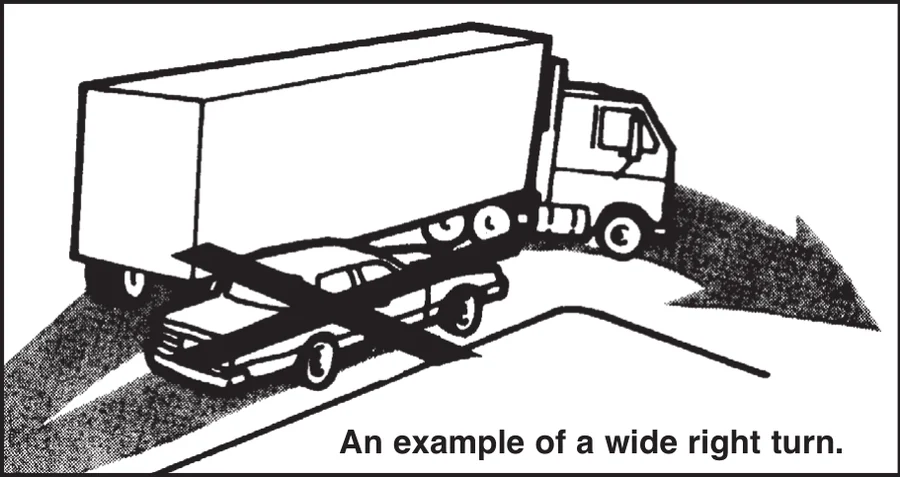
Trucks make wide turns and may look like they're going straight or left when turning right. Never squeeze between a turning truck and the curb, and don't pass until the turn is complete.
Never cross behind a truck preparing to back up; wait the few seconds for it to finish. Never stop or park near truck escape (runaway) ramps, which are only for out-of-control large vehicles.
Oversized loads travel with pilot vehicles bearing special signs and lights; treat them like trucks, and expect them to cross lane lines. Treat buses the same way as trucks.
A tractor-trailer ahead swings left before turning right at an intersection, opening a gap at the curb. Don't pull into it: the trailer will sweep through that space and the driver can't see you. Stay put until the turn is complete.
Check your understanding
Read the question, decide on an answer, then open it to check the explanation. These are Roadwise study questions based on the source handbook.
On a level highway, about how much longer does it take to pass a truck compared to a car?
3 to 5 seconds longer
20 to 30 seconds longer
No difference at all
1 minute longer
Answer: 3 to 5 seconds longer
Passing a truck on level ground typically takes 3-5 seconds longer than passing a car.