roadwise.Open study app

Nevada driving lesson · Turning, Passing & Parking

Passing safely

A 4-minute lesson from the Nevada course. Read the rules and examples, follow the handbook page references, and check your understanding before you move on.

Read time
4 minutes
Course unit
Turning, Passing & Parking
Checkpoint questions
6
Source pages
47, 48

Passing puts you in the path of oncoming traffic or in another driver's blind spot. Pass only where it's legal, only when you can see enough road, and never by speeding or driving on the shoulder.

Know the rule

Never exceed the speed limit to pass, and never use the shoulder of the road to pass.

Handbook p. 47 ↗

On a two-lane road you may pass on the left only when:

  • You can see clearly ahead and there's no immediate oncoming traffic
  • There's a broken yellow line, or the broken yellow line is in your lane
  • It is safe to do so
Handbook p. 47 ↗
Passing on a two-lane road

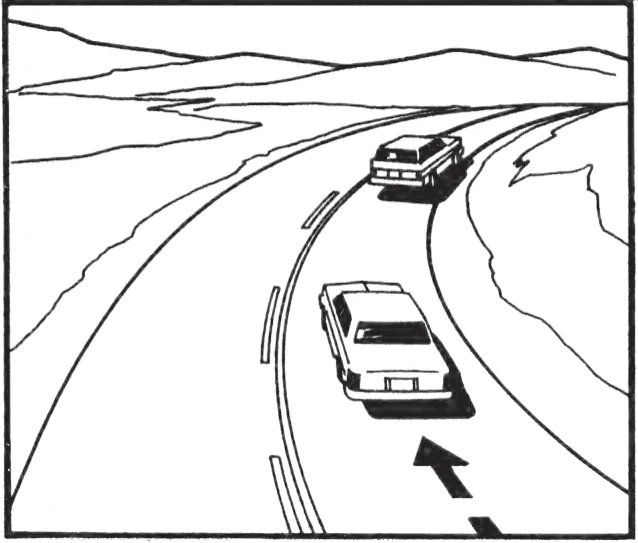
Do not pass on a two-lane road:

  • Approaching a curve or hilltop where you can't see far enough ahead
  • At or within 100 feet of a street crossing
  • At or within 100 feet of a railroad crossing
  • Where there's a double solid yellow line
  • Where signs prohibit passing
Handbook p. 47 ↗

Know the rule

Signal left 100 feet ahead in business or residential areas, 300 feet ahead elsewhere. Pull back into your lane when you can see the passed vehicle in your rear-view mirror.

Handbook p. 47 ↗

Know the rule

When someone behind you signals to pass, move right in your lane and let them pass. Never speed up while being passed.

Handbook p. 47 ↗

Know the rule

On multi-lane roads, pass on the left when no signs or markings forbid it and it's safe — signal, check mirrors and look over your shoulder. Never pass to the left of a driver making or signaling a left turn.

Handbook p. 47 ↗

Know the rule

On a highway with two lanes in your direction, it's illegal to drive in the far left lane below the speed limit while a faster vehicle is overtaking you from behind in that lane.

Handbook p. 47 ↗

…that left-lane rule doesn't apply when:

  • Driving within a city or town
  • Preparing for a left turn at an intersection
  • Directed by law enforcement to use the far left lane
  • Driving an authorized emergency vehicle on official duty
  • Traffic, weather or other hazards make the left lane necessary
  • Overtaking another vehicle going your direction
Handbook p. 47 ↗

Know the rule

Pass on the right only where the road is clearly marked for two or more lanes going your way and it's safe — never by driving off the paved portion of the highway.

Handbook p. 47 ↗

Know the rule

Passing a bicyclist: move into the lane to the left if there's more than one lane your way and it's reasonably safe. Otherwise pass at least 3 feet to the left, and don't move back right until safely clear. Never drive in a marked bike lane.

Handbook p. 48 ↗

Passing parked cars — watch for signs one may pull out:

  • Turn signal on, white backup lights or red brake lights
  • Exhaust coming from the tailpipe
  • Pedestrians, bicyclists or skateboarders crossing between parked cars
  • Doors opening in front of or beside you
Handbook p. 48 ↗

Put it into practice

On a two-lane highway you're behind a slow truck. The center line is broken yellow, but a railroad crossing is 80 feet ahead. Wait — you can't pass at or within 100 feet of a railroad crossing.

Check your understanding

Read the question, decide on an answer, then open it to check the explanation. These are Roadwise study questions based on the source handbook.

On a two-lane road, when may you legally pass on the left?
  1. Any time there's no oncoming traffic visible
  2. When a solid yellow line is on your side
  3. Clear view ahead, broken yellow line, safe
  4. On any two-lane road at any time

Answer: Clear view ahead, broken yellow line, safe

Passing on the left requires a clear view ahead, a broken yellow line, and safe conditions.

Handbook p. 47 ↗
You may not pass on a two-lane road within how many feet of a railroad crossing?
  1. 50 feet
  2. 300 feet
  3. 20 feet
  4. 100 feet

Answer: 100 feet

Passing is prohibited within 100 feet of a railroad crossing.

Handbook p. 47 ↗
You may not pass on a two-lane road within how many feet of a street crossing?
  1. 100 feet
  2. 300 feet
  3. 15 feet
  4. 500 feet

Answer: 100 feet

Passing is prohibited within 100 feet of a street crossing.

Handbook p. 47 ↗
When passing on a two-lane road outside business or residential zones, you must signal how far ahead?
  1. 100 feet
  2. 500 feet
  3. 300 feet
  4. 50 feet

Answer: 300 feet

Signal 300 feet ahead in other (non-business/residential) areas before passing.

Handbook p. 47 ↗
When passing a bicyclist, if no adjacent lane is available, you must give the cyclist at least:
  1. Three feet of clearance
  2. One foot of clearance
  3. Ten feet of clearance
  4. No specific distance is required

Answer: Three feet of clearance

Pass a bicyclist at a safe distance, at least three feet, when no adjacent lane exists.

Handbook p. 48 ↗
Outside any city, you're below the speed limit in the far left of two same-direction lanes, and a faster car comes up behind you. What must you do?
  1. Stay; you're at a legal speed
  2. Move out of the far left lane
  3. Speed up past the posted limit
  4. Move over only if they flash lights

Answer: Move out of the far left lane

On a highway with two lanes in your direction, it's illegal to drive in the far left lane below the speed limit while a faster vehicle overtakes you from behind, unless an exception applies.
Handbook p. 47 ↗
Take the lesson checkpoint in the app

More in Turning, Passing & Parking