roadwise.Open study app

Nevada driving lesson · Turning, Passing & Parking

Parking rules

A 3-minute lesson from the Nevada course. Read the rules and examples, follow the handbook page references, and check your understanding before you move on.

Read time
3 minutes
Course unit
Turning, Passing & Parking
Checkpoint questions
5
Source pages
48

Legal parking keeps your car visible, out of traffic's way and secure. The rules cover how close to the curb you park, which way you face, what the curb color means, and what to do if you must stop on a highway.

Whenever you park and leave your vehicle:

  • Turn off the engine and set the parking (emergency) brake
  • Look carefully for bicycles and other vehicles before opening your door
  • Be sure you have your keys, then lock the vehicle
  • Face the direction normal traffic flows
Handbook p. 48 ↗
18 inches

Legal parking position: front and rear wheels within this distance of the curb

Handbook p. 48 ↗
200 feet

Your parked car should be visible this far (about 20 car lengths) in each direction

Handbook p. 48 ↗

Know the rule

No curb or barrier and no signs or markings? Park parallel to the road.

Handbook p. 48 ↗

If you must stop on a highway:

  • Park with all four wheels well off the pavement, if possible
  • Leave enough space for other vehicles to pass safely
  • Use parking lights or four-way flashers if visibility is poor or between sunset and sunrise
  • In highway or freeway emergency parking areas, always use four-way flashers or parking lights
Handbook p. 48 ↗

Curb colors

Curb colors
ColorMeaning
WhiteVery short stop: load/unload passengers or drop mail
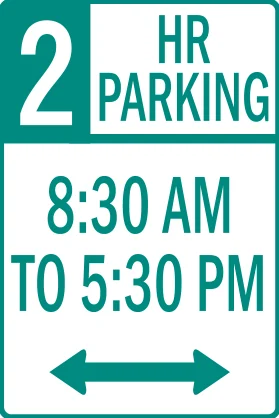
GreenPark for a limited time, usually shown on a sign
YellowLoading zone; rules depend on local laws
RedNo stopping, standing or parking; local laws apply
BlueHandicapped parking
Handbook p. 48 ↗
Time-limited parking
Time-limited parking sign

Know the rule

Never turn the ignition to "lock" while the vehicle is moving — the steering will lock when you turn the wheel and you'll lose control.

Handbook p. 48 ↗

Put it into practice

You pull up to a green curb downtown with a 2-hour sign. You may park, but only for the posted time. Set the brake, check for bikes before opening your door, and lock up.

Check your understanding

Read the question, decide on an answer, then open it to check the explanation. These are Roadwise study questions based on the source handbook.

The legal parking position requires your wheels to be within how many inches of the curb?
  1. 12 inches
  2. 24 inches
  3. 36 inches
  4. 18 inches

Answer: 18 inches

The legal parking position is with wheels within 18 inches of the curb.
Handbook p. 48 ↗
Your parked vehicle should be visible from how far away in each direction?
  1. 200 feet
  2. 100 feet
  3. 300 feet
  4. 50 feet

Answer: 200 feet

Your vehicle should be visible for 200 feet in each direction.

Handbook p. 48 ↗
A blue curb marking indicates:
  1. A loading zone
  2. Handicapped parking
  3. No stopping or standing
  4. A short stop only to load passengers

Answer: Handicapped parking

Blue curb markings designate handicapped parking areas.

Handbook p. 48 ↗
A red curb marking means:
  1. A limited-time parking zone
  2. Handicapped parking only
  3. No stopping or parking
  4. A loading zone

Answer: No stopping or parking

Red curb markings mean no stopping, standing, or parking.

Handbook p. 48 ↗
A yellow curb marking generally indicates:
  1. No parking at any time
  2. Handicapped parking
  3. Limited-time parking
  4. A loading zone

Answer: A loading zone

Yellow curb markings mean a loading zone, with rules depending on local laws.

Handbook p. 48 ↗
Take the lesson checkpoint in the app

More in Turning, Passing & Parking