roadwise.Open study app

Nevada driving lesson · Turning, Passing & Parking

Parallel parking & hills

A 3-minute lesson from the Nevada course. Read the rules and examples, follow the handbook page references, and check your understanding before you move on.

Read time
3 minutes
Course unit
Turning, Passing & Parking
Checkpoint questions
4
Source pages
49

Parallel parking is a skill you may be tested on, so learn the steps and go slowly. On a hill, the direction of your front wheels decides where the car rolls if the brakes ever let go.

About 5 feet

How much longer than your car a parallel parking space should be

Handbook p. 49 ↗

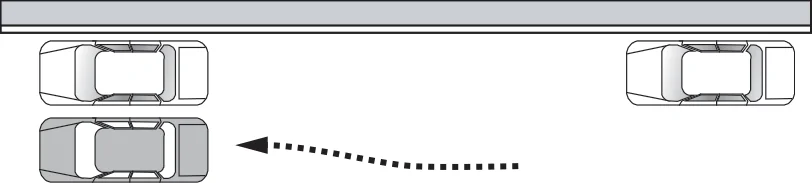
Parallel parking on the right side of the road:

  • Check traffic; signal if the driver behind is far enough back to stop or go around
  • Pull up beside the car ahead of the space, 2–3 feet away, rear bumpers lined up
  • Shift to reverse, check mirrors and over your shoulder; back slowly, wheel turned all the way right
  • When the back of your front seat lines up with that car's rear bumper, straighten by steering left
  • Keep backing slowly until your front fender clears the other car's bumper
  • Look over your right shoulder, back slowly while turning left, and stop before touching the car behind
  • Shift to drive, straighten the wheels and center the car — about 18 inches from the curb
  • Stop, shift to park (first gear or reverse in a manual) and set the parking brake
Handbook p. 49 ↗
Parallel parking maneuver
Pull up beside the car ahead of the space, then back in

Know the rule

Common errors: if you don't straighten your front wheels, your right rear wheel hits the curb; turn too far left and your right front fender may hit the car you're parking behind.

Handbook p. 49 ↗

Know the rule

Parking on the left side of the road? Use the opposite actions.

Handbook p. 49 ↗

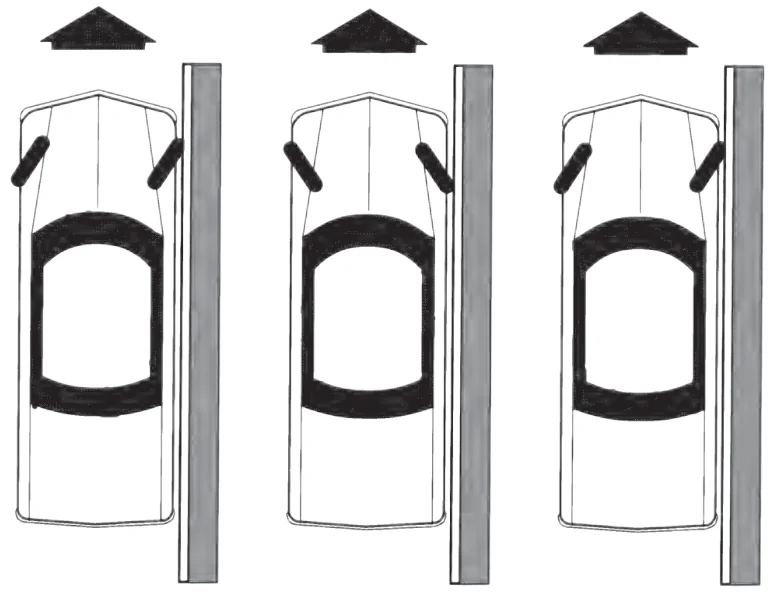
Parking on a hill

Parking on a hill
SituationTurn your front wheels
Headed downhillToward or into the curb or road shoulder
Uphill, with a curbAway from the curb
Uphill, no curbToward the road shoulder
Handbook p. 49 ↗
Parking on a hill (wheel position)
Wheel positions: downhill, uphill with curb, uphill without curb

Know the rule

The goal on a hill: if the vehicle starts to roll, it moves away from traffic or into the curb. Always set your parking brake.

Handbook p. 49 ↗

Put it into practice

You park facing uphill on a street with a curb. Turn your front wheels away from the curb; if the car rolls back, the front tire stops against the curb. Then set the parking brake.

Check your understanding

Read the question, decide on an answer, then open it to check the explanation. These are Roadwise study questions based on the source handbook.

About how big should a space be for you to parallel park in it?
  1. About as long as your car
  2. About 2 feet longer than your car
  3. About 5 feet longer than your car
  4. About 10 feet longer than your car

Answer: About 5 feet longer than your car

Make sure the space is big enough — about 5 feet longer than your car.
Handbook p. 49 ↗
You park facing uphill on a street with a curb. Which way should you turn your front wheels?
  1. Toward the curb
  2. Straight ahead
  3. Away from the curb
  4. Toward the road shoulder

Answer: Away from the curb

Headed uphill with a curb, turn your front tires away from the curb so the car rolls into the curb.

Handbook p. 49 ↗
When parking facing downhill, you should turn your front wheels:
  1. Toward the curb or shoulder
  2. Away from the curb
  3. Straight ahead
  4. Toward the center of the road

Answer: Toward the curb or shoulder

When headed downhill, turn your front tires toward or into the curb or road shoulder.

Handbook p. 49 ↗
When parking uphill where there is no curb, turn your front wheels toward the road shoulder.
  1. True
  2. False

Answer: True

Headed uphill with no curb, turn your front tires toward the road shoulder.

Handbook p. 49 ↗
Take the lesson checkpoint in the app

More in Turning, Passing & Parking