roadwise.Open study app

Montana driving lesson · How to Drive Safely

Signaling your plans

A 3-minute lesson from the Montana course. Read the rules and examples, follow the handbook page references, and check your understanding before you move on.

Read time
3 minutes
Course unit
How to Drive Safely
Checkpoint questions
6
Source pages
67, 68

Other drivers expect you to keep doing what you're doing. Warn them before you turn, change lanes or slow down — early enough to help, but not so early that someone guesses the wrong spot.

Know the rule

Let others know what you're doing with your signals, your vehicle's position and eye contact.

Handbook p. 67 ↗

Use your turn signal before you

  • Change lanes
  • Turn right or left
  • Merge into traffic
  • Pass on a highway or interstate
  • Park
Handbook p. 68 ↗

Know the rule

Signal every time you change direction or lanes, even when you don't see anyone around — it's easy to miss someone.

Handbook p. 68 ↗
100 ft / 300 ft

Signal before a turn: 100 feet (1/3 city block) in town, 300 feet in rural areas

Handbook p. 68 ↗

Know the rule

Don't signal too early. If there are streets, driveways or entrances between you and your turn — or a vehicle is about to pull out there — wait until you've passed them.

Handbook p. 68 ↗

Know the rule

After a turn or lane change, make sure your signal is off. After small turns it may not cancel itself, and others may think you'll turn again.

Handbook p. 68 ↗

Know the rule

If you'll stop or slow where others won't expect it, tap the brake pedal three or four times quickly to warn drivers behind.

Handbook p. 68 ↗

Signal (with your brake lights) when you slow down to

  • Turn off a road that has no separate turn or exit lanes
  • Park or turn just before an intersection
  • Avoid something in the road, or stopped traffic the driver behind can't see
Handbook p. 68 ↗
Vehicle brake and turn signal light meanings
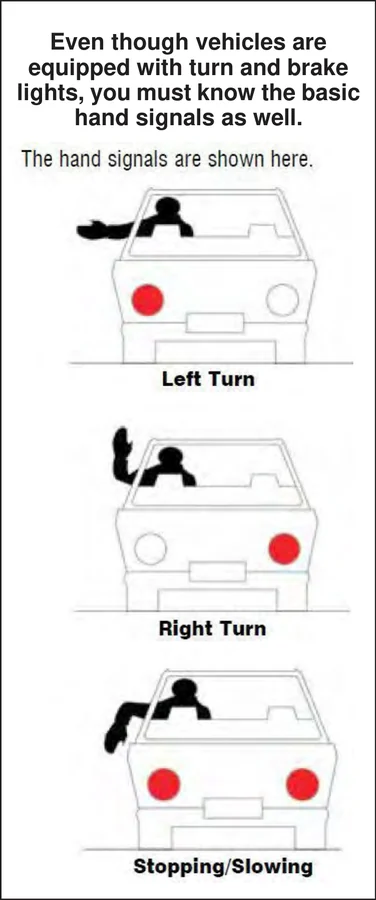
Hand signals: left turn, right turn, stop or slow

Hand signals

Know them even though cars have signal lights: left arm straight out for a left turn, bent up for a right turn, bent down to stop or slow.

Handbook p. 68 ↗

Put it into practice

You plan to turn right into the second driveway ahead, and a car is waiting to pull out of the first one. Wait until you've passed that car before you signal, so its driver doesn't think you're turning where they are.

Check your understanding

Read the question, decide on an answer, then open it to check the explanation. These are Roadwise study questions based on the source handbook.

When should you tap your brake pedal several times quickly, instead of just braking normally?
  1. Every time you approach a stop sign
  2. Only when driving downhill
  3. Never, this is not recommended
  4. When slowing somewhere unexpected

Answer: When slowing somewhere unexpected

Tapping the brake several times warns following drivers when you're slowing at an unexpected spot, like a driveway.
Handbook p. 68 ↗
What should you check after completing a turn or lane change?
  1. That your turn signal has turned off
  2. That your hazard flashers are on
  3. That your parking lights are on
  4. That your wheels are turned right

Answer: That your turn signal has turned off

After a turn or lane change, verify your signal has canceled; small turns may not cancel it automatically.

Handbook p. 68 ↗
Why should you avoid signaling a turn too early if there are driveways or side streets before your turn?
  1. Drivers behind may try to pass you
  2. A driver might pull out expecting your turn
  3. Signaling too early is against the law
  4. It makes drivers behind you brake early

Answer: A driver might pull out expecting your turn

Signaling too early can mislead a driver near an intermediate driveway or street into pulling into your path.

Handbook p. 68 ↗
Besides using your turn signal, how else can you show other drivers your intention to turn?
  1. Vehicle position and eye contact
  2. Turning your wheels sharply beforehand
  3. Slowing down well before the intersection
  4. Flashing your headlights repeatedly

Answer: Vehicle position and eye contact

Vehicle positioning and eye contact help communicate your intentions beyond just using turn signals.

Handbook p. 67 ↗
You should signal every time you change direction or lanes, even if you don't see anyone else around.
  1. True
  2. False

Answer: True

Get into the habit of always signaling, since it's easy to miss someone who needs to know your intentions.

Handbook p. 68 ↗
Which of these does the handbook list as a time to use your turn signal?
  1. When you stop at a red light
  2. When going straight through an intersection
  3. Before you pull over to park
  4. When you slow for a school zone

Answer: Before you pull over to park

Use your turn signals before you change lanes, turn right or left, merge into traffic, pass on a highway or interstate, or park.

Handbook p. 68 ↗
Take the lesson checkpoint in the app

More in How to Drive Safely