roadwise.Open study app

Montana driving lesson · How to Drive Safely

Seeing well and scanning ahead

A 3-minute lesson from the Montana course. Read the rules and examples, follow the handbook page references, and check your understanding before you move on.

Read time
3 minutes
Course unit
How to Drive Safely
Checkpoint questions
6
Source pages
61, 62, 63

The single biggest contributor to crashes is failing to see what's happening. Many drivers in crashes with motorcycles, bikes and pedestrians said they looked but didn't see. Keep your eyes moving: far ahead, to the sides, and behind.

Know the rule

Don't take your eyes off the road for more than a few seconds at a time. To look at a map, pull safely off the road first.

Handbook p. 61 ↗
10 seconds

Minimum distance to look ahead of your vehicle

Handbook p. 62 ↗

How far is 10 seconds?

How far is 10 seconds?
WhereAbout
CityOne block
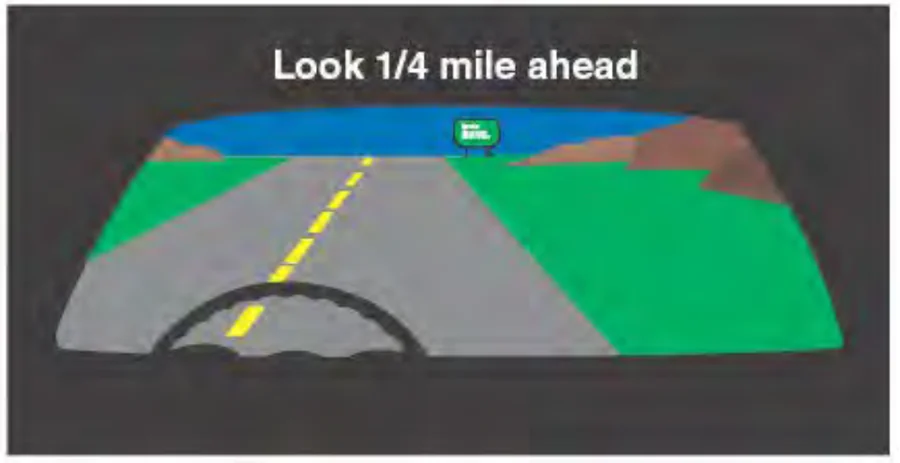
HighwayFour city blocks, or a quarter mile
Handbook p. 62 ↗
Look a quarter mile ahead (highway driving)
On the highway, look about a quarter mile ahead

Check your look-ahead time

  • Find a non-moving object ahead, like a sign or telephone pole
  • Count one-one-thousand, two-one-thousand… until you reach it
  • The number you counted is how many seconds ahead you were looking
Handbook p. 62 ↗

Looking well ahead helps you

  • Avoid last-minute braking or turning
  • Save fuel by avoiding unnecessary stops
  • Keep traffic moving at a steady pace
  • Steer straighter, with less weaving
  • Give drivers behind you more time to react
Handbook p. 62 ↗

Know the rule

Scan to the sides for vehicles, pedestrians and animals, especially at intersections and railroad crossings — where you should always expect a train.

Handbook p. 62 ↗

Intersection

Any place where traffic merges or crosses: cross streets, side streets, driveways, and shopping center or parking lot entrances.

Handbook p. 63 ↗

At intersections

  • Look left and right before entering; if stopped, look again just before moving
  • Look across the intersection to make sure your path is clear
  • Turning left: find a safe gap, check the street you're entering, look again at oncoming traffic
  • Turning right: check traffic from the left, oncoming left-turners, and crossing pedestrians
  • Watch for red-light runners, especially just after your light turns green
  • If your view is blocked, edge forward slowly until you can see
Handbook p. 63 ↗

Know the rule

Don't rely on signals or signs to stop cross traffic — drinking or reckless drivers may not stop. Look to the sides near shopping centers, parking lots, construction, busy sidewalks, playgrounds and school yards.

Handbook p. 63 ↗

Put it into practice

Stopped at a stop sign, you find a parked van blocks your view to the left. Edge forward slowly until you can see. Cross-traffic drivers will see your front bumper before you see them, giving them time to slow or warn you.

Check your understanding

Read the question, decide on an answer, then open it to check the explanation. These are Roadwise study questions based on the source handbook.

How many seconds ahead should you look down the road to avoid last-minute braking or turning?
  1. At least 10 seconds
  2. At least 4 seconds
  3. At least 2 seconds
  4. At least 20 seconds

Answer: At least 10 seconds

You should look down the road at least 10 seconds ahead to have time to react smoothly.
Handbook p. 62 ↗
On the highway, 10 seconds of looking ahead is roughly equal to what distance?
  1. About one city block
  2. About a quarter mile
  3. About a mile
  4. About 50 feet

Answer: About a quarter mile

On the highway, 10 seconds ahead equals about four city blocks, or roughly a quarter mile.

Handbook p. 62 ↗
In city driving, 10 seconds of looking ahead is roughly equal to what distance?
  1. About a quarter mile
  2. About four blocks
  3. About one block
  4. About 50 feet

Answer: About one block

In the city, 10 seconds ahead is about one block, compared to about four blocks on the highway.

Handbook p. 62 ↗
You're stopped at an intersection where your view of the cross street is blocked. What should you do?
  1. Wait for another driver to signal you're clear
  2. Pull out quickly to limit your exposure
  3. Back up to gain a better view
  4. Edge forward slowly until you can see

Answer: Edge forward slowly until you can see

Edging forward slowly lets you see and be seen by crossing drivers, giving them a chance to react.

Handbook p. 63 ↗
Why is it important to look left and right at an intersection even if you have a green light?
  1. Some drivers run reds right after yours turns green
  2. Cross traffic may have a green arrow
  3. It helps you time the next light
  4. Cross traffic must always stop first

Answer: Some drivers run reds right after yours turns green

Even with a green light, watch for red-light runners, especially just after your signal turns green.

Handbook p. 63 ↗
According to the handbook, what is the single biggest contributor to crashes?
  1. Poor tire maintenance
  2. Worn-out brakes
  3. Failing to see what's happening
  4. Bad weather alone

Answer: Failing to see what's happening

The handbook states that failing to see what is happening is the single biggest contributor to crashes.

Handbook p. 61 ↗
Take the lesson checkpoint in the app

More in How to Drive Safely