Roadwise States Montana Driving lessons Checking behind, changing lanes and backing Montana driving lesson · How to Drive Safely
Checking behind, changing lanes and backing A 3-minute lesson from the Montana course. Read the rules and examples, follow the handbook page references, and check your understanding before you move on.
Read time 3 minutes
Course unit How to Drive Safely
Checkpoint questions 6
Source pages 63, 64, 65 Traffic behind and beside you matters as much as traffic ahead. Mirrors leave blind spots near your rear corners, so a quick look over your shoulder is part of every lane change.
Know the rule
Check behind you more often in heavy traffic, and always when you change lanes, slow down, back up, or drive down a long or steep hill.
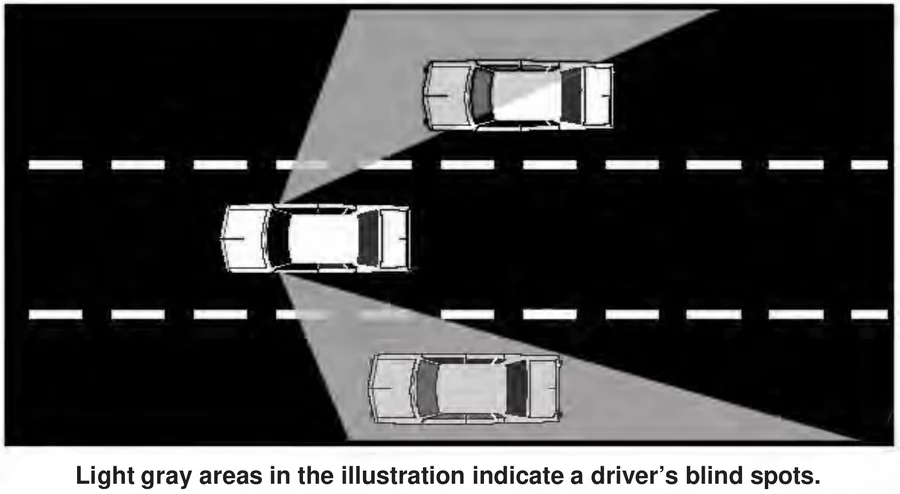
Handbook p. 63 ↗ Blind spots Areas near your vehicle's rear corners that you can't see in your mirrors. You have to turn your head and look.
Handbook p. 64 ↗ Blind spots (light gray areas) Know the rule
Changing lanes includes moving from one lane to another, merging from an entrance ramp, and entering the road from the curb or shoulder.
Handbook p. 64 ↗ Changing lanes Signal to show which lane you'll enter Check the rearview and side mirrors — no one in the lane or about to pass Look over your shoulder in the direction you're moving Check quickly — don't take your eyes off the road ahead for more than an instant Check the far lane: someone there may be moving into the same lane Watch for harder-to-see motorcycles, bicycles and pedestrians Handbook p. 64 ↗ Know the rule
Be cautious passing a bicycle: the rider may have to swerve into traffic to avoid something on the road.
Handbook p. 64 ↗ Know the rule
Check behind whenever you slow down, especially quickly or where others won't expect it, such as at private driveways or parking spaces.
Handbook p. 64 ↗ Know the rule
Pulling away from the curb: signal, look over your left shoulder, and pull out when it's safe.
Handbook p. 64 ↗ Backing up safely Back as little as possible — in a lot, pick a space you can drive through Check behind the vehicle before you get in; children and small objects can't be seen from the seat Put your right arm on the seat back and look directly through the rear window Don't depend on mirrors — you can't see directly behind you Back slowly; the vehicle is harder to steer in reverse Use a helper outside the vehicle whenever possible Handbook p. 65 ↗ Put it into practice
You want to move left on a four-lane road. Signal, check your mirrors, glance over your left shoulder into the blind spot, and check the far-left lane too — a car there may be heading for the same gap.
Check your understanding Read the question, decide on an answer, then open it to check the explanation. These are Roadwise study questions based on the source handbook.
When should you check the traffic behind you, according to the handbook? Only before entering a highway When changing lanes, slowing, or backing up Only when you hear a siren Only when your mirrors need adjusting Answer: When changing lanes, slowing, or backing up
You should check behind you before lane changes, slowing down, backing up, or driving down long or steep hills.
Handbook p. 63 ↗ What are 'blind spots'? Any area behind your vehicle The area directly in front of your hood Rear corners mirrors can't show you Areas only trucks and buses have Answer: Rear corners mirrors can't show you
Blind spots are areas near your vehicle's rear corners that mirrors can't show; you must turn your head to check them.
Handbook p. 64 ↗ Before backing up, what does the handbook say to do before you even get in the vehicle? Roll down the rear window Adjust your side mirrors Turn on your hazard flashers Check behind for children or objects Answer: Check behind for children or objects
Check behind your vehicle before you get in; children and small objects can't be seen from the driver's seat.
Handbook p. 65 ↗ You should always rely on your rearview and side mirrors when backing up, since they show what's directly behind you. True False Answer: False
Mirrors cannot show what's directly behind the vehicle; you must turn and look through the rear window instead.
Handbook p. 65 ↗ Why should you check the traffic behind you more often when traffic is heavy? To see if police are following you To spot tailgaters or fast-approaching cars To find a faster lane to merge into To judge the speed of oncoming cars Answer: To spot tailgaters or fast-approaching cars
Checking behind you more in heavy traffic helps you notice tailgaters or fast-approaching vehicles in time to react.
Handbook p. 63 ↗ You should check the far lane before changing lanes, since someone there might also be moving into your target lane. True False Answer: True
Checking the far lane helps you spot another driver who may also be moving into the same lane you want to enter.
Handbook p. 64 ↗ Previous lesson Seeing well and scanning ahead Next lesson Night driving More in How to Drive Safely About the source Roadwise’s Montana course uses the driver handbook edition supplied with this study pack. This lesson cites source pages 63, 64, 65. The linked PDF is a third-party mirror of the handbook, rather than a government-hosted page.
Open the handbook source PDF · View the source edition
For current application requirements, fees, appointments, and the format that applies to your age or license type, check Montana’s MVD. Roadwise provides study material and does not issue permits or licenses.