roadwise.Open study app

Montana driving lesson · Signs, Signals & Markings

Pavement markings and special lanes

A 3-minute lesson from the Montana course. Read the rules and examples, follow the handbook page references, and check your understanding before you move on.

Read time
3 minutes
Course unit
Signs, Signals & Markings
Checkpoint questions
6
Source pages
44, 45

Lines on the pavement tell you where you may pass, change lanes, turn and stop. Yellow lines separate traffic going opposite ways; white lines separate lanes going the same way.

Know the rule

Solid lines along the side of the road mark its edge. Lines between same-direction lanes are white; lines between opposite-direction traffic are yellow.

Handbook p. 44 ↗

Yellow center lines

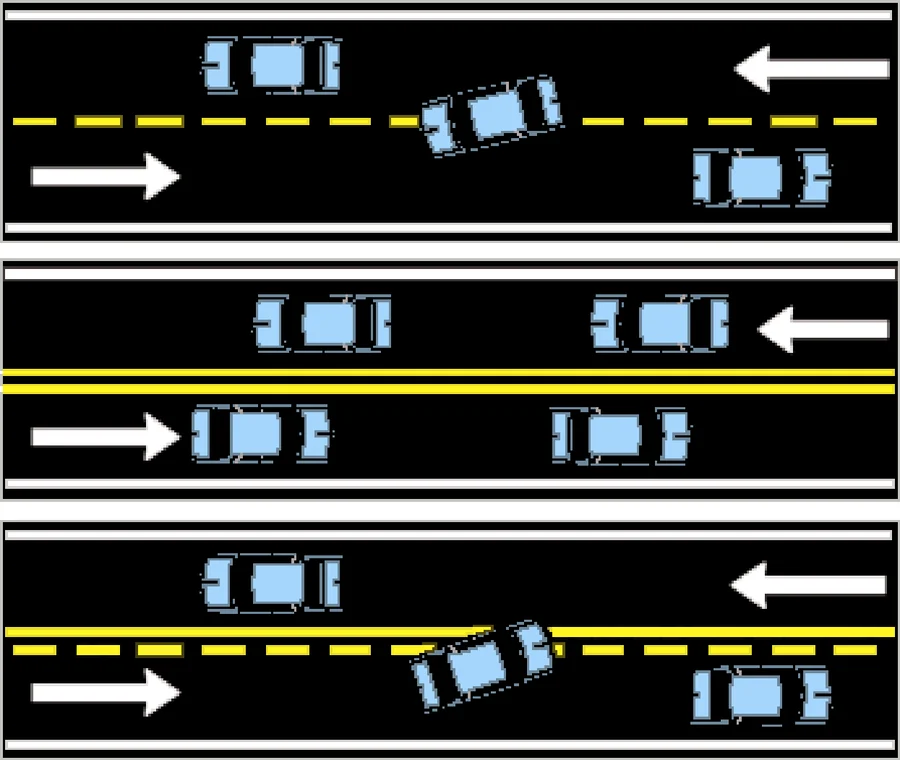
Yellow center lines
MarkingWhat you may do
Broken yellow lineCross it to pass when it's safe
Solid yellow on your sideDon't pass
Dashed yellow on your sidePass when it's safe
Double solid yellowNo passing in either direction
Handbook p. 44 ↗

Know the rule

You may cross a solid yellow line only to turn left — into a public or private parking lot, a private driveway or a roadway — when it's safe.

Handbook p. 44 ↗
Passing zone markings (solid vs broken yellow)
When a yellow center line lets you pass

Know the rule

A dashed white line means you may change lanes when safe; a solid white line means stay in your lane unless a special situation requires a change.

Handbook p. 44 ↗

Know the rule

When a sign or signal requires you to stop, stop before the stop line, or before the crosswalk if there is one. Yield to pedestrians in or about to enter a crosswalk — and remember not all crosswalks are marked.

Handbook p. 44 ↗

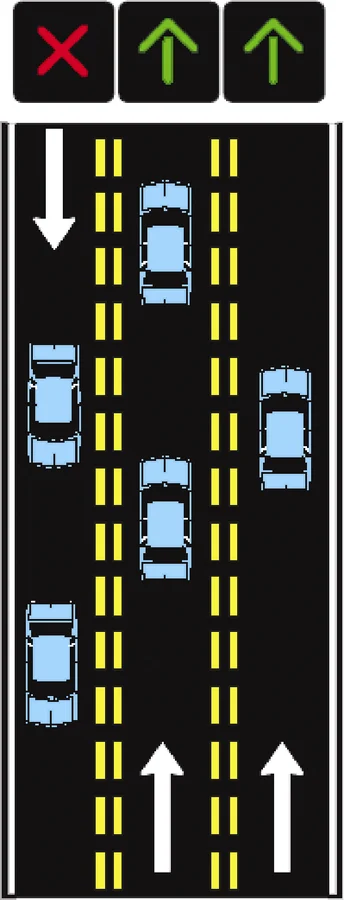
Reversible lane

A lane that carries traffic one way at certain times and the opposite way at others, usually marked with double-dashed yellow lines. Check signs or signals before using it.

Handbook p. 45 ↗

Lane-use signals over reversible lanes

Lane-use signals over reversible lanes
SignalMeaning
Green arrowYou may use this lane
Red XYou may not use this lane
Flashing yellow XLane is for turning only
Steady yellow XLane use is changing — move out when safe
Handbook p. 45 ↗
Reversible lane control signals (X and arrows)
Reversible lanes and lane-use signals

Reserved lanes (often marked with a white diamond)

  • Transit or Bus: buses only
  • Bicycle: reserved for bicycles
  • HOV: vehicles with more than one person; the sign gives the number, days and hours
  • HOV 3: at least three people must be in the vehicle
Handbook p. 45 ↗

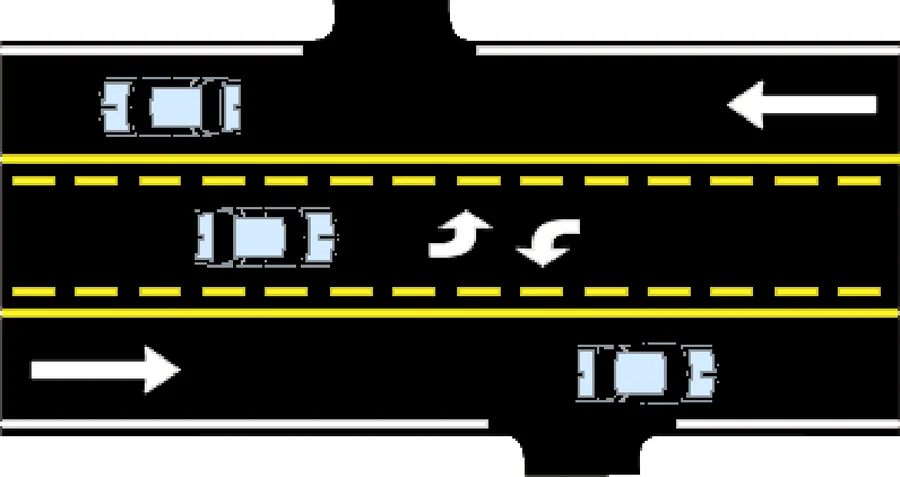
Shared center lane

A center lane marked on each side by a solid and a dashed yellow line, used by traffic from both directions for left turns (and U-turns where permitted).

Handbook p. 45 ↗
Two-way left turn lane with merge point
Shared center left-turn lane

Put it into practice

You're stuck behind a slow truck. On your side of the center line is a solid yellow line; the oncoming side is dashed. You may not pass here — wait until the dashed line is on your side and it's safe.

Check your understanding

Read the question, decide on an answer, then open it to check the explanation. These are Roadwise study questions based on the source handbook.

A broken yellow centerline on your side of the road means you may:
  1. Never cross it under any circumstance
  2. Cross it only to make a U-turn
  3. Cross it to pass when safe
  4. Cross it only to turn right

Answer: Cross it to pass when safe

A broken yellow centerline may be crossed to overtake or pass when it is safe to do so.
Handbook p. 44 ↗
There is a solid yellow line on your side of the centerline and a broken yellow line on the oncoming side. What does this mean for you?
  1. You may pass whenever it's convenient
  2. Both directions may pass freely here
  3. You may pass if the oncoming lane is clear
  4. You may not pass on the solid side

Answer: You may not pass on the solid side

When the solid yellow line is on your side, you may not pass; only the side with the dashed line may pass.

Handbook p. 44 ↗
What does a double solid yellow centerline mean for traffic in both directions?
  1. Neither side may cross to pass
  2. Only the right side may pass
  3. Only the left side may pass
  4. Both sides may pass with caution

Answer: Neither side may cross to pass

Two solid yellow lines mean neither direction can legally cross the centerline to pass.

Handbook p. 44 ↗
A solid white line separates two lanes moving in the same direction. What should you do?
  1. Change lanes freely at any time
  2. Stay in your lane unless it's necessary
  3. Treat it the same as a dashed white line
  4. Cross it only to pass slower cars

Answer: Stay in your lane unless it's necessary

A solid white lane line means you should stay in your lane unless a special situation requires a change.

Handbook p. 44 ↗
Overhead signals above a reversible lane show a flashing yellow X. What does that mean?
  1. The lane is closed entirely
  2. You may use the lane freely
  3. The lane is reserved for buses
  4. The lane is for turning only

Answer: The lane is for turning only

A flashing yellow X over a reversible lane means the lane may only be used for turning.

Handbook p. 45 ↗
A shared center lane on a roadway is marked with left-turn arrows facing both directions. What is it used for?
  1. Passing slower traffic only
  2. Left turns, by traffic from either direction
  3. Emergency vehicles only
  4. Straight-through travel in heavy traffic

Answer: Left turns, by traffic from either direction

Shared center lanes are reserved for left turns or permitted U-turns and can be used by traffic from both directions.

Handbook p. 45 ↗
Take the lesson checkpoint in the app

More in Signs, Signals & Markings