roadwise.Open study app

Montana driving lesson · Signs, Signals & Markings

Traffic and pedestrian signals

A 3-minute lesson from the Montana course. Read the rules and examples, follow the handbook page references, and check your understanding before you move on.

Read time
3 minutes
Course unit
Signs, Signals & Markings
Checkpoint questions
6
Source pages
40, 41

Signals assign right-of-way at busy intersections and midblock crosswalks. Know what every steady, flashing and arrow signal means — and still look both ways, because some drivers run red lights.

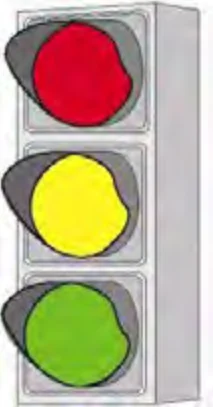
Traffic signal (red, yellow, green)
Traffic signal

What each signal means

What each signal means
SignalMeaning
Steady redStop; right turns (and some lefts) allowed after stopping
Steady red arrowStop; stay stopped except allowed turns on red
Flashing redSame as a STOP sign
Steady yellowCaution — the light is about to turn red
Steady yellow arrowProtected turn is ending; clear the intersection
Flashing yellow arrowLeft turn allowed after yielding to oncoming traffic
Handbook p. 40 ↗

Know the rule

At a red signal, stop before the stop line; if there's none, before the nearest crosswalk; if there's no crosswalk, before the intersection.

Handbook p. 40 ↗

Know the rule

After stopping on red, you may turn right into a two-way street unless a sign or officer says not to, yielding to pedestrians, bicyclists and traffic. From a one-way street onto a one-way street, you may also turn left.

Handbook p. 40 ↗

Know the rule

Don't enter an intersection against a steady yellow light unless you're too close to stop safely.

Handbook p. 40 ↗

Know the rule

A flashing yellow signal means proceed with caution — it usually means slow down.

Handbook p. 41 ↗

Know the rule

A steady green means go, cautiously — look both ways for traffic that may run the red. A green arrow means a protected turn; with no green arrow, turning traffic must yield to oncoming traffic and pedestrians.

Handbook p. 41 ↗

Know the rule

If a signal isn't working, stop as you would at stop signs in all directions. Courtesy says the driver who stopped first goes first — but make sure it's safe even when you were first.

Handbook p. 40 ↗

Pedestrian signals

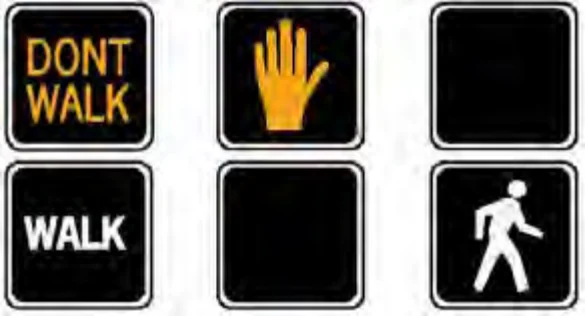
  • Pedestrians obey these instead of the red-yellow-green lights
  • WALK (white walking figure): you may start crossing
  • DON'T WALK (upheld orange hand), steady or flashing: wait for WALK
  • Already in the crosswalk when DON'T WALK starts flashing: keep going
  • Pedestrians facing a red or yellow light may not start across unless a pedestrian signal says to
Handbook p. 40 ↗
Pedestrian signal reference (Walk/Don't Walk, icons)
Pedestrian signals: DON'T WALK and WALK

Put it into practice

Your light turns green, but a car on the cross street is still coming fast. Wait. Right after your light turns green is exactly when cross-street drivers are most likely to run the red.

Check your understanding

Read the question, decide on an answer, then open it to check the explanation. These are Roadwise study questions based on the source handbook.

What must you do at a steady red traffic signal before turning right on red?
  1. Slow down but you need not stop
  2. Stop first, then turn if it's safe
  3. Proceed if no cars are visible
  4. Wait for a green arrow only

Answer: Stop first, then turn if it's safe

At a steady red light, you must stop first, then may turn right if permitted, safe, and no sign prohibits it.
Handbook p. 40 ↗
What does a flashing red traffic signal mean?
  1. Proceed with caution, no stop needed
  2. Yield only, do not stop
  3. The same as a stop sign
  4. Stop only if pedestrians are present

Answer: The same as a stop sign

A flashing red signal means the same as a stop sign: come to a complete stop, then proceed when safe.

Handbook p. 40 ↗
What does a flashing yellow arrow signal allow?
  1. An unrestricted left turn with no yielding
  2. A protected left turn only
  3. Stopping is required at all times
  4. Left turns, after yielding to oncoming traffic

Answer: Left turns, after yielding to oncoming traffic

A flashing yellow arrow permits a left turn but only after yielding to oncoming traffic and pedestrians.

Handbook p. 40 ↗
What does a steady yellow traffic light mean?
  1. Caution; it's about to turn red
  2. Speed up to clear the intersection
  3. Stop only if pedestrians are crossing
  4. The light will turn green next

Answer: Caution; it's about to turn red

A steady yellow light means caution, the signal is about to turn red; don't enter unless too close to stop safely.

Handbook p. 40 ↗
If a traffic signal is not working at all, how should you treat the intersection?
  1. Proceed without stopping if traffic is light
  2. Only the busier road must stop
  3. Treat it as a yield sign in all directions
  4. As if stop signs control all directions

Answer: As if stop signs control all directions

When a signal is completely out, treat the intersection as if stop signs controlled all directions.

Handbook p. 40 ↗
What does a steady yellow arrow signal usually indicate?
  1. A protected turn is just beginning
  2. You must stop immediately
  3. The signal is malfunctioning
  4. A protected turn is ending soon

Answer: A protected turn is ending soon

A steady yellow arrow means the protected turn period is about to end; clear the intersection and prepare for the next signal.

Handbook p. 40 ↗
Take the lesson checkpoint in the app

More in Signs, Signals & Markings