roadwise.Open study app

Missouri driving lesson · Signs, Signals & Markings

Speed limits and railroad crossings

A 3-minute lesson from the Missouri course. Read the rules and examples, follow the handbook page references, and check your understanding before you move on.

Read time
3 minutes
Course unit
Signs, Signals & Markings
Checkpoint questions
6
Source pages
52, 53

A speed limit is the most you may drive in ideal conditions, not a promise that the speed is safe. Missouri sets limits by road type and requires you to slow down when conditions demand it. Railroad crossings have their own must-stop rules.

Know the rule

Adjust your speed for hills, curves, slippery roads, limited sight distance, pedestrians, bicyclists and slow-moving vehicles. By law, you must slow down when conditions demand it.

Handbook p. 52 ↗

Maximum speeds unless posted otherwise

Maximum speeds unless posted otherwise
RoadMaximum
Rural interstates and freeways75 mph
Rural expressways65 mph
Urbanized interstates, freeways, expressways60 mph
Other roads not in an urbanized area60 mph
Lettered roads55 mph
Any city, town or village25 mph
Handbook p. 52 ↗

Know the rule

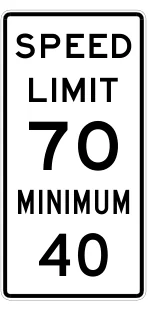
Interstates also have minimum speeds. You may not drive slower than 40 mph on interstate highways under normal conditions; if that's too fast for you, use another route.

Handbook p. 52 ↗

Know the rule

The Missouri Highway and Transportation Commission may set limits higher or lower than the uniform maximums for safety or traffic flow. Lower speeds are often posted on urban interstates with frequent interchanges.

Handbook p. 52 ↗
Speed limit with minimum speed
Interstate sign: speed limit 70, minimum 40

At railroad crossings:

  • A round advance warning sign, or pavement markings, means a crossing is ahead
  • Never try to beat a train across the tracks
  • Don't start across until there's room for your vehicle on the other side
  • Don't shift gears while crossing, in case you stall
Handbook p. 52 ↗

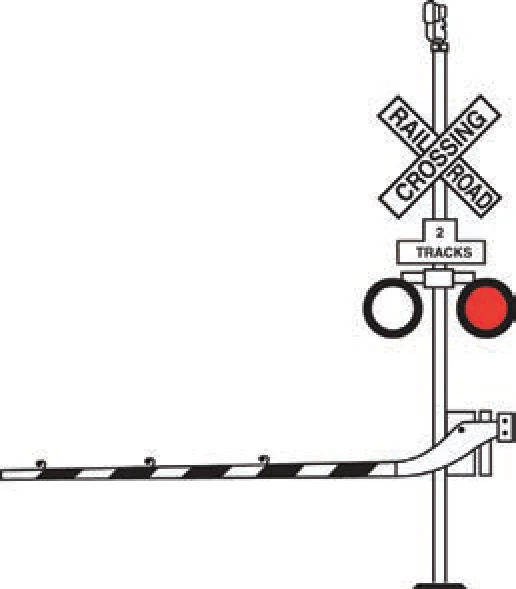
Crossbuck

The white X-shaped sign at a railroad crossing. It means the same as a yield sign: yield to trains. A sign below it shows how many tracks cross the road.

Handbook p. 53 ↗

Know the rule

You must STOP if the red lights are flashing or the gate is down, and you can't cross until the train has passed. Never go around the gate.

Handbook p. 53 ↗
15–50 ft

When required to stop, stop within this distance before the railroad tracks

Handbook p. 53 ↗

Know the rule

The red lights may keep flashing after the train has passed. If there are two or more tracks, look for a second train before you cross.

Handbook p. 53 ↗
Railroad flashing lights and gate
Crossbuck with flashing lights and gate

Put it into practice

Red lights start flashing as you near a crossing. Stop between 15 and 50 feet from the tracks. After the train passes, the lights keep flashing and there's a second track, so look for another train before you go.

Check your understanding

Read the question, decide on an answer, then open it to check the explanation. These are Roadwise study questions based on the source handbook.

What is the minimum speed you may generally drive on a Missouri interstate highway under normal conditions?
  1. 40 mph
  2. 25 mph
  3. 50 mph
  4. 55 mph

Answer: 40 mph

You may not drive slower than 40 mph on interstate highways under normal roadway conditions.
Handbook p. 52 ↗
Unless posted otherwise, what is the speed limit in any Missouri city, town, or village?
  1. 25 mph
  2. 20 mph
  3. 30 mph
  4. 35 mph

Answer: 25 mph

The speed limit in any city, town, or village is 25 mph unless posted otherwise.

Handbook p. 52 ↗
What is the maximum speed limit on Missouri's rural interstates and freeways?
  1. 60 mph
  2. 75 mph
  3. 65 mph
  4. 55 mph

Answer: 75 mph

The p.52 maximum speed table lists 75 mph for rural interstates and freeways.

Handbook p. 52 ↗
A white, X-shaped sign at a railroad crossing is called what, and what does it mean?
  1. A chevron; it means construction ahead
  2. A crossbuck, same as a yield sign
  3. A pennant; it warns of no passing
  4. An object marker; it warns of debris

Answer: A crossbuck, same as a yield sign

The white X-shaped 'crossbuck' has the same meaning as a yield sign — you must yield to trains at the crossing.

Handbook p. 53 ↗
When must you stop at a railroad crossing?
  1. Only if you see a train
  2. Only if signaled by a crossing guard
  3. If the red lights flash or the gate is down
  4. Only at crossings with multiple tracks

Answer: If the red lights flash or the gate is down

You must stop if the red lights are flashing or the gate is down at a railroad crossing.

Handbook p. 53 ↗
Within what distance must you stop before railroad tracks when required?
  1. 5 to 15 feet
  2. 50 to 100 feet
  3. 100 to 200 feet
  4. 15 to 50 feet

Answer: 15 to 50 feet

You must stop within 15 to 50 feet before the railroad tracks.

Handbook p. 53 ↗
Take the lesson checkpoint in the app

More in Signs, Signals & Markings