roadwise.Open study app

Missouri driving lesson · Signs, Signals & Markings

Special lanes, unmarked roads and traffic officers

A 3-minute lesson from the Missouri course. Read the rules and examples, follow the handbook page references, and check your understanding before you move on.

Read time
3 minutes
Course unit
Signs, Signals & Markings
Checkpoint questions
5
Source pages
45

Some lanes come with their own rules: dual-use lanes, shared center lanes, and roads with no lane markings at all. And when an officer is directing traffic, the officer's directions come before any sign or signal.

Know the rule

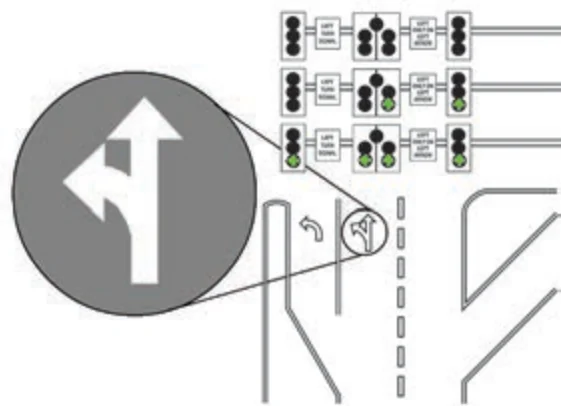
Dual-use lanes have both a turn arrow and a straight arrow. When both arrows show on the signal, you may turn or go straight. If you want to turn and only the straight arrow shows, wait for the turn arrow.

Handbook p. 45 ↗
Lane-use control arrow icon and overhead signal array
Dual-use lane: turn and straight arrows

Know the rule

Shared center lanes may be used by vehicles from both directions for left turns (or U-turns where permitted). Left-turn arrows alternate by direction, and the lane is edged by solid yellow and dashed yellow lines. Turn as soon as your path is clear.

Handbook p. 45 ↗

When there are no signs or lane markings:

  • Never back up in a travel lane; if you miss a turn or exit, go on to a safe place to turn around
  • Don't stop in a travel lane for any reason (confusion, breakdown, letting out a passenger)
  • With three or more lanes one way, stay in the right lane except to pass
  • If a lot of traffic is entering the right lane, use the center lane
  • On multi-lane roads, the left-most lane is for passing slower vehicles
  • Never pass on the shoulder; drivers may pull off without looking
Handbook p. 45 ↗

Know the rule

Passing on the right is risky: the other driver may have trouble seeing you and may change lanes in front of you.

Handbook p. 45 ↗

Know the rule

Obey traffic officers at all times. If an officer is directing traffic, do what the officer says and ignore signs and signals. If the officer signals you to stop at a green light, you must stop.

Handbook p. 45 ↗

Know the rule

Traffic control can also come from highway personnel and school crossing guards. You must obey their directions.

Handbook p. 45 ↗

Put it into practice

The light at an intersection is green, but a police officer in the intersection signals you to stop. You stop. The officer's directions override the signal.

Check your understanding

Read the question, decide on an answer, then open it to check the explanation. These are Roadwise study questions based on the source handbook.

On a road with three or more lanes traveling in the same direction, you should use the center lane as your default lane when traffic is light.
  1. True
  2. False

Answer: False

On a road with three or more lanes in the same direction, stay in the right lane except to pass; use the center lane only when there is considerable traffic entering the right lane.
Handbook p. 45 ↗
A shared center lane on a road is marked with which line pattern?
  1. Solid white lines on both sides
  2. A solid and a dashed yellow line on each side
  3. Broken white lines only
  4. Double solid yellow lines

Answer: A solid and a dashed yellow line on each side

Shared center lanes for left turns are marked on each side by a solid yellow and dashed yellow line.

Handbook p. 45 ↗
A dual-use lane shows both a turn arrow and a straight arrow illuminated. What does this mean?
  1. You must turn only
  2. You must go straight only
  3. Turn or go straight
  4. The lane is closed

Answer: Turn or go straight

When both arrows appear on a dual-use lane signal, you may either turn or go straight.

Handbook p. 45 ↗
You may back your vehicle in a travel lane if you realize you've missed your turn.
  1. True
  2. False

Answer: False

Never back a vehicle in any travel lane; go on to where you can safely turn around instead.

Handbook p. 45 ↗
If a traffic officer is directing traffic and signals you to stop at a green light, what must you do?
  1. Proceed, since the light is green
  2. Stop only if other cars stop
  3. Slow down and proceed with caution
  4. Obey the officer and stop

Answer: Obey the officer and stop

You must obey traffic officers at all times, even if it means ignoring a traffic signal.

Handbook p. 45 ↗
Take the lesson checkpoint in the app

More in Signs, Signals & Markings