roadwise.Open study app

Maine driving lesson · Sharing the Road

Turning, passing and keeping space near large vehicles

A 3-minute lesson from the Maine course. Read the rules and examples, follow the handbook page references, and check your understanding before you move on.

Read time
3 minutes
Course unit
Sharing the Road
Checkpoint questions
4
Source pages
107, 108, 109

Large vehicles push air, throw spray and need extra room to turn and stop. Give them that room when they turn, when you pass them, and when they pass you.

Know the rule

Stopped behind a large vehicle on a hill, leave space: it may stall or roll backward as it pulls forward.

Handbook p. 107 ↗

Know the rule

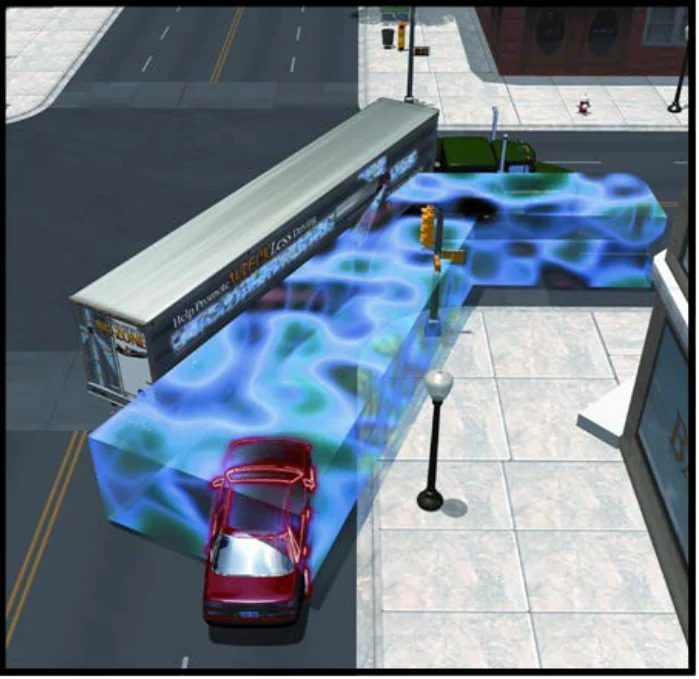
Watch a large vehicle's turn signals and give it lots of room. It may swing wide left to clear a curb on a right turn, so don't turn until it has finished its turn.

Handbook p. 108 ↗
Truck no-zone blind spot
A bus swings wide to make a right turn

Keep in mind:

  • When meeting a truck, avoid wind blast by moving to the rightmost part of your lane
  • Drivers often misjudge a truck's speed before turning left; if unsure, wait until it passes
  • Always stop behind stop lines; they leave larger vehicles room to turn
  • Don't cut in front of a truck or race it into a single-lane construction zone
Handbook p. 108 ↗

Maintaining space:

  • Give large vehicles an extra margin on all sides in poor weather or low visibility
  • Forcing hard braking on slick roads can cause skids or jackknifes
  • If you can't see the mirrors of the vehicle you're following, you're too close and in its blind spot
Handbook p. 108 ↗

Know the rule

Always dim your headlights when following a large vehicle at night. Bright lights reflect off its mirrors and make it hard for the driver to see.

Handbook p. 109 ↗

Passing and being passed:

  • Before passing, check ahead, behind and in the direction you'll move
  • Pass only in a legal passing zone, and don't speed to complete the pass
  • Pull back in only when you see the vehicle's front in your mirror; check your blind spot
  • Being passed (or meeting one), stay far right in your lane: it pushes a cushion of air
  • Don't speed up while a large vehicle passes; keep your speed or slow slightly
  • On wet roads, turn on your wipers before it passes to handle the spray
Handbook p. 109 ↗

Put it into practice

It's night and you're following a box truck on a two-lane road. Switch to low beams: your high beams would bounce off its big side mirrors into the driver's eyes.

Check your understanding

Read the question, decide on an answer, then open it to check the explanation. These are Roadwise study questions based on the source handbook.

You should leave plenty of space when stopped behind a large vehicle on a hill, since it may roll back before starting forward.
  1. True
  2. False

Answer: True

Leave space between your car and the larger vehicle, since it may stall or roll back before pulling forward.
Handbook p. 108 ↗
When a large vehicle passes you, you should move toward the left side of your lane until it is clear.
  1. True
  2. False

Answer: False

False. The wind cushion from a large vehicle pushes to the side, so stay as far to the right of your lane as possible until it is clear.

Handbook p. 109 ↗
Why should you dim your headlights when following a large truck at night?
  1. It helps you judge the truck's speed
  2. Your lights reflect off its mirrors and blind the driver
  3. Trucks are required to use low beams too
  4. The truck's reflectors will blind you

Answer: Your lights reflect off its mirrors and blind the driver

Bright lights reflect off the large vehicle's mirrors and make it hard for the driver to see the road ahead.

Handbook p. 109 ↗
According to the large-vehicle section, why are stop lines at intersections placed back from the corner?
  1. To give larger vehicles more turning space
  2. To leave room for cars parked along the corner
  3. To mark the end of the school zone
  4. To show where to begin signaling

Answer: To give larger vehicles more turning space

Stop lines at intersections are designed to give larger vehicles more turning space, so always stop behind them.

Handbook p. 108 ↗
Take the lesson checkpoint in the app

More in Sharing the Road