roadwise.Open study app

Maine driving lesson · Sharing the Road

Motorcycles and mopeds

A 3-minute lesson from the Maine course. Read the rules and examples, follow the handbook page references, and check your understanding before you move on.

Read time
3 minutes
Course unit
Sharing the Road
Checkpoint questions
6
Source pages
105

Motorcyclists have the same rights as other drivers but no protection around them. Many crashes happen because a driver turning left doesn't see the motorcycle or thinks it's slower than it is.

Know the rule

Motorcyclists have the same rights and responsibilities as other drivers, and as much right to the road as cars. A separate manual covers the motorcycle endorsement test.

Handbook p. 105 ↗

Sharing the road with motorcycles:

  • Give motorcycles a full lane; never try to share the lane
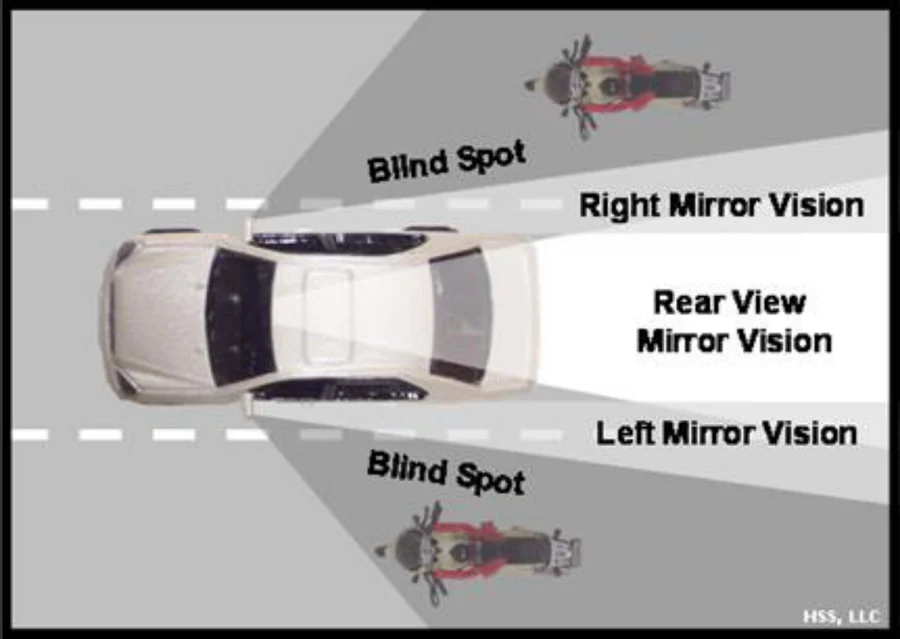
  • They're smaller and harder to see, so always check mirrors and blind spots
  • Before turning left, look carefully to the front and sides for motorcycles
  • Don't assume a motorcycle is turning because its signal is on; signals may not self-cancel
  • Scooters and mopeds travel at much lower speeds than motorcycles
Handbook p. 105 ↗
4 seconds

Minimum following distance behind a motorcycle; increase it when wet

Handbook p. 105 ↗

Know the rule

Riders may suddenly change speed or lane position to avoid potholes, gravel, wet or slick spots, pavement seams, railroad crossings and grooved pavement.

Handbook p. 105 ↗

Know the rule

When you pass a motorcycle, give it a whole lane; don't squeeze past. Riders move side to side to see, be seen and avoid objects.

Handbook p. 105 ↗
Blind spots and mirror vision zones
Motorcycles hide easily in your blind spots

Motorcycle risk

Motorcycle risk
Share ofMotorcycles
Vehicles on the road4%
All motor vehicle deathsNearly 10%
Handbook p. 105 ↗

Know the rule

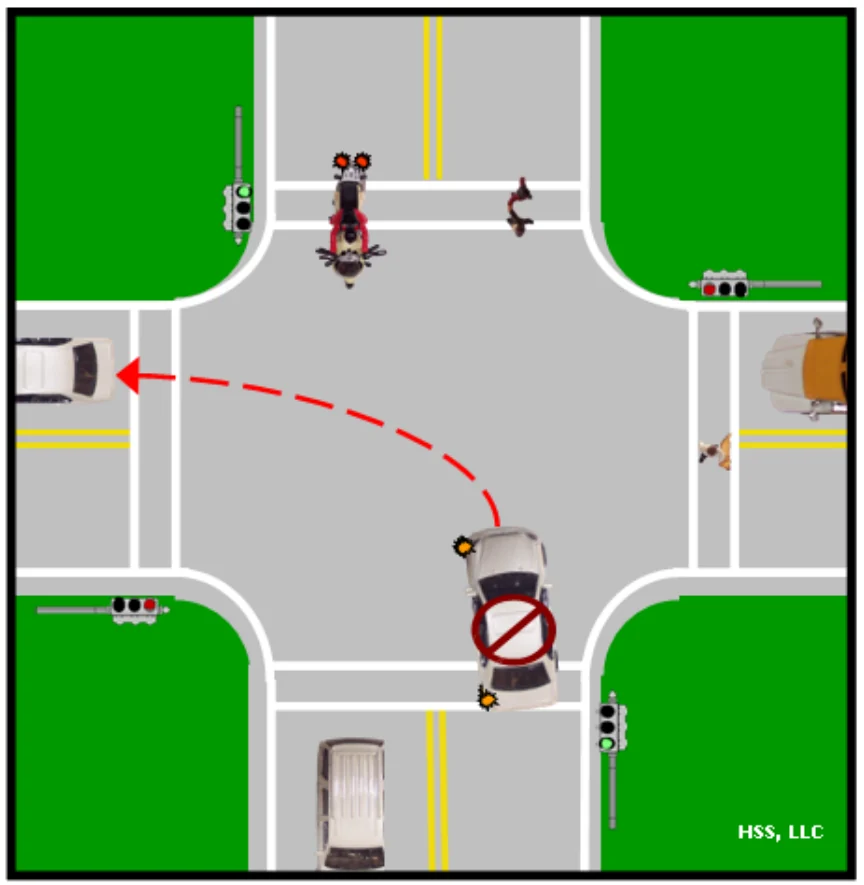
Drivers turning left in front of an oncoming motorcycle cause many crashes; they fail to see it or think it's going slower than it is. Wait for an oncoming motorcyclist to pass before turning left.

Handbook p. 105 ↗
Intersection turn restriction
Don't turn left in front of an oncoming motorcycle

Put it into practice

You're waiting to turn left and see a single headlight approaching. It looks far off and slow, but motorcycles are easy to misjudge. Wait until it passes, then turn.

Check your understanding

Read the question, decide on an answer, then open it to check the explanation. These are Roadwise study questions based on the source handbook.

How much of the lane should you give a motorcycle when passing or sharing the road?
  1. Half a lane
  2. No specific space is needed
  3. A full lane
  4. A quarter of the lane

Answer: A full lane

Give motorcycles a full lane; do not attempt to share the lane with one.
Handbook p. 105 ↗
What is the minimum recommended following distance behind a motorcycle?
  1. 4 seconds
  2. 10 seconds
  3. 2 seconds
  4. 6 seconds

Answer: 4 seconds

When following a motorcycle, stay at least 4 seconds back, increasing the distance when wet.

Handbook p. 105 ↗
Should you assume a motorcycle is about to turn just because its signal is flashing?
  1. Yes, but only at intersections
  2. No, motorcycle signals may not self-cancel
  3. Yes, always assume it will turn
  4. Yes, if it is also slowing

Answer: No, motorcycle signals may not self-cancel

Motorcycle turn signals may not self-cancel, so the rider may have forgotten it is still on.

Handbook p. 105 ↗
Roughly what share of all motor vehicle deaths involve motorcycles, despite being a small share of traffic?
  1. Nearly 25%
  2. Nearly 10%
  3. Nearly 1%
  4. Nearly 50%

Answer: Nearly 10%

Motorcycles are involved in nearly 10% of motor vehicle deaths, though they make up only about 4% of vehicles.

Handbook p. 105 ↗
What is a common cause of accidents between cars and motorcycles at intersections?
  1. Motorcycles running red lights
  2. Motorcycles exceeding the speed limit
  3. Cars following too closely behind motorcycles
  4. Drivers turning left in front of an oncoming motorcycle

Answer: Drivers turning left in front of an oncoming motorcycle

Many accidents happen when drivers turning left fail to see an oncoming motorcycle or misjudge its speed.

Handbook p. 105 ↗
Mopeds and scooters generally travel at much lower speeds than motorcycles.
  1. True
  2. False

Answer: True

The handbook notes that scooters and mopeds travel at much lower speeds than motorcycles.

Handbook p. 105 ↗
Take the lesson checkpoint in the app

More in Sharing the Road