roadwise.Open study app

Maine driving lesson · Sharing the Road

Large vehicles and the No-Zone

A 3-minute lesson from the Maine course. Read the rules and examples, follow the handbook page references, and check your understanding before you move on.

Read time
3 minutes
Course unit
Sharing the Road
Checkpoint questions
6
Source pages
105, 106, 107

Trucks and buses are big, heavy and slow to stop, and their drivers can't see large areas around them. Staying out of those blind spots, the No-Zones, is the key to sharing the road with them.

250,000+

Crashes each year between cars and large vehicles

Handbook p. 105 ↗

What makes large vehicles different:

  • They are bigger and harder to handle than a car
  • They have much larger blind spots; drivers rely mostly on mirrors
  • They need more space to speed up, stop and turn
  • Their speed can drop sharply uphill and climb quickly downhill
  • Their stopping distances are much greater than a car's
Handbook p. 106 ↗

Know the rule

Never try to pass behind a truck or bus that is backing up.

Handbook p. 106 ↗

Know the rule

If you can't see the mirrors of the large vehicle ahead of you, its driver probably can't see you.

Handbook p. 106 ↗

Know the rule

When a large vehicle is behind you, leave plenty of space ahead of you. Never pass or pull in front of a large vehicle that is already slowing or stopping; it has planned its braking on that space.

Handbook p. 106 ↗

Know the rule

To turn right, large vehicles often must swing left first to clear the curb or objects like a telephone pole. Watch their position and signals, and don't drive into their turning path.

Handbook p. 106 ↗

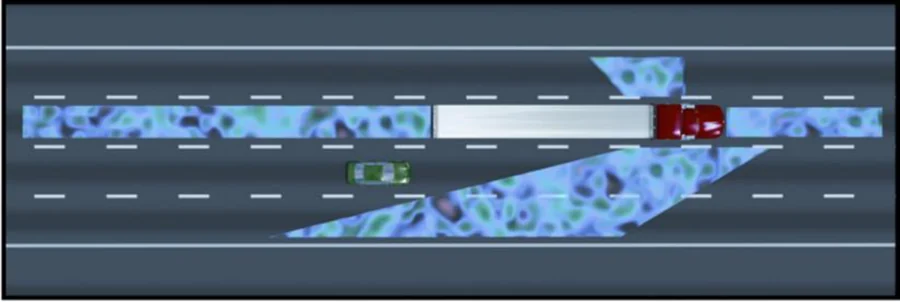
No-Zone

The areas around a large vehicle that are in the driver's blind spots, on the sides, rear and front.

Handbook p. 107 ↗

The No-Zones

The No-Zones
ZoneWhat to know
SidesLargest on the right, from behind the cab along the truck
SidesNo driver's face in their mirror? They can't see you
FrontDon't merge or change lanes close in front of it
RearUp to 200 feet; stay left in your lane to be seen
Handbook p. 107 ↗
335 feet

At least this far for a loaded truck at 55 mph to stop: more than 1½ times a car's distance

Handbook p. 107 ↗

Know the rule

Don't drive alongside a large vehicle any longer than you must. After passing, pull back in only when you can see the whole front of the vehicle in your rearview mirror.

Handbook p. 107 ↗

Know the rule

Don't "draft" closely behind a truck thinking its wind drag will pull you along. It doesn't work and it's extremely dangerous.

Handbook p. 107 ↗
Truck no-zone blind spot
Side No-Zones: a truck's biggest blind spot is on the right

Put it into practice

You're cruising beside a tractor-trailer's right side, just behind the cab, and can't see the driver's face in his mirror. You're in his largest blind spot. Drop back or pass it promptly on the left.

Check your understanding

Read the question, decide on an answer, then open it to check the explanation. These are Roadwise study questions based on the source handbook.

About how far can a large truck or bus's rear blind spot, or No-Zone, extend?
  1. Up to 500 feet
  2. Up to 20 feet
  3. Up to 200 feet
  4. Up to 1,000 feet

Answer: Up to 200 feet

Large vehicles have huge blind spots behind them, up to 200 feet.
Handbook p. 107 ↗
About how far does it take a loaded truck traveling 55 mph to stop?
  1. At least 1,000 feet
  2. At least 335 feet
  3. At least 100 feet
  4. At least 600 feet

Answer: At least 335 feet

A loaded truck at 55 mph takes at least 335 feet to stop, more than 1.5 times a car's stopping distance.

Handbook p. 107 ↗
Is it safe to pass behind a truck or bus that is backing up?
  1. No, never attempt to pass behind it
  2. Yes, if the driver waves you on
  3. Yes, if moving slowly
  4. Yes, only in a parking lot

Answer: No, never attempt to pass behind it

Never attempt to pass behind a truck or bus that is backing.

Handbook p. 105 ↗
If you cannot see a truck driver's face in their side mirror, what does that mean for you?
  1. It means nothing about visibility
  2. It means you are following too far back
  3. The driver cannot see you either
  4. You are in a safe spot to pass

Answer: The driver cannot see you either

If you cannot see the driver's face in the side mirror, they cannot see you.

Handbook p. 107 ↗
Why should you avoid 'drafting' closely behind a large truck?
  1. It is safe if you stay centered
  2. It is risky only at night
  3. It does not work and is very dangerous
  4. It is illegal only on the interstate

Answer: It does not work and is very dangerous

Drafting closely behind a truck does not work as intended and is extremely dangerous.

Handbook p. 107 ↗
What should you watch for when a large vehicle is preparing to turn right?
  1. It will use a much smaller turning radius than a car
  2. It will always signal using its hazard lights
  3. It may first swing wide to the left to clear the turn
  4. It will always turn from the far-right lane only

Answer: It may first swing wide to the left to clear the turn

Large vehicles may swing wide to the left before turning right to clear the curb or an obstacle.

Handbook p. 106 ↗
Take the lesson checkpoint in the app

More in Sharing the Road